It’s overdriven pop vs. minimalist country as Ash takes on Gillian Welch
Note: As many of you saw, I recently wrote about a Best Record of 2001 challenge and noted that I’d be writing some of these up.
The plan is to do quick hits on each first-round matchup and post them directly to the page. Some will be longer, some won’t, and some might just be a handful of sentences. There’ll probably be a few typos. We’ll also have a few guest posts along the way, so make sure to stay tuned for those!
Check ’em out and let me know your thoughts! Chin wags & hot takes welcome! Sharing and restacks always appreciated.
KA—
Ash – Free All Angels
Coming into Free All Angels, I expected a blast of guitars and that familiar late‑90s angsty….or something like 3 Doors Down. Honestly, I had no idea what I was in for (I know! I know!). What I didn’t expect at all was how bright and melodic this record sounds. Ash lean hard into pop hooks and glossy production, and it suits them nicely. Open “Walking Barefoot” bounces with energy, driven by big choruses and a reckless sense of fun. The band shifts from power‑pop charm to radio-friendly and back again, without losing its edge. The vocals are gritty, but the melodies push the songs toward the sunny side of the road, not garage rock.
What stands out most is how clean the songwriting feels. Every track swings for immediacy; nothing drags or hides behind fuzz. It’s all overdrive, man. Even when the themes turn darker, the delivery keeps the songs moving with a lift in tone. By the time “Shining Light” and “Burn Baby Burn” hit, it feels like Ash translating youthful frustration into something almost joyous.
This album captures a band embracing melody without apology. I don’t know what Ash was chasing with Free All Angels, but they found it in sing‑along choruses and unguarded optimism. It’s brash, catchy, and a bit sentimental. All the things! It reminds me of someone fondly looking back at a summer stay at the beach.
Gillian Welch- Time (the Revelator)
In the run-up to the bracket kicking off, this came up as a record people should check out ahead of time. There’s usually a lot of those, of course — everyone’s fighting their corner and wants their pet picks to be heard. That’s half the fun! But rarely does someone else chime in and say (really, really paraphrasing here) “If you haven’t heard this record, you haven’t heard music.” I know I butchered that, but what was unmistakable was the endorsement. You gotta love it when someone goes to the mat for a record, book, whatever. So, being one of the people who had somehow made it to 50 without ever (knowingly) hearing Welch, I had to see what the fuss was.
Turns out “Gillian Welch” isn’t just Gillian. It’s her and David Rawlings — her musical and life partner. Welch takes the lead on these songs, her voice steady and unhurried, while Rawlings floats around her with a dry, golden guitar tone.
Time (The Revelator) is ten country songs about heartache, and it’s a fantastic thanks to the duo’s next-level songwriting.
A few songs in, and I would’ve bet my house that Welch was from somewhere like West Virginia — one of those places in a holler that looks to Beckley as the “big city.” Imagine my surprise to learn she’s from L.A. That’s a heck of a pastiche. But the authenticity is never in doubt. These are her and Rawlings putting their all into these songs, and it shows. These aren’t my bag, but I get why the poster said what they did. I suspect that by the time we get through all 64 of the first-round matchups, more than a couple of records will have been flung onto the “sounds of its time” heap. This won’t be one of ’em. Time isn’t holding us, time isn’t after us. Turns out, time is a revelator (and a timeless record).
Bottom Line: Both of these are solid outings. I went with Welch primarily on the endorsement I opened this post with and a little name recognition. I have a feeling this one could easily go either way.
Any thoughts on either of these records? Agree/disagree with my takes? Which one of these would you vote for? Sound off in the comments!
Ben Folds takes on The Langley Schools Music Project.
Good morning!
Today we’re taking a look at Ben Folds’ Rockin’ the Suburbs (#48) and The Langley Schools Music Project’s Innoncence and Despair.
Note: As many of you saw, I recently wrote about a Best Record of 2001 challenge and noted that I’d be writing some of these up.
The plan is to do quick hits on each first-round matchup and post them directly to the page. Some will be longer, some won’t, and some might just be a handful of sentences. There’ll probably be a few typos. We’ll also have a few guest posts along the way, so make sure to stay tuned for those!
Check ’em out and let me know your thoughts! Chin wags & hot takes welcome! Sharing and restacks always appreciated.
KA—
Ben Folds- Rockin’ the Suburbs
Talk about bad timing.
Rockin’ the Suburbs should’ve been Ben Folds’ ticket to stardom. There’s no more “five” riding his coattails (okay, there’s three of ‘em still, but still…), he’s got a couple of great records behind him and a new one in the can ready to go. It’s chock full of the usual witticisms that brought us all to the party in the first place. There’s plenty of piano and a good chunk of fuzzy bass. What’s not to love?
If only they hadn’t picked September 11th for the release day. And really, who releases a record on a Tuesday?! Maybe that’s a thing? I dunno. Either way, I spent the day at the airport, smoking, “guarding planes” (lol), and listening to ABC radio; Ben probably spent it wondering what might’ve been.
One of the things I’ve always dug about Folds’ writing is how he writes about the human condition but wraps it in a brand of wit that makes you feel good about it all. “Army” could’ve been a dirge about not getting along with his dad. Instead, a whole generation of us has “Grew a mustache and a mullet/got a job at Chick-fil-A” stuck in our head like a sonic sleeper agent, just waiting to be our next earworm. This, of course, makes piano-led music more palatable. I also suspect he wrote many of these not as catharsis but for his own amusement.
The first song on Rockin’ the Suburbs is “Annie Waits,” and doesn’t pivot too far. As Exhibit A for the people, I offer you: “Annie waits… But not for me.” Iseewhatyoudidthere. The title track is also one of the catchiest on the record, and my fave of the lot. Catchy is good, as there’s a good deal of heavier material here. And tbh, after 9/11, that’s the last thing anyone needed.
Folds’ records have always been a mixed bag for me, with some must-listens and some must-skips. I’ve only ever owned/borrowed these on CD; that came in handy. But the highs! So, so high. I suspect at some point, I’ll be wandering the halls of the old folks home and will just start singing “Army,” or I’ll be in the dining hall and the melody to “Don’t Change your Plans” will pop into my head. It’s a high bar.
And it’s a bar that ‘Suburbs never quite clears. It’s good, not great. Some of the tracks are wonderful, but I can guarantee there’s no way I’ll be signing “Annie Waits” at some random point in old age.
What might’ve been.
The Langley Schools Music Project- Innocence and Despair
Speaking of getting old, I hate that time keeps screaming by, but there are a few silver linings. One of ‘em? No more elementary school “programs.” Look, I love my kids, but there is no need for me to ever sit through another music program. No reason to pretend not to be driven mad by off-key crooning or that one kid whose parents made him play the French horn. Remember that weird resurgence Journey enjoyed about 10-12 years ago? Yeah. Just in time for my oldest’s (then ) third-grade class to do a whole-ass thing featuring their songs. You’d think this would’ve been fun, if only ironically. You would be wrong.
But this! This is great. Maybe it’s because I didn’t feel like attendance was compulsory. I mean; literally no one was gonna give a f**k if i didn’t play this. And tbh, I thought about it. But this whole record made me feel some kind of way. Recorded in 1976-1977, it’s essentially a school-assembly-as-covers record using hits of the era. Bowie? Sure, why not? Rhiannon? Okay. Sweet Caroline? Gotta take the bad with the good, I ‘spose.
On paper, there is no reason why I would normally like this, but some sort of Grinch-type stuff happened, and my heart grew three times its normal size. Maybe it’s the shit state of play in 2026, but man, this was exactly what I needed today. They even cover Herman’s Hermits! Something tells me I’m into something good? You better believe it.
Bottom Line: Bracket pick: Ben Folds all day. There are quite a few first-round matchups where I defaulted to picking the higher seed. This is one of ‘em. My vote? Going to the kids.
Any thoughts on either of these records? Agree/disagree with my takes? Which one of these would you vote for? Sound off in the comments!
Everyone’s favorite murder ballad merchant takes on some British hip hop
Good morning!
Today we’re taking a look at Nick Cave and The Bad Seeds No More Shall We Part (#49) as it faces off against Roots Manuva’s Run Come Save Me (#80)
Note: As many of you saw, I recently wrote about a Best Record of 2001 challengeand noted that I’d be writing some of these up.
The plan is to do quick hits on each first-round matchup and post them directly to the page. Some will be longer, some won’t, and some might just be a handful of sentences. There’ll probably be a few typos. We’ll also have a few guest posts along the way, so make sure to stay tuned for those!
Check ’em out and let me know your thoughts! Chin wags & hot takes welcome! Sharing and restacks always appreciated.
KA—
Nick Cave and The Bad Seeds- No More Shall We Part
I need you to understand that I’ve always regarded Nick Cave as a modern-day vampire. I don’t mean the cartoony Count Chocula caricature; I mean something like Lestat’s musically inclined cooler cousin. The type of guy that is never not wearing top-notch finery and lives in a castle with innumerable candles. None of this is close to accurate, of course. But still, if I ever saw him in, say, shorts and a T-shirt, it would probably short-circuit my mind. We all saw what happened when Danzig was snapped buying kitty litter. I don’t need that fourth wall being shattered again! Wasn’t a duet with Kylie Minogue enough? It’s also worth noting that I happen to love his newsletter, most of which is his pontificating on the world around us wrapped around the kernel of answering fan mail. He’s seen some shit (a given when you’re 377 years old) and has a pretty unique take on the world. All jokes aside, he’s suffered incredible loss, which has certainly colored his world and shaped his view of it. He’s pretty open about his faith, which, if nothing else, seems to be rare in his corner of the music universe.
I say all of this so you, A) have an idea how my brain works, and B) have an idea of the lens through which I hear everything Cave (and/or the Bad Seeds) have done.
So! About this record: No More Shall We Part is full of the devotion, guilt, prayer, and private bargaining one might expect. It comes across as a record written with a quill pen by candlelight while rain lashed the windows. It comes across as a record penned by someone coming to grips with what his innermost thoughts are trying to tell him. Say what you will about our murder ballad merchant; he’s consistent.
One of the things I find most off-putting about evangelicals is their tendency to describe everything in absolute terms. Conversely, one of Cave’s most endearing traits is his refusal to do so. At the risk of sounding like the laziest bot you’ve ever heard of, I kept coming back to that push-pull while listening to the record. This was also the first record he made after going clean, and once you know that, you can’t unhear it (not derogatory). I suppose some of you might be wondering which, if any, tracks to listen to, and to that I say Hallelujah, God Is in the House, and Fifteen Feet of Pure White Snow are all good picks.
No More Shall We Part is ornate, theatrical without being over the top, and weathered by the weight of experience but not self-pitying. In other words, a Nick Cave record. It’s also not my bag at all. In other words, a Nick Cave record. More power to everyone that loves his work, but I’ll stick to the newsletter and call it good. And would it kill him to do a nice little pop number with Kylie Minogue next time?
Roots Manuva- Run Come Save Me
Oh hey! A British rapper rapping about British things. Fun! Didn’t we already do this with Tricky and (maybe) Prodigy? Having an intro track called No Strings that’s nothing but strings didn’t help. Irony is fine in limited doses. A whole-ass song? That’s an overdose. No matter. I was sure I wasn’t gonna like this record but decided to push through anyway (the things I do in the name of “research”!). What I really wanted was something with what we used to call a “jeep beat”—in other words, something that sounded hella good as the bass proceeded to take apart your trunk, rivet by rivet. This vein of underground rap is fine, but again, not something I’m super into. I’ve got a couple of faves (i.e., Jurassic 5), and that’s enough for me. It took a few tracks, but when Join the Dots hit full speed, I found myself thinking it sounded like… Jurassic 5. Not terrible! Ital Visions was more of the same, and I’ll take all of that you’ve got.
It’s not fair to compare British and American hip-hop. There’s more ragga and dub influence oozing into the mix. Different beats, too (I wonder if there’s a British Jeep Beat equivalent?). If there is, this ain’t it. Their sounds are solid, the production is good, there are the aforementioned couple of standout tracks, and I’m willing to bet that with a few more listens, some appreciation would come. But this was never going to be something you heard comin’ from around the way.
Bottom Line: If you forced me to pick only one of these to listen to forever, my first response would be to ask why you’re so mad at me. My second (after much consternation) would be to go with Nick Cave; if I were stuck in prison or a dungeon, I would probably want something with some clarity, and No More Shall We Part would be the better of the two at delivering it. Bracket-wise, the dilemma’s easier- I’m sure the hipster contingent will show up/show out for Roots manuva, but I’m banking on Cave’s name recognition to carry the day.
Any thoughts on either of these records? Agree/disagree with my takes? Which one of these would you vote for? Sound off in the comments!
Best of 2001 Day 5: Tori Amos closes out her time with Atlantic by reinventing the music of men.
Good morning!
We’re in for a treat today, as Z-sides Music takes the wheel, and shares his take on Tori Amos’ Strange little Girls release.
Note: As many of you saw, I recently wrote about a Best Record of 2001 challengeand noted that I’d be writing some of these up.
The plan is to do quick hits on each first-round matchup and post them directly to the page. Some will be longer, some won’t, and some might just be a handful of sentences. There’ll probably be a few typos. We’ll also have a few guest posts along the way, so make sure to stay tuned for those!
Check ’em out and let me know your thoughts! Chin wags & hot takes welcome! Sharing and restacks always appreciated.
Today, Z-Sides Music stops by to share his take on Strange Little Girls. The words—and work— below the jump are all his, and I’m grateful he let me share this with everyone! I think you’ll dig it, too.
KA—
Tori is known for her prolific list of covers (“Smells Like Teen Spirit” anyone?) that she’s recorded in the studio and performed live. It was a matter of time before she used her skills for reinvention to make her own covers project.
What would it include? This go around, she gathered an eclectic group of songs, all written by men, to spin from a female perspective. This marks the last album on Atlantic Records before she signed with Epic. This is also a bit of a soft boundary between Amos’s more rugged words of the 90s and the softer sound she would adopt on later projects. Each song brings something different to the table. She’s traded out the Kurzweil for a Wurlitzer and Rhodes. We also trade out Steve Caton, Tori’s long-time guitarist, for Adrian Belew.
The richness of Tori’s heavily reverberated Wurlitzer adds a unique depth to this Velvet Underground cover of “New Age.” Her keys keep the dreamy psychedelic vibe of the 1969 original. Amos’s heavy vocals add the proper amount of sultriness to the sexuality that Lou Reed’s words provide. Adrian Belew’s guitar work beautifully matches the vibe Tori created.
A promotional image from the Strange Little Girls album shoot. (Photo from The Dent)
The most evocative song on the album is her take on Eminem’s “‘97 Bonnie and Clyde”. She places you in the woman’s point of view from the car’s trunk. She’s half alive and overhearing her husband relay, in a twisted paternal way, why her mother is soon to be dead. It’s chilling. Amos takes on this spoken, whispered tone throughout the song that sends shivers down your spine.
Compared to the demented sing-song-like rap verses Eminem brings at you, Tori’s breathy delivery drives the image of a half-dead woman hearing her husband’s psychotic reasonings to his daughter over the soon-to-be death of her mother. The loss of breathe at the end of the lines, “Here, you wanna help da-da tie a rope around this rock?/ We’ll tie it to her footsie then we’ll roll her off the dock/ Ready now, here we go, on the count of free../ One.. two.. free.. WHEEEEEE!”, really drive home the image of this woman’s last moments alive. It’s a powerful take on one of the more violent tracks in Eminem’s catalog.
The cover of the single “Strange Little Girl.” (Photo from Discogs)
The only single to be taken from the album is Tori’s version of The Stranglers’ “Strange Little Girl.” She gives the song a more 70s wash, opting for the Wurlitzer over the original synths and giving a rushing drum progression that quickly grabs you from the song’s beginning.
I really liked the take Amos has on the character when put into the progression of the album’s track list:
“This is the little girl whose father killed her mother in Eminem’s song, all grown up, having to deal with the fact that she was an accomplice to the murder. She’s a dichotomy of things because she’s divided — even when parents divorce, if they turn one child against one parent, you’re dividing that child at the core. It’s a manipulative thing to do.”
The words, “one day you see a strange little girl look at you/ one day you see a strange little girl feeling blue/ walking home in her wrapped up world/ she survived, but she’s feeling old/ cause she found all things cold,” give off such a broken vibe after reading that response. I thoroughly enjoy the fast-paced drum and guitar work that evokes the feeling of frantically outrunning your past, present, and future.
Tori takes a much more stark approach to Depeche Mode’s “Enjoy the Silence.” She strips away all of the electronics, leaving just her vocals, piano, and the most subtle synth and bass line to add some levity. It gives the words a much harsher tone. They are quite literally breaking the silence. The small change to the second verse’s lines, “Pleasures remain/ So does the pain/ Words are meaningless/ And unforgettable,” adds such a heavy gravity to the power of words and the scars they can leave behind.
Regarding transformations, Amos made an extremely emotionally impactful move to an alt/electronic classic. I quite enjoy Amos’s take on 10cc’s “I’m Not in Love.” The originally airy 70s song gets a much darker makeover. The 10cc original has a very flowery vibe, which gives the lyrics a more sarcastic, playful mood in response to the woman he is singing to. Amos gives the song a threatening coldness. This juxtaposition of sound makes the man’s lines emotionally abusive: “Said, I’d like to see you, but then again/ It doesn’t mean you mean that much to me/ So if I call you, don’t make a fuss/ Don’t tell your friends about the two of us.” Chamberlain’s empty percussion creates a beautifully dark, hollow mood.
Tori tones down the tempo just a hair on the Lloyd Cole track “Rattlesnakes.” Keeping the richness of the strings through the use of a slide guitar and a Rhodes piano. It gives the song a touch of Americana that I think works in its favor. Tori’s vocal delivery, I think, provides more depth to Jodie’s story, a troubled woman still haunted by the loss of her unborn child. I wish this had been another single off the project. It’s a nice bridge to what would come on Amos’s next project.
One of multiple album covers of Strange Little Girls. (Photo from Discogs)
One of the album’s most straightforward covers is the Tom Waits cover of “Time.” Trading Waits’ guitar for Amos’s piano keeps the same reverence as the original. One thing that makes this track stand out is its familiarity. It sounds so much like something Amos would pull out on stage solo for a special moment.
She had thought to put this on the organ but opted for the stripped-down take:
“I thought about taking this to the organ, but I stripped it back… It’s from the point of view of Death, so I felt like you need to feel like you are sitting on the piano stool. No masks, no effects, it’s right here, dry, with a little compression on vocals.”
It’s a very special moment on the album. Tori’s take on Neil Young’s “Heart of Gold” is one of the few that misses the mark for me. We trade out the folk styling of Neil’s original for a more ’70s-styled rock sound that layers Amos’s vocals over one another. It just feels a bit too chaotic and cluttered compared to the other reinventions she’s created on the album thus far.
Like her treatment of “Enjoy the Silence,” The Boomtown Rats’ “I Don’t Like Mondays” is a simple Rhodes-and-vocal track. The lush reverb on the Rhodes is a treat for the ears. Compared to the other tracks on the album, it feels just a bit flat. Seeing this a song about a woman shooting up an elementary school playground, the mellow mood of the song just doesn’t match the subject matter on the song well.
A promotional image from the Strange Little Girls photo shoot. (Photo from The Dent)
The longest song on the album is her spin on The Beatles’ “Happiness Is a Warm Gun.” Coming in at 9 minutes, it is interspersed with audio clips of George H.W. and George W. Bush, Daniel Bocking, and Tori’s own father, Dr. Edison Amos, discussing their thoughts on gun violence. It’s probably one of the most abstract takes on the entire album.
Giving this song a menagerie of political clips alongside Lennon and McCartney’s words makes for a unique stand for gun control, which has only become an even greater issue in recent years. I find Amos’s dual-wielding of the synth and piano to be outstanding and the spin on the track to be much more powerful now. I just wish it had a bit more form.
Another favorite of mine off the project is the unique spin on Slayer’s “Raining Blood.” She flips the speed metal track on its head, opting for a deep, crawling piano line, a growling bass line, and a vocal reverb that only highlights the song’s emptiness. It’s battered and seething compared to the original, tearing viciousness.
Of her take on the song, Tori told Oor:
“The text is really beautiful indeed, the words touched me deep. The ‘Raining Blood’ girl revealed herself to me from the moment that I heard the song. She said from the first line, ‘Come with me Tori, I’ll show you everything.’ She took me to a warfield, pure horror. Still I felt safe with her, because of her braveness. But not only the girl came to me. There was another image. Of a big, beautiful vagina in the air. From which blood is raining. It’s falling out of the air on certain countries which are so terribly violent against women. Like Afghanistan, where women can’t even go on the street without a man, are not allowed to study and often get raped. And these horrors can not be lead in any way to religion. It’s straight from the spirit of men”
This malice-fueled feminine point of view only promises retribution for the horrors the women have suffered: “The sky is turning red/ Return to power draws near/ Fall unto me, unto/ Fall unto me the sky’s crimson tears/ Abolish the rules/ Abolish the rules made of stone.” Though extremely colorful in Amos’s description above, the notion pours thickly over you as the track oozes.
We end off the project with another, more straightforward take on Joe Jackson’s “Real Men.” For an album that focused on reinventing songs from a male perspective, it is only fitting that she would cover one that calls out all kinds of masculinity. Her vocal hums in the song’s chorus are absolute ear candy. I’m glad she saved this one at the end of the album. It feels like the perfect closing chapter to Tori’s narrative.
Overall, I think most of the album shows Amos’s talent for covering a song and making it all her own. Some of the tracks, “‘97 Bonnie and Clyde”, “I’m Not in Love,” and “Raining Blood,” become something entirely their own through Tori’s interpretation.
That said, I think there are a few missteps on the album. “I Don’t Like Mondays” is too calm compared to its dark lyrics, and “Heart of Gold” feels overloaded. I wish her covers of David Bowie’s “After All” and Alice Cooper’s “Only Women Bleed” took the place of those two tracks instead of being B-sides.
As for the vote: Not all of these tracks landed with me. There are some discussions as to whether this was Amos trying something new, or simply mailing it in to meet the terms of her contract with Atlantic. I’m choosing to buy into the former, so she’s getting both my bracket pick and vote. And Aesop Rock? I like hip-hop, but nothing about this album stuck with me.
Slowcore legends Low take on post-hardcore band Thursday
Good morning!
Today we’re taking a look at Low’s Things We Lost in the Fire (#16) and Thursday’s “Full Collapse” (#113)
Note: As many of you saw, I recently wrote about a Best Record of 2001 challenge and noted that I’d be writing some of these up.
The plan is to do quick hits on each first-round matchup and post them directly to the page. Some will be longer, some won’t, and some might just be a handful of sentences. There’ll probably be a few typos. We’ll also have a few guest posts along the way, so make sure to stay tuned for those!
Check ’em out and let me know your thoughts! Chin wags & hot takes welcome! Sharing and restacks always appreciated.
KA—
Low- Things We Lost in the Fire
Duluth, Minnesota, is incredibly underrated. Yes, the winter weather is, um, “problematic,” but if you can tolerate a little meteorological volatility, it’s well worth your time.
Part of the appeal lies in its being right on Lake Superior. It’s a majestic, magical body of water that does well to remind one of their place in the universe. The city is also close to the Iron Range, where a lot of taconite pellets begin their journey to become products and infrastructure in our lives. They’re carried on freighters (”lakers”) that traverse the Great Lakes for most of the year, hauling all the underrated stuff we never notice until it’s not there. It’s what the Edmund Fitzgerald was carrying when the lake took her, spawning a song by Gordon Lightfoot and starting the tradition of that track appearing in every jukebox within 200 miles. It’s probably a licensing requirement. I dunno. Either way, the lake is now synonymous with the boat, and vice versa.
That’s a lot of words to say that Duluth is more important to people than they might realize. It’s also a great place to see a lot of ships coming and going.
When talking about transportation, I always have to remind myself that not everyone is as into it (or cares) like I do. I’m the kind of person who works with airplanes all day and then takes a vacation somewhere with front-row seats to shipping lanes. I like watching these leviathans come and go—from filling your entire field of vision to becoming a mirage on the horizon, then disappearing completely. They’re stately, steady, and a little anachronistic. Frankly, I’m often amazed at how much mileage (literally and figuratively) we’ve gotten out of this fleet of lakers, many of which were in service alongside the Edmund Fitzgerald, and have been going strong for over fifty years.
Duluth also gave us Alan Sparhawk and Mimi Parker, aka slowcore elder statesmen Low, and bear with me as I make one of the clunkiest analogies in the history of this newsletter. A lot of people don’t realize how important Low has been in their musical diet. If you like slowcore at all, Low’s probably a big reason for that. If you enjoy beautiful vocal pairings—well, I have some good news. If you like simple, stripped-down music with only rudimentary mechanics, you can find that at both the harbor and on records like Things We Lost in the Fire.
Like the lake following the seasons, across their career, Low’s sound has moved from icy to something warmer and open. Things We Lost in the Fire does a good job of capturing that shift. There’s a glow that feels (to my ear, anyway) like the light of morning. guitars hum and whir like the thrum of diesel engines, drums pulse at an unhurried pace, and the vocal harmonies fit nicely against the space around them, without ever threatening to take them over. Songs such as “Sunflower,” “Dinosaur Act,” and “July” feel more open(?) than songs from earlier records. Elsewhere, touches of strings and acoustic elements give the record a little movement without losing its placidity. Is placidity a word? It is now.
I should mention that this record sounds like most every other Low record, but what else was it going to sound like? Long winters can make people do strange things, but it’s not like they were going to spin off and do their version of Metal Machine Music. This, of course, is reductive and akin to saying every ship looks the same. Neither is true. There are variations here, and in a couple of spots, things plod along right on schedule until, as noted, there’s a burst of vocals, strings, or some other surprise element(s).
The knock on them is this consistency, this sameness, but like a boat still moving along after almost six decades, why would they have tried to fix what wasn’t broken?
Thursday- Full Collapse
Somewhere, there is someone who loves this record. Maybe they had a lot of angst in 2001, and this spoke to them. Maybe they just had a penchant for songs that burst into primal screaming right on cue. Someone loved this record enough to nominate it for this tournament. Enough someone’s liked it for it to make the cut. And it’s not even seeded last. That someone is not me. First track? Pretty rad! After that, the novelty wears off. Fast. Hard pass.
Bottom Line: Thanks for bearing with me as I compared a slowcore record to an upper midwest port city and a fleet of Lakers. That might’ve been was clunky, but my vote and bracket pick are as clear as day: Things We Lost in the Fire takes it without a second thought.
Any thoughts on either of these records? Agree/disagree with my takes? Which one of these would you vote for? Sound off in the comments!
Today we’re taking a look at Poses by Rufus Wainwright (#64) and Kings of Convenience’s Quiet is the New Loud (#65).
Note: As many of you saw, I recently wrote about a Best Record of 2001 challenge and noted that I’d be writing some of these up.
The plan is to do quick hits on each first-round matchup and post them directly to the page. Some will be longer, some won’t, and some might just be a handful of sentences. There’ll probably be a few typos. We’ll also have a few guest posts along the way, so make sure to stay tuned for those!
Check ’em out and let me know your thoughts! Chin wags & hot takes welcome! Sharing and restacks always appreciated.
KA—
Rufus Wainwright’s Poses is baroque pop personified. Strings and piano carry most of the weight here, wrapping even the plainest melodies in old-world finery. It followed his 1998 debut, the one that caught Rolling Stone’s attention and had Elton John calling him “timeless.” By the time Poses arrived, Wainwright was living at the Chelsea Hotel, brushing up against fame, trouble, and everything in between. Poses feels like a record made by someone living in an upscale hotel; the atmosphere feels like it’s surrounded in mahogany and tall-backed chairs…and I really hope that makes as much sense on your screen as it did in my head.
This isn’t a bad record. The production gleams, Wainwright’s voice comes across as a man out of time, and the arrangements feel expensive in the best way. The problem is me. Chamber pop doesn’t do it for me in 2026–and it definitely wouldn’t have been something I was into in 2001. Beyond “California,” most of these songs pass through like a conversation with someone I’ll never see again… in a place like a hotel lobby. Nice enough in the moment, nothing sticky (again, carving out an exception for “California” here.).
Wainwright’s voice reminds me a bit of what Cameron Winter from Geese does—except where Geese lean into the ramshackle, Wainwright pushes the emotion until it circles back around and starts to flatten. Maybe that’s the design? Maybe he’s chasing sincerity so hard it becomes too clever by half? Maybe I missed the point entirely. Either way, I find myself admiring the effort put into it more than I enjoy the ride.
Hooboy, I hope you don’t get tired of hearing me say, “This is a new one for me,” because it’s going to happen a lot over the next few weeks. I’d never even heard of Kings of Convenience before the submission window for this challenge opened. My surface-level take? They’re basically the Norwegian version of The Shins—part of that same narrow vein of quiet, introspective indie folk.
I had heard of The Shins, of course—mostly because everyone alive owned that Garden State soundtrack at some point. Like Wainwright above, I’ve never had much taste for this brand of muted, rainy‑day music. There’s a softness to it I’ve just never connected with. When I was younger, I wanted sharper sounds hitting my ears—you’d think that would mellow with age, but even now I still crave something with an edge.
Look, I get why people dig it (clearly, it made the cut over a few far more deserving records, IMO). But still…this is in that liminal space between “too slow for the Hyatt lobby” and “not new age‑y enough for the spa.”
Bottom Line: This is a matchup between #64 and #65. In other words, the two records are right in the middle of the bracket. Some would say that’s indicative of a (relatively) broad appeal. Others would say it speaks of middling and ambivalence. Guess which camp I’m in? Matches like this are tough- you want to be objective, but when every fiber of your being is screaming “go listen to something faster!” it’s tough. In baseball, the tie goes to the runner. In today’s matchup, the tie goes to name recognition. Wainwright it is.
Any thoughts on either of these records? Agree/disagree with my takes? Which one of these would you vote for? Sound off in the comments!
Here we go! It’s a battle for the Midwest as Wilco takes on Slipknot.
Good morning!
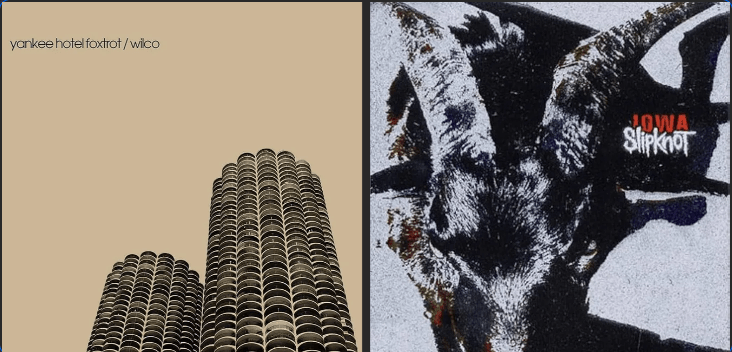
Today we’re taking a look at Wilco’s Yankee Hotel Foxtrot (#1) and Slipknot’s Iowa (#128)
Note: As many of you saw, I recently wrote about a Best Record of 2001 challengeand noted that I’d be occasionally writing some of these up.
Each day, I’ll do some quick hits of each first-round match-up and post them directly to the page. Some will be longer, some won’t, and some might just be a handful of sentences. There’ll probably definitely be a few typos. We’ll also have a few guest posts along the way, so make sure to stay tuned for those!
Check ’em out and let me know your thoughts! Chin wags & hot takes welcome! Sharing and restacks always appreciated.
KA—
Wilco’s Yankee Hotel Foxtrot is one of those records that is usually described in hushed tones and with reverence. For a certain demographic (i.e., suburban dads), it’s canon. It’s given as a meaningful gift and passed down from dad to son. It gets boxed up for anniversaries and treated as the moment Wilco turned from alt‑country to something in the pantheon of dad rock. For many listeners, it’s a landmark and must-have.
For me, it’s never landed.
On paper, I should be all over this. I like the genre. I’m a fan of good writing and stories that aren’t quite in focus. I wear cargo shorts and Sambas. I prefer Microbrews over Miller. Yankee Hotel Foxtrot checks those boxes…and yet…
The opener, “I Am Trying to Break Your Heart,” is a declarative statement, despite a wonky groove, and vocals that range between weary and half‑asleep, which frankly is how it leaves me feeling. I can admire how the whole thing is put together. That doesn’t change the fact that my favorite part of the whole deal is the cover art.
I want to like this record, I really do. I’m supposed to, right?! Lord knows I’ve tried. “Kamera?” Check. “I’m the Man Who Loves You?” check. Absolute apathy towards the sound? Check.
Maybe it all feels undercooked? I know that was a choice, and there are a lot of records that aim for intentionally good, not great, as an aesthetic. Maybe the hype surrounding it has led to horribly mismatched expectations. I dunno. All I can tell you is that I walk away from the sound machine feeling underwhelmed. This is a record that should be a gut punch.
None of this makes Yankee Hotel Foxtrot a failure, of course. It’s thoughtful, was clearly labored over, and clearly means a lot to a lot of people. I’m just not one of them. This is the #1 seed in the bracket and will likely make a deep run in the tourney. Heck, even I’ve pipped it to take it all (I’m pragmatic if nothing else). My bigger concern is that it’s gonna hoover up a ton of discourse oxygen. Hopefully, I’m wrong. Wouldn’t be the first time.
Slipknow’s Iowa, meanwhile, felt like everything YHF wasn’t; it was loud, dangerous, and maybe most importantly unique. The production here is a choice as well, and that choice is “don’t sand the edges off.”
The masks, jumpsuits, and numbers for names read as a gimmick (and still do, tbh), but the band said they wanted people to focus on the music, and I get it.
Tracks like “People = Shit,” “Disasterpiece,” and “The Heretic Anthem” aren’t trying to steal your heart so much as rip it out of your chest and show it to you. Joey Jordinson’s drums sound fully formed, for lack of a better term. Corey Taylor sounds like a man possessed. It’s uncomfortable. It’s glorious.
I also think that part of the appeal is where the band came from. And I mean that literally. As in the flyer states. Specifically, well, Iowa. Pop culture and tastemakers love to ignore the Central time zone, and when you put out a record that sounds like a blast furnace, that’s hard to do.
Bottom Line: Somewhere there’s a universe where Iowa is on the right side of a #1 vs #128 match-up. Unfortunately, we don’t live there. I love rooting for the underdog, and will vote for Iowa out of spite, if nothing else. But I can’t see a way out for Clown & Co. My bracket pick begrudgingly goes to YHF.
Any thoughts on either of these records? Agree/disagree with my takes? Which one of these would you vote for? Sound off in the comments!
Good morning! Need an antidote for the algorithms? Looking for a place to share the music you love with like-minded people? You’re in the right spot.
For those of you who are new, we kick off every week by sharing what we’ve been playing, and the playlist below is some of what’s been in heavy rotation for me.
As always, thank you to those who have recently upgraded their subscriptions. Your direct support fuels this community and makes a positive impact. Shares and reposts also help!
When you’re ready, joining them is easy. Just click here:
For avgeeks, it’s hard to beat last week’s date run. March 19, 20th, and 21st don’t mean much to most people, but those also happen to be – at least in the US, anyway – written as 3/19, 3/20, and 3/21. And what better excuse to celebrate the Airbus family of narrowbody aircraft (i.e., the A319, A320, A321)? We’re incredibly fun at parties!
At any rate, that got me thinking a bit about the numbers for Playlist 341. I’ve never been a fan of math- I was that stereotypical kid who wailed about taking algebra. Why should I take the time to learn something I’ll never use?! Joke’s on me; I use it almost every day; sometimes I even use it while working weight and balance on flights flown by…A320s. Go figure.
I’d covered Roxy Music’s “Virginia Plain” a little over three years ago. It popped back into my head after watching an episode of Barry that everyone else watched in 2019. Late to the party again. The interwebs tells me the band’s “For Your Pleasure” LP turns 53 today. “Virginia Plain” and “Street Life” are on the records on either side of it.
It’ll be 36 years ago this summer that I first saw Sonic Youth. Two of the band members have newsletters right here on this very platform. A 3rd is in a band that made one of the best records of 2026 (so far). We’ve got 9 months to go, but I’m guessing it’ll make a deep run on my AOTY list. The 4th, Kim Gordon is here with my #1 favorite song off her 3rd album.
It feels like I’ve been listening to Wire for a million years (not true), and they’re back with “23 years too late” for the 19th Record Store Day on 4/18 (very true).
There’s also plenty of brand new 2026 stuff here, including fresh racks from Lawn, Genre is Death, and Weird Nightmare. We close things out with a great new track from our friend Binnie Klein.
There’s more tracks than usual this week (12, actually). Hopefully you find a new favorite or 2 over the next seven days!
This week, Side A is tracks 1–15 (ending with “Mantis”), with Side B being 16–39. Yes, it’s lopsided; sometimes, that’s just how it goes.
Good morning! Need an antidote for the algorithms? Looking for a place to share the music you love with like-minded people? You’re in the right spot.
For those of you who are new, we kick off every week by sharing what we’ve been playing, and the playlist below is some of what’s been in heavy rotation for me.
As always, thank you to those who have recently upgraded their subscriptions. Your direct support fuels this community and makes a positive impact. Shares and reposts also help!
When you’re ready, joining them is easy. Just click here:
Sometimes truth is stranger than fiction, and in honor of Social Distortion dropping a new single, I thought I’d reshare the 100% true, 100-word story about how I met the band. Worth noting that Mike Ness & co. were quick to steer me right toward the Gatorade (and away from everything else). Teenage me was annoyed. Middle-aged me is grateful.
In school, I won tickets to see Social Distortion by calling into a local radio station and naming the song (“Story of My Life”).
The show was at Pine St. Theater in Portland, & the band used plastic jellyfish as de facto backstage passes. My friend Pauli got one. We did not.
After an amazing show, she went up to meet them (backstage was actually upstairs). We were out front waiting when we heard a noise above us. It was guitarist Dennis Darnell, about to pee out the window. Instead, he asked us up.
And that’s how I met the band.
KA—
On to the music…
The new SD is here, but they’re not the only ones making a triumphant return. Heavenly is back, as is our pal Joel Daniel and Tinvis. There’s a new record on the way, and you can check that out here. We’ve also got some fresh sounds from Peter Patrick Pedro, Deary, and Hedge.
A few of you have asked whether I sequence these as an album or mixtape. The answer is always “yes.” In my head, I imagine them being played on your morning commute or road trip. I’m too old to use the word “vibes” as much as I have lately, but, well, if the shoe fits…
This week, Side A is tracks 1-13 (ends with “Other Lives”), with Side B being 14-27.
Volume 12 | February 2026: Sam & I make trip-hop starter packs as a little treat.
Good morning!
Today Sam Colt and I are each sharing a few of our favorite trip hop records.
We are so back.
Welcome to the latest installment of our (not so) new series! For those of you who may have missed previous editions, here’s a bit of context:
In this monthly series, Sam Colt and I will each share our picks for artists and/or titles that haven’t received their due. You’ll recognize Sam’s name from our On Repeat and Friends Best of Series, as well as our Top 100 of all-time series last fall. These posts will adopt the latter’s format; I will make my case for my three picks and my reaction to Sam’s. Sam’s page will do the reverse.
In the inaugural post, we noted that successive editions would narrow things down slightly. Maybe a specific genre…maybe a specific era…maybe a specific…well, who knows!
One of the best lines of advice I ever heard about what makes a good podcast, newsletter, whatever is that it’ll “treat your audience like it’s already almost the end of the first quarter.” This was for an American football podcast, and the idea was to assume your audience is highly knowledgeable but not necessarily subject-matter experts. In other words, it assumes listeners already know that touchdowns are worth six points, what a safety is, etc., so you needn’t take time explaining such things. That’s something I’ve always taken to heart and is why you won’t see something like “Webster’s defines trip hop as…” as an opener. At the same time, they might not know the intricacies of a specific play or why it worked or failed. That middle ground is where you kick off from.
Trip hop’s a fun one for me for a couple of reasons. First, as many of you know, I’m a fan of just about anything with a big beat. The more my hearing diminishes, the more my need to (literally) feel the beat grows. So there’s that. It’s also a genre I know my way around, but am still finding new corners to explore and alleys to go down. Lastly, this is a genre where artists both obey and overstep the definitions. The guardrails are already broad — there’s a lot of time zones between, say, Portishead and Tricky — but artists pushing the limits make for a fun ride.
“Dummy” felt like a default option, so it’s not on the list. To be clear, it’s incredible, but it’s ground most people have already covered. That’s a major reason we picked this theme. Mapping out an entire genre — especially one this fluid — would be like kicking a 73-yard field goal in a stiff wind, but I think we covered a ton of ground. Mostly, we just want to help you find a few favorite records (or two).
You likely know this band, even if you don’t recognize the name. “6 Underground” was a huge hit (and their only one, as it turns out). It was also on the soundtrack for The Saint, another case of a great soundtrack outshining a… not-so-great movie. But I digress.
Back to the record: for my money, “6 Underground” aside, it’s one of the more accessible trip-hop records out there. That’s why it’s here. If you imagine Tricky and Massive Attack on one end and Portishead on the other, Sneaker Pimps are squarely in the middle, leaning far more into the beats and a poppier sound. That all makes for an easy on-ramp with a low grade. The tracks bounce between dimensions, but the transitions are easy to navigate. This isn’t a record with tight corners. If pressed for time, refresh your memory on “6 Underground,” but also make room for opener “Low Place Like Home” and “Spin Spin Sugar” (this writer’s fave).
Singer Kelli Ali (aka Kelli Dayton) has a distinct voice and talent. A lesser singer might’ve been tripped up by a couple of the weaker tracks here. For better or worse, Ali was the face of the band — and I’m using the past tense here, as she was unceremoniously cut from the band not too long afterward. Shame, really, as the subsequent records are lukewarm at best.
Sam’s Pick and My Take: Bowery Electric- Lushlife
Broadly speaking, trip hop generally falls into two camps: the soundtrack to a late-night (or predawn) drive, or the soundtrack to some sort of heist. With its swirls and noir atmosphere, Lushlife is definitely in the former camp. That familiar air of menace that runs through the genre is there, but it’s abstract rather than acute.
If there’s one word to describe Lushlife, it’s “consistent.” The duo of Martha Schwendener and Lawrence Chandler follow the same template throughout the record: a dash of swirl and/or piano to set the tone, then a hefty bassline is laid down as scaffolding for some strings and Schwendener’s voice. It’s quite a ways from records like 1996’s Beat, which feels much more sparse and spartan — incomplete, almost. Lushlife is the opposite: fully fleshed out and whole.
If this isn’t your bag, that sameness won’t have much of a shelf life. But if you find it making you move, then it’s all upside.
Bomb the Bass- Clear
At some point in the ’90s, there was a pivot: everyone left the rave, turned up the lights, and got into books like Naked Lunch. Was this Gen X’s version of “performative reading”? Maybe, maybe not. But all kinds of records started with quotes from these works. This was a memo Tim Simenon clearly got, and 1995’s Clear is no different, with the first line we hear being: “I think it’s time to discuss your philosophy of drug use as it relates to artistic endeavour…” It’s a sample, sure, but it also reads as a thesis statement. It’s the last bit of calm before things pop off.
Opener “Bug Powder Dust” kicks in, sounding like U.N.K.L.E. and The Prodigy got together in the studio just to see what might happen. It’s quite a hot gem, but that sort of thing burns fast and not for long.
“Sleepyhead” dials things way back and is swathed in dub bass and haze. “Dark Heart” is bass and pressure. The vocal could (should?) almost exist in isolation as a straight roots cut, but Simenon wraps it in something darker, building something else entirely.
On “5ML Barrel,” the monologue is particularly gritty, with no shortage of gruesome boxes checked, all with precision and economy.
It’s also a ’90s record, so one shouldn’t be surprised to learn that cynicism and a sort of suspicion are oozing out from every corner.
Simenon isn’t alone here. He’s brought along some co-conspirators and friends, such as Justin Warfield, Bim Sherman, and Sinéad O’Connor. The latter, in particular, shines singing the chorus on closing track “Empire.” If an RFP for this song landed on your desk, you’d chuckle a little before tossing it. It shouldn’t work, but man, it sure does.
To be sure, there are a couple of tracks you can skip if you’re sober (take a bow, “Somewhere”), but with its weight-bearing basslines and spoken word, Clear is a great snapshot of what it looked like to emerge from the club into the cold light of day.
Sam’s Pick and My Take: Hooverphonic- A New Stereophonic Sound Spectacular
My hot take hereis that this sounds like a Belgian version of Massive Attack (not derogatory). And like that band, this record clearly comes from someone with one of the cooler record collections out there. A Supreme… draws on elements of ambient, bossa nova, and more. It all makes for a very polished, very urbane sound — and one that makes for very enjoyable listening.
In the intro, I noted that our ultimate goal is for you, the reader, to find a new favorite record. That goes for us, too. We’re always trying to get new records on one another’s radar, and this was one for me.
Thievery Corporation- Radio Retaliation
I have a confession: when I mentioned records and artists stretching genre definitions, this was the record I had in mind. And while it’s objectively true, I also wanted to use that as a load-bearing rationalization for including this record.
At its heart, this is a protest record. There is a common complaint that the band played it too safe here—perhaps all the more so when one considers their other work. This is, after all, a duo with a well-known penchant for switching things up. But I’d bet the other way. “Playing it safe” is also often a euphemism for “boring,” and frankly, the BPM count for most of the album is too high for that to apply.
I also don’t share the opinion that Rob Garza and Eric Hilton mailed it in. Rather, I think they doubled down on the record they thought made the most sense for when it was recorded. And it makes sense in 2026. “Sound the Alarm’s” urgency reflects the tension we’re all living through in 2026. “Mandala” follows that up with some sitar at the start and horns at the end. Who else but Thievery Corporation would bookend a track like that? The title track is a potent shot of dancehall. “The Numbers Game” is as close to a textbook definition of trip-hop as we might get, with “Sweet Tides” a close second. Both are fantastic.
Could this have used a little more punch? Sure. At 15 tracks, it’s roughly two to three songs too long, but the ones that hit are hella good and more than make up for it.
Sam’s Pick and My Take: Supreme Beings of Leisure- S/T
One last allegory, if you’ll indulge me: I’ve been rewatching Mad Men lately and am currently in the middle of Season 5. My elevator pitch for this record would be “soundtrack to one of the cooler dinner parties on the show.” It’s got a relaxed, smoothed-out vibe, but is remarkably confident for a debut. It’s got my kind of drum & bass, elements of Middle Eastern sounds (see: the sitar on “Strangelove Addiction,” a track which, FWIW, would also be right at home on The Saint soundtrack), and there’s just enough funk to keep the groove moving right along. And that’s before we get to Geri Soriano’s vocals.
In my head, I imagine it’s the sort of thing Bert might’ve found distasteful, but Peggy, Stan, and Ginsberg would be way into…
That’s a wrap! What are your thoughts on these records? Do you own any of them? Share your thoughts in the comments! Rants, raves, and spicy takes are all welcome. And if you have any ideas on future themes, please share those as well! Don’t forget to check out Sam’s thoughts over at This Is a Newsletter!






 Kevin Sent
Leave a comment