Good morning!
Today we’re taking a look at the latest from at the latest from David Forman.
The boilerplate intro: Every year, I celebrate all the great music we’ve been gifted while worrying that next year will see the other shoe drop. I first did that in December 2020 and have been proven wrong every month since. Not only are there a ton of releases steadily coming out, but it also transcends genre or any other artificial guardrail we try to put up.
In other words, a ton of good stuff is still coming out, and there’s something for everyone. It’s almost overwhelming— but in all the best ways. These are another batch that caught my attention recently.
Hard to believe that it’s 2026 already, but here we are. Luckily for us, the records keep coming. Below are a few quick field reports from right between the sound machine.
Let’s get into it!
David Forman- Who You Been Talking To
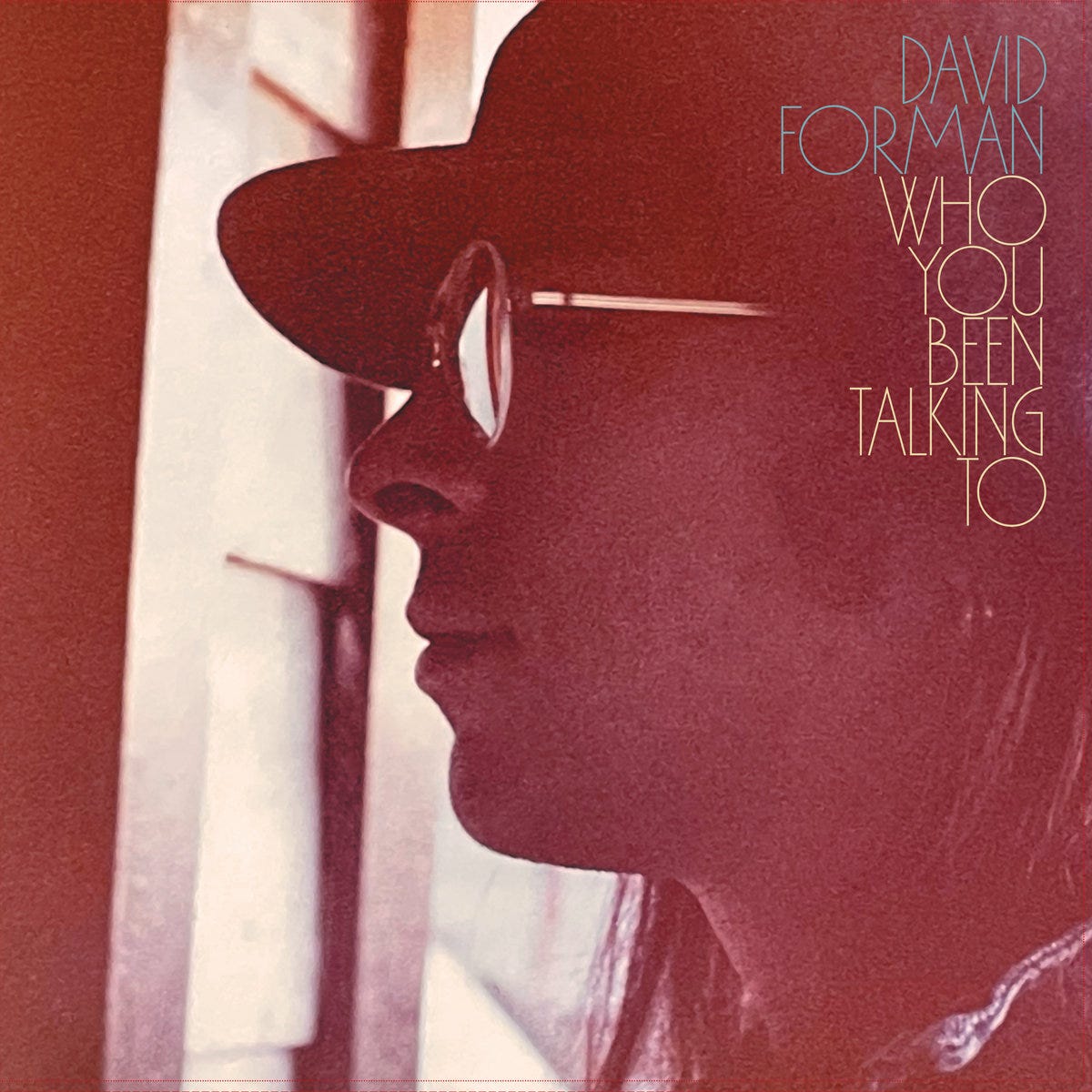
Anytime I think of LA, I think of all the people that haven’t quite made it yet; the people whose story we don’t yet know. The waitress who’s in the biz, but that really just means a couple of IMDB credits as an extra. The disillusioned film major working a shitty office job, hoping for a better tomorrow. The hotel clerk working nights who’s got a screenplay that’s perfect- it just needs to get in front of the right eyes.
The second in the two-record deal Forman signed in 1976, Who You Been Talking To was recorded at the Sound Factory on Selma Avenue in Hollywood over two weeks in late summer 1977 (just days after Elvis Presley’s death) and engineered by Dave Hassinger, who had worked with the Rolling Stones and Frank Sinatra. Despite the extraordinary musicianship and Forman’s remarkable vocal performances, Arista Records head Clive Davis chose not to release the album, claiming he didn’t hear a radio hit, instead offering to return it to Forman to shop elsewhere. Devastated, Forman declined, and the tapes went into storage for nearly fifty years.
The story of David Forman’s Who You Been Talking To is the stuff of just such a screenplay. It’s the sort of story we love: an artist delivers their debut to incredible acclaim, only to record a follow-up at exactly the wrong time. The label refuses to release it, and said artist falls into obscurity, known still only to a few people who have copies of the first record.
Enter a music listening club- in this case, journalist Joe Hagan, photographer Tim Davis, and museum curator Joel Smith (Disclosure: Hagan offered to send me a copy of the album to listen to, which I accepted.). Smith happens upon the record in a cutout bin and falls in love with it. He shares it with the group, who all follow suit, and a minor obsession is born. Through a little detective work, they figure out Forman lives nearby and invite him to lunch. Forman plays them the (then) unreleased record, and a campaign to get it out into the world is launched.
Hagan had sent me links to the liner notes and a Bandcamp link ahead of time, but I decided to go into it cold (literally, as it was -18 when I first played it). My first surface-level impression was one of surprise; this is a really well-done record, with a murderer’s row of session musicians, including Ry Cooder, Jim Keltner, David Lindley, Fred Tackett, Tim Drummond, and Flaco Jimenez.
And while I get that Arista might not’ve wanted to go in this direction, I’m surprised they didn’t at least hold onto it and ship it later. I mean, Kudos to Clive Davis for offering it back to Forman, but still… this strikes me as a rare mistake by the man.
My second impression is that Forman reminds me of Randy Newman. Like, a lot. Especially his vocal stylings on tracks like “Thirty Dollars.” That’s certainly not a bad thing, but it’s a theme I couldn’t shake as the record went on.
The title track kicks things off and sets the tone; it’s a sultry groove, and once it landed in my ears, it stayed there for the rest of the day. “A Train Lady” is a bit of infectious soul that reminds me of sounds from the Grand Strand on the opposite coast. Maybe I just have beaches on my mind. Either way, it’s a ride I’m grabbing a ticket for.
Things slow down with the ballad “Painted in a Corner,” before a bit of a mistake with “Let It Go Now.” A pleading number, it feels like the stereotypical track they threw everything at (falsetto included). The money shot, as it were. You miss 100% of the shots you don’t take, I guess.
But just like one bad scene doesn’t take down a whole movie, we’re quickly back on track with “Midnight Mambo,” one of this writer’s favorites on the record. This represents a sharp shift to late-50s/60s pop melodies (right down to the obligatory sax solo). I spent a lot of time thinking about who might be best to cover it, and what their versions might sound like. My two faves were Jimmy Buffett and Dean Martin (suspension of disbelief is, of course, required here).
If “Midnight Mambo” dips a toe into the ‘50s/’60s, “What is so Wonderful” does a cannonball into the deep end, with its doo-wop and backup singers. Penultimate “Losing” is a dark track best suited for the backside of the clock. Not my cup of tea, but that’s a me issue. Maybe it was one Davis couldn’t get past, and that helped drive his decision to pass? We’ll never know. Either way, “Now That I Found You” kicks the tempo back up and ends things on a high note.
Fifty (ish) years is a long time to wait for a sequel. I talk a lot about records finding you at the right time, and this was a textbook example. I love that the universe aligned so that the right group of people found this at the right time and were able to share it with the world. Talk about a storybook ending.
 Kevin Sent
Leave a comment