Today we’re taking a quick look at the latest from Automatic, The Cords, and Ryan Davis and the Roadhouse Band.
Longtime readers may recall that I reviewed 100 new (to me) records last year. Because I’m a glutton for punishment love music, I’m doing it again this year. This is the latest in the series.
Good morning!
Today we’re taking a look at the latest from Automatic, The Cords, and Ryan Davis and the Roadhouse Band
The boilerplate intro: Every year, I celebrate all the great music we’ve been gifted while worrying that next year will see the other shoe drop. I first did that in December 2020 and have been proven wrong every month since. Not only are there a ton of releases steadily coming out, but it also transcends genre or any other artificial guardrail we try to put up.
In other words, a ton of good stuff is coming out, and there’s something for everyone. It’s almost overwhelming— but in all the best ways. Below are another trio that caught my attention recently.
Let’s get into it!
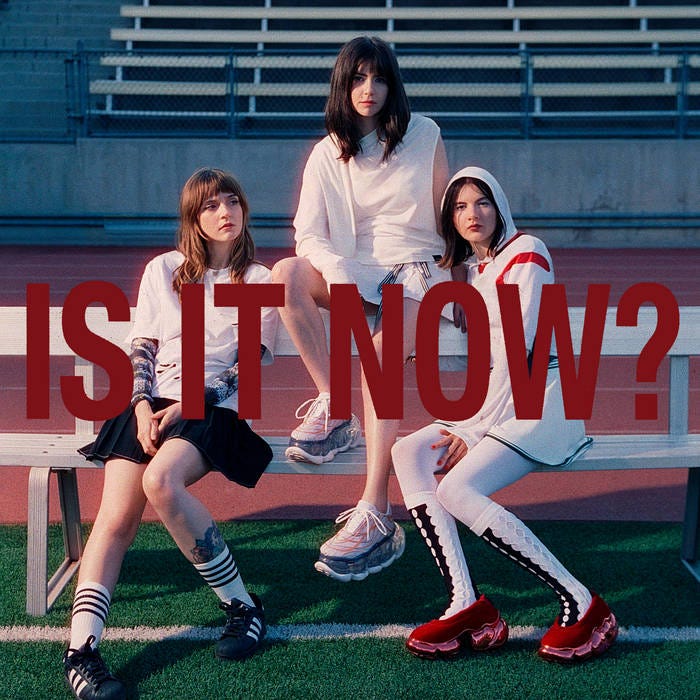
Automatic- Is It Now?
Cover art courtesy of Stones Throw Records
When we last heard from Los Angeles’ Automatic, they had us looking toward the stars. On this latest release, they’re looking at the world collapsing around them.
Is It Now? finds the trio deepening their sound while sharpening their focus. Formed nine years ago, the band has this time teamed with producer Loren Humphrey (Arctic Monkeys, et al.), who brings a lean precision to their already taut mix of minimalist grooves and pop-forward melodies.
When I wrote about Excess, I asked readers to “close your eyes and imagine Devo as a dance band—or a collaboration between the Go-Go’s and Wire—and you have Automatic.” That description still holds, but Is It Now? pushes further into darker territory. The group uses those perky, tightly wound rhythms as a vehicle to deliver commentary on automated warfare, mindless consumerism, and the political machinery of oil and power.
The grooves remain effortlessly cool, but the themes cut waaay deeper.
Of the single “Black Box,” Izzy Glaudini says, “The title ‘Black Box’ refers to the black box in a crashed plane. The repetitive synth is supposed to suggest a plane gliding as it crashes/ an alarm distress call. I was listening to the Leonard Cohen album The Future a lot around the time the lyrics were written. It’s a pretty straightforward critique of people that have sold out on a large scale, specifically within creative industries. Thierry Mugler said, “art used to tell money what to do, now money tells art what to do” and the world is a less interesting place because of it.”
Okay, then!
Elsewhere, the woozy synths on “Mercury” are fantastic—coming in and out of focus, staying just long enough for you to find their rhythm before disappearing again. Those fragmented textures leave you slightly off balance in the best way.
“Lazy” is a chilled-out groove that I played three times in a row, trying to place its reference point before landing on Altered Images. I’m curious to hear if you hear it, too. And I’ll tell you this: “Country Song” doesn’t refer to the genre.
Last time around, I said the band had a bass sound that felt like it “came from the same finishing school as Peter Hook.” I meant that as high praise, and I’ll happily repeat it here, doubly so on the title track. The song is the album’s centerpiece—icy, chaotic, and alive all at once. It sounds like Movement-era New Order at their most up-tempo, and it absolutely hits.
Is It Now? is a record that makes you think as much as it makes you move. The beats are irresistible, the message impossible to ignore. Unlike Excess, this isn’t about escapism—it’s about working your way through the current moment, heavy as it may be. Luckily, Automatic know how to turn reflection into rhythm.
Good morning! Need an antidote for the algorithms? Looking for a place to share the music you love with like-minded people? You’re in the right spot.
As always, thank you to those who upgraded their subscriptions this past week. Your direct support fuels this community and makes a positive impact. Shares and reposts also help! Thank you!
When you’re ready, joining them is easy. Just click here:
For those of you who are new, we kick off every week by sharing what we’ve been playing.
The playlist below is some of what I’ve had in heavy rotation. This week, we’re starting by heading to Portland (the best city on Earth, in my extremely biased opinion) for a taste of “America’s best Krautrock band.” From there, it’s off to Nashville and some very-much-not-country music from palm Ghosts. The first three wrap up with the latest from Coast City Bus.
Side 2 kicks off with a little bit from The Church’s Starfish album, a brand new one from This House is Creaking, and a 1-2 combo of Dummy and Immersion. From there we wind things out with a lesser known SY track, a gem from Pąșśìóň Pïț and a jolt of jangle pop from The Radio Dept.
Broken record alert: I know I’ve said it for several weeks now, but it’s true: 2025 might be is a hot mess, but not when it comes to new music.
Good morning! Need an antidote for the algorithms? Looking for a place to share the music you love with like-minded people? You’re in the right spot.
As always, thank you to those who upgraded their subscriptions this past week. Your direct support fuels this community and makes a positive impact. Shares and reposts also help! Thank you!
When you’re ready, joining them is easy. Just click here:
For those of you who are new, we kick off every week by sharing what we’ve been playing.
The playlist below is some of what I’ve had in heavy rotation. This week, we’re starting with one from Former Champ and the latest from Chicago’s Ratboys, before heading down to Louisville for the new single from Second Story Man, a band a reviewer once asked readers to think of as a “female-fronted Jawbreaker.” ICYMI, Natalie Weiner recently wrote a great piece on Amanda Shires for Texas Monthly. Tsar’s 1998 demos are finally (!) seeing the light of day and sound fantastic.
Side 2 kicks off with some Immersion. If you’ve been here a little while, you know what a fanboy I am of Wire and frontman Colin Newman’s solo work. Immersion is the work of he and his partner Malka Spigel. Look for a review of the record soon. There is also a (relatively) deep cut from Depeche Mode, and a little something from Total Wife, before coming back to Chicago and ending with a (definitely) deep cut from Urge Overkill.
I know I’ve said it for several weeks now, but it’s true: 2025 might be is a hot mess, but not when it comes to new music.
Volume 9 | September 2025: Sam & I throw on hoodies and share some perfect records for fall listening.
Good morning!
Today Sam Colt and I are each sharing a few of our favorite fall records…ones that might’ve been overlooked or deserve more time in the spotlight.
Welcome to the ninth installment of our (not so) new series! For those of you who may have missed previous editions, here’s a bit of context:
In this monthly series, Sam Colt and I will each share our picks for artists and/or titles that haven’t received their due. You’ll recognize Sam’s name from our On Repeat and Friends Best of Series, and also our Top 100 of all-time serieslast fall. These posts will adopt the latter’s format; I will make my case for my three picks and my reaction to Sam’s. Sam’s page will do the reverse.
In the inaugural post, we noted that successive editions would narrow things down slightly. Maybe a specific genre…maybe a specific era…maybe a specific…well, who knows!
As many of you know, I live in a college town. It’s a big enough school that the city’s energy ebbs and flows in tune with the academic year. Spring is full of excitement about what’s to come. Summer is for the locals. Winter is… well, I live in the upper Midwest, so winter is usually for hunkering down and trying not to track salt everywhere. And hockey. Always hockey.
That leaves fall. As a card-carrying Gen Xer, it’s in my DNA to snicker at woo-woo things like “vibe shifts,” but there’s a palpable change that happens as soon as the first wave of students returns for the new academic year. The chaos usually kicks off with Hippie Christmas, followed by the steady arrival of new and returning students, and all the familiar events we associate with the collegiate experience: football games, drinks at the Memorial Union, and so on.
There’s a brief window before we lose the daylight and bearable temperatures where the dial turns down from “sweltering” to “this is kinda nice.” The dress code might call for a parka in the morning and a t-shirt in the afternoon. It’s a heady time for the shorts-and-hoodie crowd (of which I am also a card-carrying member). That’s the sweet spot we’re traveling to today.
This month, Sam and I are sharing a few fall records that for whatever reason might’ve been overlooked.
When you’re done here, remember to check out Sam’s take at This Is a Newsletter!
Let’s get to it!
KA—
Brothertiger- Fundamentals III
You have to dig deep to find a silver lining in the COVID lockdown, but if you’re struggling to come up with an example, I offer you Brothertiger’s Fundamentals series. Like many musicians, John Jagos was forced to stop public performances in 2020, but that didn’t mean he stopped performing. Jagos had previously made an album of Tears for Fears covers and later released a self-titled album that was one of my favorites of 2022. But in between, the pandemic forced him into pivoting to livestreams.
Each of these instrumental records was born and evolved in real time during those livestreams, while fans offered feedback to help shape them. There are four in total, but Vol. III is far and away my favorite, with Westerlies being a highlight. It’s a track a friend of the newsletter
Kiley Larsen once described as “the one with that never-ending Bruce Hornsby piano riff.” He’s right. And it’s awesome.
Likewise, the shimmering pianos of Pelée and the expansive quality of closing track Gran Canaria wrap the album in light—something I find myself desperately clinging to as the days grow increasingly shorter.
Each of the records is loosely built around an element, but I also think there’s an unintentional(?) emotional arc across the series. I might be reading too much into it, but for me Vol. I is moody and uncertain. Vol. II, even more so. In contrast, Vol. III feels like a release. It’s much more buoyant and joyful than the two that came before it.
Whenever I’m stuck writing a piece, I like to look out the window. In my field of vision is a tree that seems to operate on its own schedule. It’s the first to turn bright red while the others around it are still enamored with their lush green colors. It just does its own thing—looking forward to whatever’s coming next and ignoring everything else around it. That tree reminds me of this record, and vice versa.
Sam’s pick and my take: Cleo Sol- Rose in the Dark
The first thing I should tell you is that in my early research, I came across Cleo Sol’s name in a forum thread where someone described her music as “Erykah Badu meets Sade.” That got my attention. The second was that I was shocked to pull up this record on Spotify and see that she has over 3 million monthly listens. Another case of my being late to the party, I guess.
And that count makes more sense when you learn that Sol is a part of SAULT, but this records stand firmly on its own. Rose in the Dark may not carry the experimental edge of her group projects, but it thrives in its own constraints. The mood here is chilled out, and the sound is stripped down. IMO, that subtlety is a strength. Her singing is poised, and she‘s not overselling the emotion. The production mirrors that approach: pared back, easygoing, and full of nods to 1970s soul. You hear it in instruments like flutes and synths. It all makes for an unhurried groove and a pretty neo-soul record. I can see listening to this on a frosty Sunday morning or pairing it with a nice cozy dinner at home.
R.E.M.- Green
Okay, hear me out. I know this series is all about underrated records—or albums that might’ve flown under your radar. Green is not that. I’m also aware of the irony in choosing a record titled Green for a series on fall records. But perhaps more than any other here, this reminds me of autumn. That’s influenced in large part by the fact that I first heard this at the beginning of the school year. I was also lucky enough to see them in concert while they were on the road supporting this record. That show was in… October.
I’m the kind of listener who is long on association. There’s simply no way my brain can be rewired to tie this to the dog days of summer. Not to oversell it, but I really only listen to it in the fall and winter. By contrast, I regard Out of Time as a “summer record.” Even the pop brilliance of Pop Song ’89 takes me right back to those gray, rainy days and claustrophobic halls of junior high, where headphones were as much about body armor as they were about listening to music.
With its mandolin, You Are the Everything just feels like a fall evening.
Another (possible) hot take: Get Up is fantastic. I know it sets some listeners’ hair on fire, and the lyrics are… okay. But that rhythm? I’ll take all of that, you got! Turn You Inside Out is my vote for “R.E.M. song that should’ve been bigger.” It’s one fans know & love, but not a whole lot of casual listeners are familiar with. If that’s you, please check it out ASAP. The closest analog I can think of (it’s still early) is Push by The Cure.
Michael Stipe would spend a lot of the late ’80s and early ’90s in the political arena, and World Leader Pretend is one of the first times he writes an overtly political track—or at least one that unveils some of his political leanings. And hey, we have elections in the fall, right?
Orange Crush is about Agent Orange, which was used in Vietnam—a war we just happened to learn about in the fall of that same school year. It was all very timely, you see.
My on-ramp to the band was a 1-2 punch of Green and Eponymous. Some people say that it’s the band’s first bad record, but I’d argue the other way. I think it holds up well (yes, even Stand). I rate Green—and even Eponymous—higher than someone who came to the band earlier might. That raises some hackles every time it comes up, but I stand by it. I might be convinced to listen to this in the dog days of summer, but I’ll never be convinced that this is a poor studio outing for the group.
Sam’s pick and my take: Julia Holter- Have You In My Wilderness
Julia Holter’s fourth studio album is packaged with a distinctly sunlit, atmospheric sound, drawing clear inspiration from 1970s SoCal. The production evokes early mornings when the marine layer hasn’t quite yet lifted. It’s a backdrop well-suited to Holter’s strengths: carefully crafted songwriting and a precise sense of arrangement.
One of the record’s more striking qualities is its accessibility. Melodies are open and inviting, and the sounds are layered without ever feeling dense.
If there’s a fault here, it’s that, for as sunny and accessible as this record is, Holter occasionally overindexes on the ethereal. It’s almost as if that same marine layer will obscure her completely. That said, the storytelling is nothing if not vivid. Who else is going to work the line “sharp and high on the Balearic Promontory” into a song? A song about being seduced and then left to die on an island, by the way.
Like those early, misty mornings, this can be hard to get on the first listen, but once that burns off and the sky is clear and a million, you’re in for a treat.
Cleaners From Venus- Midnight Cleaners
This is lo-fi before any of us knew what lo-fi meant. Originally only available on tape, it was later reissued on CD and vinyl. I have a copy of the latter, and while it’s remastered and sounds great, many of the rougher qualities are still there—I hope that was by design, because in my opinion it’s a feature, not a bug.
Midnight Cleaners is at its strongest on more structured songs, like the fantastic “Only a Shadow.” The guitar is particularly sweet, and it’s something that wouldn’t be out of place on your favorite Smiths record. “Only a Shadow” also stands out because it uses real drums. I doubt anyone involved would have labeled this “lo-fi” at the time, but looking at it now, it’s tough to define it any other way. There are lots of easy GBV comparisons to make, though I can’t see Robert Pollard throwing a big block of sax on one of his records. What I can picture is this album being made in a drafty upstairs room or attic or a crisp fall evening. That aesthetic permeates the record. It too is a feature, not a bug.
Cassette recordings were never exactly high fidelity, and more than anything else, this feels like an album purpose-built for tape.
Sam’s pick and my take: Grouper-Dragging a Dead Deer Up a Hill
Ok, so my brain is clearly cooked from being terminally online, but this title had me thinking I was about to get into some sort of Swedish death metal. The closest this comes to connecting those dots is my saying that at first blush this feels like a witchy version of Cocteau Twins (not derogatory). Dragging is a record-long trip into dream pop and delicate vocals. Things get a bit gauzy, but never tip over into being too obscured to listen to. In other words, right up my alley. As for a fall record, the sounds certainly evoke this time of year, and a bunch of titles reference things like water and sleep, which aren’t exactly reminiscent of, say, July.
That’s a wrap! What are your thoughts on these records? Do you own any of them? Share your thoughts in the comments! Rants, raves, and spicy takes are all welcome. And if you have any ideas on future themes, please share those as well! Don’t forget to check out Sam’s thoughts over at This Is a Newsletter!
Good morning! Need an antidote for the algorithms? Looking for a place to share the music you love with like-minded people? You’re in the right spot.
As always, thank you to those who upgraded their subscriptions this past week. Your direct support fuels this community and makes a positive impact. Shares and reposts also help! Thank you!
When you’re ready, joining them is easy. Just click here:
For those of you who are new, we kick off every week by sharing what we’ve been playing.
The playlist below is some of what I’ve had in heavy rotation. This week, the pendulum again swings and it’s back to old faves and comfort sounds, with a few fresh tracks mixed in. We start with all-timers The dBs before launching into Home Front and Redd Kross
Side two kicks off with something from John Cale and ends with the Waterboys. Along the way, we stop in Motown, LA, and whatever universe gifted us Brothertiger.
I know I keep saying it, but it’s true: 2025 might be a hot mess, but not when it comes to new music.
The flood of great records continues! Today we’re taking a quick look at the latest from BRNDA, Grant Pavol, Water From Your Eyes, and Die Spitz.
Longtime readers may recall that I reviewed 100 new (to me) records last year. Because I’m a glutton for punishment love music, I’m doing it again this year. This is the latest in the series.
Good morning!
Today we’re taking a look at the latest from BRNDA, Die Spitz, and more!
The boilerplate intro:
Every year, I celebrate all the great music we’ve been gifted while worrying that next year will see the other shoe drop. I first did that in December 2020 and have been proven wrong every month since. Not only are there a ton of releases steadily coming out, but it also transcends genre or any other artificial guardrail we try and put up—
In other words, a ton of good stuff is coming out, and there’s something for everyone. It’s almost overwhelming— but in all the best ways. Below is another batch that caught my attention recently.
A lot of recent releases landed on my radar all at once, and I want to shine a light on them before too much more time passes. Not quite an 88 lines about 44 records kind of deal, but close. More of a clearing the decks, if you will.
Let’s get into it!
BRNDA – Total Pain
Emerging from the D.C. music scene sometime around 2011 or 2012, BRNDA has spent over a decade honing a sound that blends post-punk urgency, twee charm, and occasional nervous energy into something uniquely their own. Their latest record, Total Pain, balances moments of melancholy with bursts of off-kilter humor, producing a listening experience that feels both optimistic and restless.
From the opening moments of Peach Pit, Leah Gage, Dave Lesser, Mark McInermey, and Nick Stavely set a tone reminiscent of Dry Cleaning, pairing post-punk guitars with a detached vocal delivery. Lyrically, the album is sharp, sardonic, and often self-aware. I mean, with lines like “And again and again and again and again and you’re really not making any new friends” and “And you spend and you spend and pretend and pretend that they care that you’re reading August Wilson’s Fences,” what else can you say?
Tracks like Books Are Bad showcase a strolling bass line and vocal stylings that might evoke Chris Frantz for listeners of a certain age, while Burn the Zoo continues the album’s rambling, improvisational mood. MT Eyes offers a lighter, twee-infused interlude, recalling the charm of Tullycraft, while Everyone Chicago hits with angular riffs, urgent energy, and—yes—a flute, adding an unexpected flourish I absolutely did not have on my bingo card.
Go for Gold leans into playful absurdity with squeaks, squonks, and nonsensical lyrics like “Who’s gonna break the code? Do your knuckle worst / Breakfast of mushroom champions eat first / Who’s gonna cut my carbon? Who’s gonna cut my steak?” Yet beneath the humor, the album is suffused with subtle sadness. As the band notes,“We didn’t need to call the album Total Pain… but pain infuses the album.”
The record’s energy bounces between nervous, melodic post-punk and playful experimentation. Parquet Courts comparisons aren’t far off, but BRNDA distinguishes itself by taking turns on vocals that shine brightest when Leah Gage takes the lead, particularly on tracks like Cool Night. Themes of life’s anxieties, domestic chaos, and paranoia weave throughout, creating a record that to my ear feels both intimate and unhinged. Apropos of nothing, I read in an interview that Gage and Lesser are parents of a toddler. Having been there/done that, the frazzled mindset of this record makes sense.
Standout moments like Blenderman exemplify this duality: the repeated line “I could (feelin’ lucky) win or time could beat me / I could (feelin’ lucky) win” captures hope tempered by existential uncertainty. The album closes with the delicious chaos of My Mother, a tense, slightly bonkers meditation on the modern family.
For fans of Sweeping Promises, Dry Cleaning, and Cola. Bandcamp also suggested Gaadge, which, to be honest, isn’t a bad call, either. (Bandcamp link)
Grant Pavol- Save Some Time (EP)
A little bit Krautrock, a little bit Yo La Tengo, with a dusting of twang across the top. This EP is enjoyable from start to finish. Save Some Time is a record Pavol describes as “an adult reassessment of youthful insecurity, carrying the weight of big emotions with a steady hand.” It’s also described as a bit like the Velvet Underground at their most Cale-Forward, which is fair. (Bandcamp link)
Die Spitz- Something to Consume
One thing you should know about me is that I’m a grammar nerd. Words matter. Definitions matter. And I suppose whether or not you consider a record an EP matters where you draw the line. Is it at four tracks? 6? I mention this because everything I’ve seen online refers to this record as the band’s debut. That might make for easy copy, but it ignores 2022 EP The Revenge of Evangeline and 2023’s 7-song release, Teeth.
Okay, rant over.
My elevator pitch for this Austin-based quartet has always been simple: Die Spitz is the Gen Z equivalent of L7. To be clear, that’s meant as high praise. They’re fast, loud, and have something to say— and exactly zero Fs to give. Ava Schrobilgen, Chloe De St. Aubin, Eleanor Livingston, and Kate Halter also happen to be talented musicians. 2023’s record was centered around “Hair of Dog,” one of my favorite tracks of the year, and the EP quickly found its way onto my Best of 2023 list. It set the stage for Something to Consume. Almost a rough draft, if you will. That’s not to say that this record has the edges sanded off- it absolutely doesn’t- but it’s clear that the group has worked to evolve from those early beginnings.
The first notes of opener “Pop Punk Anthem (Sorry For The Delay)” tell listeners in no uncertain terms that this ride is different. It’s almost radio-friendly. Almost. Ditto follow-up “Voir Dire.” If you have a hard rock station in your local market, don’t be surprised to hear the latter on the air at some point. Any concerns that the band might’ve lost its edge (whatever that means) are erased with “Throw Yourself to the Sword” and its piledriver riff. “Sound to No One” balances heaviness with ethereal vocals. “RIDING WITH MY GIRLS” is all gas and no brakes and purpose-built for getting the pit going.
Like L7 before them, Die Spitz’s sound is fueled by rage at the injustice(s) around them. The targets may have changed, the ferocity has not. In an era where terms like “punk” are co-opted into aesthetics, Die Spitz makes it all refreshingly honest again. The album takes the best parts of Teeth and levels up. In a word? Something to Comsume is extraordinary. (Bandcamp link)
Water From Your Eyes- It’s a Beautiful Place
Water From Your Eyes has been bending guitars into shapes you wouldn’t think possible for nearly a decade. The Brooklyn-by-way-of-Chicago duo of Rachel Brown and Nate Amos has built a catalog where the instrument is less an anchor and more a medium. Their live shows are notorious for stretching the songs until they blur into the unrecognizable. I suppose that’s fitting; this band thrives on the idea that the analog and digital worlds don’t need to agree—they just need to collide.
It’s a Beautiful Place opens with “One Small Step,” a blurry half-minute prelude that quickly gives way to “Life Signs,” and we’re off to the races. The song staggers and surges, with all kinds of time signatures
“Nights In Armor” charges further onward with a killer groove, Brown’s voice slicing through the circular bassline with a line that doubles as both invitation and dare: “I just want to fight you ’cause I’m tired.” It’s disarmingly simple, yet lands hard. Then comes “Born 2,” a warped cousin of a Weezer anthem fed through a psychedelic filter. Amos’s guitar churns in heavy downstrokes while Brown hovers just above accessibility.
The interludes scattered across the record serve as a chance to catch your breath and get your bearings.
“Spaceship” takes a break from gravity and order, the guitars dissolving into backward swells and percussion that lands like meteors. Next up is “Playing Classics,” a highlight built on club-ready synths and a deadpan vocal. It’s funny, strange, and incredibly addictive. If you’re in the market for an earrowm, start here.
Elsewhere, “Blood on the Dollar” trades distortion for restraint, Amos’s country-tinged guitar floating beneath Brown’s more reflective delivery. But even here, the band resists simplicity, adding textures that complicate what could have been an easy folk-rock closer. The title track and final instrumental tie everything together nicely, ending the record similarly to how it started.
Across It’s a Beautiful Place, Brown and Amos ricochet between maximalist noise, crooked pop structures, and ambience, every song a shot at testing the elasticity of sound. This record asks you to commit multiple listens before making any judgment calls—not because it’s elusive (okay, it is a little), but because it keeps giving more each time. (Bandcamp link)
As always, I’d love to hear your thoughts on these records! Did I get it right, or am I way off the mark?
Good morning! Need an antidote for the algorithms? Looking for a place to share the music you love with like-minded people? You’re in the right spot.
As always, thank you to those who upgraded their subscriptions this past week. Your direct support fuels this community and makes a positive impact. Shares and reposts also help! Thank you!
When you’re ready, joining them is easy. Just click here:
For those of you who are new, we kick off every week by sharing what we’ve been playing.
The playlist below is some of what I’ve had in heavy rotation. This week, we again overindex new tracks, with a couple of old faves balancing things out. We start with community fave Water From Your Eyes before kicking into high gear with a 1-2 punch of Bob Mould & Die Spitz. From there, we’ve got the latest from our friend,
The Ririverse, and we end Side 1 with the latest from a longtime DC area band.
Side two kicks off with a track from a record I once deemed the #4 record of all time, before taking a trip to Pittsburgh to hear some Gaadge. I’m not on Threads anymore, but before I left, I was lucky to meet a couple of you and find Palm Ghosts. Their latest is here. Here’s to silver linings.
I know I keep saying it, but it’s true: 2025 might be a hot mess, but not when it comes to new music.
The flood of great records continues! Today we’re taking a quick look at the latest from Ivy, Dar Williams, Lail Arad, and more!
Longtime readers may recall that I reviewed 100 new (to me) records last year. Because I’m a glutton for punishment love music, I’m doing it again this year. This is the latest in the series.
Good morning!
Today we’re taking a look at the latest from Ivy, Dar Williams, Maia Sharp, and more!
The boilerplate intro:
Every year, I celebrate all the great music we’ve been gifted while worrying that next year will see the other shoe drop. I first did that in December 2020 and have been proven wrong every month since. Not only are there a ton of releases steadily coming out, but it also transcends genre or any other artificial guardrail we try and put up—
In other words, a ton of good stuff is coming out, and there’s something for everyone. It’s almost overwhelming— but in all the best ways. Below is another batch that caught my attention recently.
A lot of recent releases landed on my radar all at once, and I want to shine a light on them before too much more time passes. Not quite an 88 lines about 44 records kind of deal, but close. More of a clearing the decks, if you will.
Let’s get into it!
Ivy- Traces of You
Here are reunions, there are comebacks, and then there’s whatever Ivy just did.
Five years after losing creative engine Adam Schlesinger, and seemingly out of nowhere, Ivy is back with Traces of You.
The last time we heard new material from them was All Hours, a synth-forward pivot that left many fans blinking in confusion. Traces of You, by contrast, feels like Ivy returning to the house they built in the late ’90s and early 2000s.
What’s remarkable—at least to me—is that Schlesinger is everywhere. The band stitched his work back into the mix using fragments and demos tracked between 1995 and 2012. The result isn’t eerie or gimmicky. I’ve always disliked things like hologram performances, and wondered if this might feel similar. It doesn’t. Whatever they’ve done feels organic—authentic, not synthetic.
Dominique Durand still sounds like she’s whispering secrets from the other side of the door, while Andy Chase and longtime collaborator Bruce Driscoll know exactly how to frame that haze and shimmer.
Traces of You fits seamlessly into Ivy’s golden-era lineage. “The Midnight Hour” and “Say You Will” could easily sit on In the Clear, all velvet melancholy and zero wasted motion. “Heartbreak” flirts with bossa nova. “Lose It All” luxuriates in its own pace. And “Hate That It’s True” might be the most emotionally direct song they’ve ever recorded.
This record didn’t have to exist. No one expected it, and maybe that’s why it lands so powerfully. Traces of You feels like a gift, and it’s easily among their finest work. It’s a dreamy, deliberate, impossibly cool farewell…or perhaps just another pause. Either way, we’re lucky to have it.
Dar Williams-Hummingbird Highway
Though known for folk music, Williams knows her way around other genres. On her 13th release, she wastes no time doing just that. Put Coins On His Eyes is classic bluegrass. Tu Sais Le Printemps is a fun bit of bossa nova that will transport you to 1960s Paris, which makes for, as Williams puts it, “a light, flirty song amidst many gloomy news stories.” I’d submit that it’s just the sort of thing we can use right now.
The Way I Go is an uptempo track that will remind listeners of early Mary Chapin Carpenter work. I Want To See the Bright Lights Tonight is an excellent take on the Richard Thompson classic, kicking everything up just enough to get you moving. Maryland, Maryland is both a love letter to her home state and a call to action.
The styles are disparate, yet matched by Williams’ knack for crafting intricate narratives with rich storytelling that give you plenty to contemplate without weighing you down. Like any recipe, adding the wrong ingredient or the wrong amount can end in disaster. On Hummingbird Highway, all of these elements blend together to make a cohesive, compelling whole.
As Williams notes, “As I’ve gotten older, I feel more comfortable holding a lot of different threads in my hand to create more complicated patterns. Time has given me a better ability to hold a bunch of colors and temperaments and see what happens, where they become interesting new stories and also where I need to stop and untangle the themes and characters. It’s daunting, and I’ve learned that, you know, daunting is fine, just keep going.” Amen.
Maia Sharp- Tomboy
Maia Sharp has always written with a steady hand—and written tracks for plenty of others. Tomboy, her newest record, sharpens that instinct into something leaner, tougher, and oddly freer. Sharp shows her cards with the title: this album is about stance, and owning space you might have been told not to take up.
The production is stripped down here. Guitars cut nice, clean lines, and the drums are in the backseat. There are some horns, but they, too, are in a supporting role. Sharp’s warm, husky voice carries the weight. There’s a steadiness to it, a real old soul vibe.
She’s not going it alone, though; plenty of people are along for the ride, including Terri Clark, who joins her on “Asking for a Friend,” one of the highlights on the record.
What stands out is how unforced these songs feel. You don’t get the sense of Sharp chasing relevance, clicks, or bending toward trends. Instead, Tomboy is fueled by direct melodies, emotions, and stakes. The writing is as tight as ever, less about clever turns and more about saying what matters.
It’s the kind of album that sneaks up on you (or did for me, anyway). One listen sets the mood; give it a couple of listens, and things start to pop out at you.
In the end, Tomboy is Sharp playing to her strengths.
Also awesome:
JF Robitaille & Lail Arad- Wild Moves:
One of the coolest things Substack used to do was host workshops for writers. These meet & greets were not only informative—you always came away having learned something—but also genuinely fun. Part of the charm was the surprise; you never knew who you’d be paired with. At one of these sessions, I was lucky enough to be put in a cohort with
Lail Arad. She’s been making fantastic music for a long time, as has her partner Robitaille. Now, with Wild Moves, they’ve joined forces, and the result is a delight from start to finish. The record opens with Swim Toward Your Troubles, a track whose infectious refrain will have you singing along in no time. It only gets better from there.
Bleary Eyed- Easy:
You want some shoegaze? You got it! On their latest record, Philly’s Bleary Eyed bring it all; sludgy guitar, ethereal vocals, and just enough pop to keep you coming back for more. Somewhere Kevin Shields is looking on and smiling. (Huge shoutout to
Good news for twee pop fans! Tullycraft is back with Shoot the Point, their first release since 2019’s The Railway Prince Hotel. This is a newer band for me, and if I’m honest, my capacity for twee is negligible. But in a case like this, it’s easy to get swept away on a wave of infectious hooks, back-and-forth vocals between Sean Tollefson and Jenny Mears, and tambourines… so many tambourines. A seriously enjoyable record from a band that doesn’t take itself too seriously.
Also: I’m callin’ it now: “Jeanine’s Up Again and Blaring Faith by The Cure” is the wildest song title that’ll grace this page in 2025.
As always, I’d love to hear your thoughts on these records! Did I get it right, or am I way off the mark?
Good morning! Need an antidote for the algorithms? Looking for a place to share the music you love with like-minded people? You’re in the right spot.
As always, thank you to those who upgraded their subscriptions this past week. Your direct support fuels this community and makes a positive impact. Shares and reposts also help! Thank you!
When you’re ready, joining them is easy. Just click here:
The flood of great records continues! Today we’re taking a quick look at the latest from The Beths, Suede, Smut, and more!
Longtime readers may recall that I reviewed 100 new (to me) records last year. Because I’m a glutton for punishment love music, I’m doing it again this year. This is the latest in the series.
Good morning!
Today we’re taking a look at the latest from The Beths, Jens Kuross, Smut, and more!
The boilerplate intro:
Every year, I celebrate all the great music we’ve been gifted while worrying that next year will see the other shoe drop. I first did that in December 2020 and have been proven wrong every month since. Not only are there a ton of releases steadily coming out, but it also transcends genre or any other artificial guardrail we try and put up—
In other words, a ton of good stuff is coming out, and there’s something for everyone. It’s almost overwhelming— but in all the best ways. Below is another batch that caught my attention recently.
A lot of recent releases landed on my radar all at once, and I want to shine a light on them before too much more time passes. Not quite an 88 lines about 44 records kind of deal, but close. More of a clearing the decks, if you will.
Let’s get into it!
The Beths- Straight Line Was a Lie
As someone now squarely in middle age, I sometimes question writing about new, hip bands. Should a suburban dad be writing about whatever the kids like? I dunno. What I do know is that I like The Beths. I liked Expert in a Dying Field and love this latest release.
The record opens with a familiar ring, landing squarely in that Beths sweet spot: catchy enough to feel like it’s been rattling around your brain for years, but just weird and self-aware enough to ever get filed under “power pop.” But from there, things get… sketchier. Elizabeth Stokes has been candid about her recent health struggles. That shadow looms large here— not a downer per se, but in the gravity of song titles like “No Joy” and “Mother, Pray For Me,” and in the slower, more introspective undercurrent that runs through the record.
In the press release, Stokes noted, “I was kind of dealing with a new brain…it was like my instincts were just a little different. They weren’t as panicky.” She also mentioned that many of these tracks were written using a Remington typewriter, which IMO is fantastic. Hammering those keys daily for a month resulted in about 10 pages worth of material, much of which ultimately found its way here.
Still, this isn’t a total pivot. The Beths can still rip. “No Joy” is a sharp track, and “Metal” and “Best Laid Plans” punch through the clouds with bright, hyper-melodic jangle, the latter even flirting with some Day-Glo 80s new wave shimmer. “Roundabout” (no, not that “Roundabout”) feels like a lost gem from a late-night college radio set. As for “Take?” I’m not saying I listened to it 3x in a row on the drive home the other day, but I’m not not sayin’ it, either.
No lie: Look for this to be on a lot of AOTY lists come December/January. (Bandcamp Link)
Suede- Antidepressants
Suede’s tenth studio album is like a lightning bolt. Their first new music since 2022’s Autofiction feels less like a continuation and more like an aftershock—proof that this band, after nearly forty years in the game, has no interest in setting the autopilot and coasting along..
The record opens with “Disintegrate,” which feels like a rollercoaster drop into chaos. It’s loud, frayed, and hella angsty. That sets the tone for everything that follows: songs designed less as comfort food and more as jolts to our already overloaded nervous systems.
“If Autofiction was our punk record, Antidepressants is our post-punk record…It’s about the tensions of modern life, the paranoia, the anxiety, the neurosis. We are all striving for connection in a disconnected world. This was the feel I wanted the songs to have. The album is called Antidepressants. This is broken music for broken people.”
Suede frontman Brett Andersen
I first thought that “Disintegrate” would be the record’s feature track…and then track 2 started. “Dancing with the Europeans” is bombastic, theatrical, and over the top in all the best ways, and I’m 100% here for it.
“Criminal Ways” reminds me of early Smiths (maybe “How Soon is Now?”) and is glorious and trashy in equal measure. Andersen is in full voice here, with the band swirling around him with the urgency of people who know time is short. This is Suede mining the same sounds that made them a force in the first place—only now with the added benefit of perspective.
“Trance State” sounds like something that could have just as easily come from Republic-era New Order. I know, I know. I can see you shaking your head from here. But give it a listen—especially the bass line—and tell me it’s not reminiscent of Hooky’s work. Regardless, it’s an awesome track.
Back to my original point, what’s most striking to me is how much Antidepressants refuse to “settle.” The lyrics are heavy with dread and dissonance and are particularly relevant in this moment when everything seems particularly fraught.
Coasting would’ve been easy—and I don’t think anyone would’ve blamed them. Instead, they’ve doubled down on urgency and almost dare people not to pay attention. I know I’ve (over)used that word here plenty, but listening to the record, it’s the theme I keep coming back to.
Ten albums in, Suede sounds like a band running out of time but unwilling to slow down. The ultimate winner in all this? Us. The world might be coming apart at the seams, but at least we can say we were around to see some of Suede’s best work. (Suede’s website)
Jens Kuross- Crooked Songs
Kuross’s story is a familiar one: singer-songwriter decamps to LA with bright eyes and hope for the future, only to be chewed up and spit out by the machine. Sick of being on the fringes eking out a living as a session musician, he returned to Idaho and returned to basics. In this case, that means an entire record of just his vocals and an electric piano. The kind of thing you listen to with a glass of whiskey while you dream of going off the grid and building a boat by hand in a garage somewhere. On paper, this sounds like a solid concept. To be fair, this isn’t really in my wheelhouse, but even with that aside, I couldn’t get past the muddled mix. I’m sure that was intentional and meant to give the whole thing some sort of mystery or whatever, but Kuross’s voice is already an acquired taste. Doing this in a much more straightforward manner would have really gone a long way. With only his voice and the piano, you can only go so many directions, and Crooked Songs quickly falls into the sameness trap. If you like this sort of thing, it’s a fun place to be. For most of us, though, this is music best consumed in small doses. A song here or there is plenty. (Bandcamp link)
Smut- Tomorrow Comes Crashing
A lot has happened since Smut released their previous record, 2022’s How the Light Felt. The record had a poignant, almost ethereal quality, informed by the death of singer Tay Roebuck’s sister. At the risk of being too clever by half, in many ways, the record felt like the low light of autumn (not derogatory).
In the meantime, the band has moved, Roebuck and band member Andie Min married, and the lineup has changed, with John Steiner and Aidan O’Connor joining on bass & drums. That rhythm section sets an excellent foundation for a louder, cleaner sound. Think less Saint Etienne or Sundays and more Hole. It’s as if they’ve realized that the amps actually go up to 10. Andrew Rogers and Sam Ruschman are both on guitar, and while their presence is certainly out front, the ferocity never overtakes the sound. They alternate between clean hooks and blast furnace power chords at the right time/pace. Roebuck’s voice is the secret weapon here. She’s equally at home singing in an almost lullaby to a full-throated scream and everything in between. It not only keeps the gutiars in check, it elevates them.
You’re out of luck if you’re looking for a heavier, sludgy sound. You’ve hit pay dirt if you like your indie rock jangly with bright, clean vocals. And if you like all of that tinged with a 90s influence? Well, you might have a new favorite record on your hands.
Tomorrow Comes Crashing has something for both camps. (Bandcamp link)
Also awesome:
Planet Smashers-On the Dancefloor: Solid ska out of Montreal. I run hot and cold with this genre. I love first wave stuff, but have no taste for the unserious stylings of bands like Reel Big Fish. Not everything needs to be a joke! Thankfully, the band’s 10th record is enjoyable. Neville Staple of The Specials makes an appearance here as well. Rad! (Bandcamp link)
Mo Lowda & The Humble- Tailing the Ghost: Fun fact: These guys headlined the first show I saw post-COVID, and it was worth the wait. At any rate, Tailing the Ghost is More of the soulful sound you’ve come to expect from these Philly-based groove merchants, with tracks like “Canary” leading the way. Looks like they’re on tour again. If they’re comin’ your way, make a plan to check ‘em out! (Shopify link)
Terminal Buildings- Belles of the Bucket:The second of a 1-2 punch of records released nearly simultaneously. While A Binful of Bells was a sprawling affair, this is much more compact, and the tunes are much more economical. Speaking with frontman Finlay via email, he described the record as “[taking] the cast-offs that were too punchy to fit in with the rest of that album. The songs were written and recorded on either side of a move back to my home city of Aberdeen, which is why it took so long.” This is a fantastic dose of straight-ahead lo-fi power pop. Imagine a slightly more wistful version of GBV, and you‘ve got the gist. Also worth noting that these records are priced at Pay What You Can, with all revenue going to charity. (Bandcamp link)
As always, I’d love to hear your thoughts on these records! Did I get it right, or am I way off the mark?





 Kevin Sent
Leave a comment