#50 Lyle Lovett, Lyle Lovett and his Large Band vs. EPMD, Unfinished Business
Good morning!
Today we’re taking a look at records from EPMD and Lyle Lovett
Note: As many of you know, I recently wrote about a Best Record of 1989 challenge and noted that I’d be occasionally writing some of these up.
I’ve started doing some quick hits of each matchup and posting them directly to the page. Some will be longer, some won’t, and some might just be a handful of sentences. There’ll probably definitely be some typos.
Check ’em out and let me know your thoughts! Chin wags & hot takes welcome! Sharing and restacks are always appreciated.
KA—
If EPMD’s 1988 debut, Strictly Business, put the duo on the map, its follow-up, Unfinished Business, cemented their spot. The record is an incredible sophomore outing. Hip-hop back in the day had more weight: chunkier beats, rugged samples, and more bounce to the ounce (sorry, not sorry). The beats came out of the trunk like a left hook, except this was one you didn’t want to duck for.
That’s not to say that the duo of Erick Sermon and Parrish Smith don’t have flow- the pair has bars for days. But they lay down that flow over some industrial-grade beats. There’s fewer moving parts. Less is more. Things pop off with “So Wat Cha Sayin'” a bruising 5 minutes of funk with the infectious sampling of BT Express’“If It Don’t Turn You On (You Oughta Leave it Alone), layered over some drums from Soul II Soul of all people. Knick Knack Paddy Whack has a sample you’ll likely recognize. Try and see. Those samples and scratches are courtesy of George “DJ Scratch” Spivey, and his work on the 1s and 2s should not be overlooked here.
That flow might be their superpower. The two play off one another like two friends on a patio or sitting at a picnic table on their work break. They’re puttin’ in work, but it never feels labored (FWIW, I think P is better technically, while E has better flow per se.).
That’s not to say Unfinished Business is a no-skip record—you can feel confident in skipping “It’s Time 2 Party” and “You Had Too Much to Drink—but the good far outweighs the bad. Sermon and Smith are all business, and on this record, business was good.
I’ve never quite been able to read Lyle Lovett. Is he country? Something else? And how exactly did he and Julia Roberts wind up together? Lucky him.
That he’s never quite ascended to A-list stardom means that most audiences (and A&R reps and programming directors) were also stumped. But for those that get it, his records are a treat.
I hadn’t heard this one before, and if I’m honest, I wasn’t ready for the bluesy/jazzy/band-y flavor here. It’s good, just not what I thought would be on order. On brand for the man, I suppose. For example, I did not have “Here I Am” with its monologue in the middle on my bingo card. Nor was there a spot for a straight-faced cover of Tammy Wynette’s ” Stand by Your Man.” Yet here we are.
This record is light years from what I was playing in ’89, but listening now, it’s pleasant (not derogatory). I can easily see myself giving this a spin over brunch or on one of those rare days when I get to lie on the couch with Gizmo and stare out the window. It feels like Lovett came to terms with not being a “star,” embraced it, and made the record he wanted to make. Lucky us.
My vote: My heart (vote) says EPMD. My head (bracket pick) has me sayin’ Lyle Lovett.
Any thoughts on either of these records? Agree/disagree with my takes? Which one of these would you vote for? Sound off in the comments!
#15 Madonna, Like a Prayer vs. #114 Peter Murphy, Deep
Good morning!
Today we’re taking a look at records from Madonna and Peter Murphy
Note: As many of you know, I recently wrote about a Best Record of 1989 challenge and noted that I’d be occasionally writing some of these up.
I’ve started doing some quick hits of each matchup and posting them directly to the page. Some will be longer, some won’t, and some might just be a handful of sentences. There’ll probably definitely be some typos.
Check ’em out and let me know your thoughts! Chin wags & hot takes welcome! Sharing and restacks are always appreciated.
KA—
In 1989, Madonna was everywhere. How you react to that sentence is a tell. Older readers will simply nod in agreement, with younger readers wondering what the fuss is. She was riding high on a string of hit records. She’d tried acting with somewhat less success. She’d been in a high-powered/, hot-tempered marriage with actor Sean Penn—the kind of wild ride that launches entire tabloids—or at least it did in 1989.
By the time Like A Prayer rolled around, most of that was beginning to show her. But Madonna Louise Ciccone was never one to shy away from a bit of controversy.
Ask that same crowd about MTV, and they’ll likely launch into a stemwinder about the channel actually playing videos. That’s true. There was more to life than just Tosh 2.0 ad infinitum. They also premiered videos in a way that harkened back to the glory days of Hollywood. A Madonna video? That was a big f’in deal. And it was appointment viewing.
You also have to understand that anything even vaguely religious was likely to give legions of Americans the vapors. Add a little interracial love into the mix, and you’ve got a bona fide scandal on your hands—a scandal that, at the very least, cost her a Pepsi commercial.
That video was for the title track on Like A Prayer, her blockbuster record. In the years up to this, she’d shown she was never afraid to push boundaries, but to this writer’s ears, the record serves as a dividing line: On one side, you have her earlier poppier sounds. This is the world of “Holiday” and “Angel.” Fantastic tracks, but there’s not a lot of heft there.
On the other hand, you have an artist trying to take back control of the narrative. She’s not Sean Penn’s wife anymore. She doesn’t owe anyone. Free of those guardrails, she’s free to push up against the corners and pressure test her sound. She wasn’t gonna answer to anyone.
If the title track didn’t telegraph that message, the second track, “Express Yourself,” surely did. This is Madge’s declaration of independence, and it’s a banger.
It’s not a clean break, though. “Til Death Do Us Part” is a bit of easy-breezy pop reminiscent of so much of her earlier stuff. “Cherish” doubly so; so much so that I could have sworn it was actually on True Blue. All well and good until you read the lyrics for the former and realize she’s singing from inside the dystopian hellscape of an abusive relationship. Oof.
Knowing the history (or at least what we read about in the papers), it’s hard not to see this record as explicitly autobiographical. And maybe it is. Today, stars leveraging trauma for clicks and money is par for the course. Thirty-six years ago, not so much. And in the end, maybe it doesn’t matter. Art and real life have always been a blurry line for her. What Like a Prayer made clear was that anything after this was going to be on her own terms.
That both Love and Rockets and Peter Murphy have records in this challenge should tell you something about the bumper crop of records we got that year. When talking about Love and Rockets earlier in the series, I commented that it felt like they were trying to make as un-Bauhaus of a record as possible. The same holds true here, with the band’s frontman shedding many darker themes and moods for something…accessible? The tracks here have a bigger, almost bombastic sound. His deep voice makes for quite a contrast against the (relatively) lighter sounds. It’s not hard to imagine a much more mainstream act doing “Crystal Wrists.”
Dare I say that Murphy is a fan of pop?
Lyrically, the record leans towards themes like love and the world around him. You have to work to untangle those words, though. Murphy likes to wrap his lyrics in riddles. They’re often enigmatic, and the challenge makes deciphering them feel all the sweeter. If you need an exact time to call Bela Lugosi’s death, let me point you to the 4:18 mark on the hit single “Cuts You Up.” This is when everything bursts open and the track hits peak exit velocity. It’s anthemic.
Bela Lugosi is dead, and he’s not reanimating for this record.
My vote: I’m a friend of the goths, but it was always gonna be Madge.
Any thoughts on either of these records? Agree/disagree with my takes? Which one of these would you vote for? Sound off in the comments!
34 Bonnie Raitt, Nick of Time vs. #95 The Field Mice, Snowball
Good morning!
Today we’re taking a look at records from Bonnie Raitt and The Field Mice
Note: As many of you know, I recently wrote about a Best Record of 1989 challenge and noted that I’d be occasionally writing some of these up.
I’ve started doing some quick hits of each matchup and posting them directly to the page. Some will be longer, some won’t, and some might just be a handful of sentences. There’ll probably definitely be some typos.
Check ’em out and let me know your thoughts! Chin wags & hot takes welcome! Sharing and restacks are always appreciated.
KA—
Blockbuster…Comeback…Second Act…Phoenix-like. These are all descriptors for Bonnie Raitt’s Nick of Time record, and they’re all words you’ve read before. You won’t have to reread them here, but I think it’s important to note just how much that idea of starting new colors this record. Raitt was recently sober, out of a relationship1, and looking for a new label.
Capitol took a chance on her, signing her to a smaller-scale deal. It became a hit, and the rest, they say, is history. It’s a great story! Plenty of friends came along for the ride (Herbie Hancock, half of CSNY, etc.), and a Hiatt cover is always a good thing (“Thing Called Love”).
But here’s the deal; at this point, it wasn’t a comeback.
After all, if you’ve never had a hit, what are you coming back to?
Most people will recognize “The Thing Called Love,” the sultry title track, and “Have a Heart.” Today, the latter is a regular on your local grocery store’s playlist, but in 1989, it was everywhere. These three are solid and make an excellent case for the record. But she really shines on lesser-known tracks like “Real Man” and “The Road’s My Middle Name.” The latter is your standard blues that Raitt’s voice is made for.
By this point, Raitt had been through it and was ready for a new chapter. Free from high expectations (or really any expectations at all), Raitt could be herself and sing about the things on her mind. On the title track, Raitt sings, Life gets mighty precious when there’s less of it to waste. With Nick of Time, she made a record that sounds timeless. Yell “Noonan!” all you want; Raitt’s not gonna miss here.
If Raitt was at least a known quantity, The Field Mice were the exact opposite. I’d never heard of them, let alone this record.
No vocals for the first couple of minutes is a choice. It’s also maybe not the best one if you’re making a pop record in 1989, but what do I know? Maybe they were “doing it for the art,” or whatever.
Snowball is charming, I suppose. If you like softer side jangle pop, this’ll check a lot of boxes. I suspect that whoever nominated this did so out of an outsized sense of nostalgia. This could have reminded them of grad school (or the British equivalent) and a love that lasted only until graduation. Most of us have one of those, right?
Otherwise, the record is serviceable enough. As noted, there’s some pleasant jangle on here, and some fun bits of twee pop. Kinda feels like The Housemartins meets Prefab Sprout. But in 1989, there were quite a few better records to pick from, even within this subgenre.
My vote: Gimme some full throated blues from someone who’s seen some things any day. My bracket pick and vote will both be going to Bonne Raitt.
Any thoughts on either of these records? Agree/disagree with my takes? Which one of these would you vote for? Sound off in the comments!
#31 Ministry, The Mind Is a Terrible Thing to Taste vs. #98 Sepultura, Beneath the Remains
Good morning!
Today we’re taking a look at records from Ministry and Sepultura
Note: As many of you know, I recently wrote about a Best Record of 1989 challenge and noted that I’d be occasionally writing some of these up.
I’ve started doing some quick hits of each matchup and posting them directly to the page. Some will be longer, some won’t, and some might just be a handful of sentences. There’ll probably definitely be some typos.
Check ’em out and let me know your thoughts! Chin wags & hot takes welcome! Sharing and restacks are always appreciated.
KA—
I’m very much in the “Make Ministry synth pop again!” camp, but also loved The land of R*pe and Honey. I also had no reason to be angry about anything, but teenage angst is funny that way, I guess.
At any rate, earlier this year, frontman Al Jourgenson decided to listen to the masses (or his accountant) and put out The Squirrelly Years Revisited, a remaking/refresh of those early records.
Writing about it I noted,
In May of 1983, Ministry recorded With Sympathy. Frontman Al Jourgenson then spent the ensuing years telling anyone who’ll listen that it’s awful. If the “Make Ministry synthpop again “memes are anything to go by, many people never go to the memo. They’re also now getting what they want…kind of.
After With Sympathy, Ministry recorded Twitch and then began releasing a series of industrial and metal records, both as Ministry and with side projects like Revolting Cocks. All well and good until you make the same record several times in a row. The first time you hear a record like The Land of Rape and Honey, it’s amazing. But it only takes a few records to see that Jourgenson was on autopilot. For me, it was like the music version of the law of diminishing marginal returns.
Sometimes I wonder if with each passing record, Jourgenson was trying to get further and further away from those early releases. But here’s the thing: people liked records like With Symptahy and Twitch—at least where I lived, anyway. And even today, the coolest people I know still work “Every Day is Halloween” into their October playlists.
The Mind Is a Terrible Thing to Taste feels like him in a full sprint. It’s a great fusion of thrash, metal, and industrial. It’s bruising and the sort of record that is either perfect for channeling the misdirected anger you have in your life, or leaves you feeling like you’ve been in a bar fight. Better this than punching a wall or running red lights. The riffs are jagged, the beats pulverizing. It’s like taking the hardest parts of Skinny Puppy and dialing them up (they too would experiment with “louder, faster, more!” soon enough). The best parts of the record are where Jourgenson seamlessly blends industrial and metal elements. Tracks like “So What” are almost-almost!- Dance floor ready. You can run, but you can’t hide.
If nothing else, it serves as a decent enough vehicle for escape. Speaking of which, it’s worth noting that Jourgenson was absolutely off his rocker on drugs at this point.
At any rate, with each Ministry record, I grew further away from them while also (ironically) more into the Ministry adjacent bands like RevCo, and Murder Inc. Go figure. Listening to this again feels like falling into a time machine where I’m again fretting about acne, some girl, and god knows what else.
Pity my friend Mark. He is responsible for so much of my music discovery. He tried so hard to get me into Sepultura. This was literally a decades-long project. And yet, it was all for naught. It took a bracket challenge on Bluesky of all places to finally get me to listen to them.
And look, this record rips! If you’re a metal fan, you’ll love it. It’s in the same wheelhouse as LPs like Metallica’s Kill’ Em All and even Suicidal Tendencies. Perfect for ripping along back roads at 110 mph. Best played loud and not on a pair of work speakers at 8 AM, but you do what you gotta do. if I had to name a pull track, “Inner self” would do the trick.
All in all, a solid outing! A cursory glance online says that this is also a fan favorite, so there’s that.
I wouldn’t have much minded this as a teenager, but I likely would have only gone as far as getting a copy from someone. Maybe. I was just too far gone into other genres to dig this. Besides, a lot of the same people listening to this in ‘89 were the ones throwing me into lockers during passing time. Sorry, Marky, but I’m going to pass.
My vote: Chicago > Belo Horizonte. Would love to hear what you think!
Any thoughts on either of these records? Agree/disagree with my takes? Which one of these would you vote for? Sound off in the comments!
61 The Blue Nile, Hats vs. #68 Soul II Soul, Club Classics Vol. 1
Good morning!
Today we’re taking a look at records from The Blue Nile and Soul II Soul
Note: As many of you know, I recently wrote about a Best Record of 1989 challenge and noted that I’d be occasionally writing some of these up.
I’ve started doing some quick hits of each matchup and posting them directly to the page. Some will be longer, some won’t, and some might just be a handful of sentences. There’ll probably definitely be some typos.
Check ’em out and let me know your thoughts! Chin wags & hot takes welcome! Sharing and restacks are always appreciated.
KA—
In music, there’s a fine line between genuine and schmaltzy. A lot of bands try to stay on the right side of the line, only to get tripped up.
With 1989’s Hats1, Scottish band The Blue Nile does well to navigate that minefield and make it through to the other side. This record plays like an (almost) 40-minute love letter. But what kind, and to whom?
To a long-term love?
An unrequited one?
A love lost?
I never really did figure it out, and to be honest, I’m not sure it matters. However you interpret it, the songs are genuine and evocative. The lyrics are plaintive but don’t make you cringe.
This isn’t music for the party; it’s for the after-after party. For when the crowd’s gone home, and you’re dancing slowly with your tie undone and city lights in the background.
If anything, this album’s strength is delivering you to a very specific idea of a place. In his review of the record, Pitchfork’s Sam Sodomsky wrote:
Their music is patient and understated. Their songs mostly explore the trajectory of relationships, from their glittery beginnings to their plateaus of contentment and their exhausted, haunted finales. Their stories are set in the smoky locales of noir: in ragtown, shantytown, tinseltown. It’s usually raining. To listen passively to the Blue Nile is to ride in a taxi through the city at night as familiar scenes blur outside your window.
Verdict:
Like the fleeting scenes in the songs, the record isn’t too long. Forty minutes is about right, I think. Any more and it would’ve run the risk of becoming too much. Torch songs are a medicine best taken in moderation.
This is a great record for very specific times/places. Giving it a first listen midday in a very busy Ready Room at work was probably not the best decision, but that it was able to take me away to different universe speaks to its strengths.
Junior high dances are an interesting exercise. A fun night out if you’re in the right crowd. A preview of hell if you’re not. The only thing worse than enduring an hour or two of holding up one of the side walls is not going. And so, I found myself walking to one my freshman year (note: our schools were so overcrowded at the time that you did your freshman year at “intermediate school, which is a lovely euphemism for “the bonus year of junior high:). It’s a long walk from where I lived to the school- living on the far edge of the district was another strike against me, but I didn’t want to ride my biker- god forbid I’d roll into the place sweaty or with messed up hair (I never really did figure out how to comb out anyway)
So yeah, basically another day in early teenager hell. Until I saw a $20 on the ground. I don’t have to tell you that this might as well have been $2000. and then I saw another. And another.
Before you knew it, I was running Frogger-style in and out of traffic on Farmington Road, picking up a handful more. Manna from heaven or a windfall from someone else’s carelessness? Who cared? I was rich! I went to the dance, still resigned, but at least stoked to have some cash.
Why am I telling you this? For two reasons. First, “Keep On Moving” was big at the time and I can almost guarantee you it was played as a fast dance song. Had I even a sliver of courage back then, I would’ve been anywhere else besides the sidelines. Maybe in my next lifetime.
Second, I used that money to buy some CDs, one of which was this album.
It’s been a long time since I was in HS and probably almost as long since I played this record. It’s good, and it managed to hold its own against a rising tide of indie and hardcore records that started flooding in quickly as the year went on. As I’m playing it today for this challenge, I’m struck by how sharp it sounds and how gorgeous Caron Wheeler’s voice is. It’s the voice of an angel. That’s a sentence I’d have never written back then, either. God forbid you say anything nice. Had I been asked, I probably would’ve said something like, “She’s cool, I guess.”
I could say the same today about Jazzie B. His style is fine, but this record shines when the spotlight is on Wheeler or the beats. That’s truly where this record excels. The music itself pulls the best elements of dance, R&B, and African rhythms together, aggregating it all and producing something wholly new. It’s a clean sound with fat beats and a lovely sheen over the top. Even at age 36, I could see this playing in an upscale shop or coffeehouse. There’s some filler here, but even that feels like it would be fine in the right element. A clean, well-lit place. With lovely tile floors and some ferns. Probably.
I didn’t know it then, but one of the best things about that school was how it similarly fused all kinds of different elements into one: rich kids, poor kids, every race and demographic you could think of. All brought together because their families had decided to live in proximity to one another. Almost as random as finding a bunch of money on the way to a dance.
Bottom Line:Both of today’s records are fantastic for very specific times/places. Hats would be an absolute bummer to hear midday, and Keep On Movin’ has no place at the after-after party on a dreary fall evening.
My vote: My bracket says “Hats,” but my heart—and vote— say “Soul II Soul.”
Any thoughts on either of these records? Agree/disagree with my takes? Which one of these would you vote for? Sound off in the comments!
4 The Cure, Disintegration vs. #125 Cher’s Heart of Stone
Good morning!
Today we’re taking a look at records from The Cure and Cher.
Note: As many of you know, I recently wrote about a Best Record of 1989 challenge and noted that I’d be occasionally writing some of these up.
I’ve started doing some quick hits of each matchup and posting them directly to the page. Some will be longer, some won’t, and some might just be a handful of sentences. There’ll probably definitely be some typos.
Check ’em out and let me know your thoughts! Chin wags & hot takes welcome! Sharing and restacks are always appreciated.
KA—
I’ll save everyone some time: Disintegration is one of my Desert Island Discs. Some Cure fans will swear by a record like 17 Seconds. For others The Head on the Door is a hill they’re willing to die on. A chaos agent or two might even throw a vote in for Wild Mood Swings.
Me? It’s this record, and it’s not even close.
Last fall, as
Sam Colt and I wrapped up or top 100 records of all time, I slotted Disintegration in at #4. Nothing has changed in the ensuing months.I’m resharing that blurb in full below:
Do kids these days still go through their “Cure phase?” Growing up, it just seemed like something you were supposed to do, even if you weren’t feeling particularly miserable. There was always a bit of irony there.
Robert Smith was feeling down when recording this began. He felt pressure to follow up on the success Kiss Me Kiss Me Kiss Me had brought, and he was disillusioned with the band’s newfound popularity. He escaped those closing walls by taking a lot of LSD. Disintegration was every bit a group effort, but the result feels like we’re on one of Smith’s trips.
This was Sam’s #38 pick, and he wrote that he “…threw on some headphones and was blown away by how big everything sounded…” I’m not sure when Sam first put this record on, but I can tell you my first impression was almost the same. Even when they wandered a bit, the band’s previous records felt (relatively) compact. This was much more sprawling. Languid in parts, haunting in others. It was—and is—a sonic kaleidoscope, “Plainsong” especially. “Fascination Street” feels like the most on-brand track on the album, and even that sounds like new ground. The title track’s riff is as good as any the band ever recorded. The shattering of a mind never sounded so catchy.
For my part, I described the record as “A masterpiece. Gorgeous, lush music from the elder statesmen of the alternative/goth/whatever world. Reach into the bag and pick whatever superlative you want; they all fit. It was a record so good that one of their best tracks from that era (“2 Late”) was relegated to being a B-side. Kiss Me Kiss Me Kiss Me was one of the first CDs I ever bought. Growing up, I had a poster of Head on the Door in my bedroom. But if the house is on fire, this is the record I’m grabbing.”
In that same issue, I named Marvin Gaye’s What’s Going On my #36 pick, which, according to Sam, was an act of war. It became the yardstick against which every one of my future picks would be compared. I feel the same way with Sam “only” rating this #38. Gaye was looking to heal a splintered world. Smith was looking to heal his splintered mind. Both wound up delivering the best work of their careers.
At any rate, I think it’s pretty clear that we both hold this record in high regard—and rightly so. It remains the band’s magnum opus. Start here if you’re looking for a definitive record by The Cure.
Smith was uncomfortable with the band’s newfound popularity and wound up making one of their most significant records. Disintegration also had a love letter to Smith’s wife (“Lovesong”) that became one of their biggest hits, peaking at #2 on the Billboard Hot 100. That’s some next-level irony.
As for me? I’m pushing 50 and am still in my “Cure phase.”
Do I really l need to talk about Cher? For real? Um, okay…well, let’s see…
“If I Could Turn back Time” is pretty representative of the “big” pop from that era. It was this sort of bombastic, polished sound that launched 1000 grunge bands. Not a bad song per se, but the world was ready for something else, and this was the sort of thing that proved to be an accelerant.
There are 11 other songs on the record. They have things like chords, verses, bridges, and choruses. There’s a lovely duet with Chicago’s Peter Cetera that got a lot of airplay in my mom’s car. K103 probably just set it to autoplay. No one would’ve minded. It’s nice.
Bottom Line:Disintegration is a masterpiece. Heart of Stone is a record that happened to come out the same year.
My vote: In case it wasn’t obvious, my bracket and my vote will both be going to Robert Smith & co.
Any thoughts on either of these records? Agree/disagree with my takes? Which one of these would you vote for? Sound off in the comments!
The ways we discover and create music continue to evolve. Matthew Vanderkwaak’s new project is shining a light on both his own music and other emergent Canadian artists.
Photo: Samuel Landry
It’s 2025, and many of the guardrails and gatekeepers that used to decide what music we consumed are gone. We are no longer bound solely to whatever an A& R rep might decide we like. We can decide for ourselves.
That goes for artists as well. Most of us grew up with the narrative that discovery is either by sheer luck or after getting in the van and burning hard miles down the road. And even if you wanted to make a record, that might prove cost-prohibitive.
While some of that is still true, for the most part, the barriers to entry are lower than they’ve ever been. Today, it’s entirely possible to make a record using your phone and a few other software programs. You can do this without ever leaving your bedroom.
So that’s the good news; if you want to make a record, you can! The not-so-good side effect is that listeners must wade through more and more records before finding you.
Discovery might’ve changed forms, but it still matters.
Enter Matthew Joel Vanderkwaak. Matthew is from Atlantic Canada and is an artist himself. Taking a page from the likes of Fog Chaser, miter and olivia rafferty, he’s creating music in real time, using new pathways, and his readers get to hear it first.
Further, he’s committed to raising the profile of other artists and has a series where he spotlights emerging Canadian musicians, with an emphasis on Canadian folk and country music.
In 2025, algorithms and digital platforms are making a lot of noise. Artists/curators like Matthew Vanderkwaak provide a valuable signal, lighting the way for new listeners.
And with that, I’ll get out of the way and let Matthew share his work.
Enjoy!
KA—
I’m Matthew Joel, an artist from Atlantic Canada on a quest to encounter the spirit of Canadian folk and country music as it lives and breathes in our moment. I’m here today to share about my new project, The New Canadiana—a journalistic series about regular and mostly unknown Canadians who are writing, recording, and releasing music right now.
In the age of algorithmic curation and procedurally generated noise, I think folks are more hungry than ever to make meaningful connections with the human beings who make the music they love. This might be one of the major upshots of ai-generated media—it shows us how precious human-made art really is. More than ever I want to feel I know the people making the music I’m listening to, and more than ever, I’m learning that this kind of relationship requires an almost heroic act of focused attention. That attention, though, leads me into the spirit of art-making that inhabits human life and makes it special.
Last year, I finally finished grad studies and realized I wanted to start recording and releasing music again. It turned out that after 10+ years of desk work, academic writing, and listening to Carrie and Lowell on repeat, a lot had changed in the world of music marketing and promotion. Back in 2010, it was all about selling CD-Rs to my friends, posting on tumblr, and sending out mass emails hoping to strike gold in the blogosphere. I had never distributed music to streaming platforms before. If I did, would anyone hear it? How could I find a community of interested listeners?
Purveyors of music-biz best practice said that I should find out who else was making music like mine and do whatever they did. But who even were these people? Where could I find them? While asking these questions from within the horizons of social media and streaming platforms, I felt lost. The fact was that many of the people I knew making beautiful music had almost no traction on a place like Spotify. But at the same time, as I gathered more and more of this pressingly beautiful music together, I started to see common threads running through these different Canadian cities.
My conviction is that algorithms cannot be trusted to tell the stories of the human beings who make the art most precious to us. It takes human beings to make known what is truly human in our music. Of course, here at On Repeat Records, I’m preaching to the choir. This is how The New Canadiana was born—out of my attempts to practice attending in a more structured and public way to the beautiful human-made art that is all around me.
In this post, I’m distilling what I’ve learned from the year so far: three rules for attending to the music of a place. I’m especially happy to share about these principles, because what I’m seeing in these Canadian cities must be happening everywhere else too. I want to know how you are following rules like these and what you have discovered along the way.
1. Start with music made in the place where you are
In the effort to resist the algorithmic anonymization of music, I think each of us has a special vocation in the places we belong to. The first rule is to begin with the music made by people you know in places you know. Then, follow the threads. Trace the outlines of the scene that you are at the centre of by virtue of the fact that you are the one listening. You are the one who most of all can understand the meaning of the music that arises out of the situation that you also arise out of. And the rest of us need you to help us access to the art you are most equipped to hear.
The spirit of locality is very close to the spirit of music making. Human-made music belongs somewhere, and that place is not primarily an Instagram reel or Youtube video (which are only records of an event). Canada, which is ostensibly the subject of The New Canadiana, is, in truth, much too large a subject.
Instead, I have begun my quest with the actual Canadians I know whose music burns bright in my ears and heart. This first rule is about learning to trust that this feeling shows me the way forward. There’s no one else with my particular experience of this music made by these particular people. This means I have a task—something to attend to.
2. Have meaningful conversations with the music you love
The great threat to music distributed by streaming platforms is that it becomes a mere mechanism to evoke a mood or vibe without ever being allowed to become an end in itself. By contrast, I’m amazed at what I discover when I sit down with a friend and really ask them about their art. I might have assumed that the public nature of an interview would involve too much self-conscious reflexivity to invite meaningful reflection. On the contrary, I find that when I have a conversation that is on record, this imparts a focus and intensity that elevates my awareness of what we are trying to explore together.
As I prepare for interviews, I bring a structured mode of attention to the music that I rarely make time for. As I pay attention, I start to get curious: what makes this music work? What is it saying to me? How can I dialogue with its particular beauty? While conducting these interviews, I feel my conscience prick—why haven’t I asked my friends these questions before? They’ve made this beautiful art, and the meaning of its beauty is at risk of slipping by, unnoticed unless someone stops to recognize what has occurred.
3. Keep a public record of your discoveries
All it takes to dignify a work of art is attention, and the third rule is to give what you have understood in the art a public voice. Let us infiltrate online spaces designed to manipulate and monetize attention with the records of what we have discovered on the ground and in our bodies with other human beings.
Let us keep coming back to places like On Repeat Records to celebrate the beautiful music that has made itself known individually upon each of us as individuals. Keep a record of what you notice—snapshots of live music, reflections on concert experiences, evidence of physical media, listening journals, conversations shared between friends and fellow aspirants. The record of these experiences matters because only a human can access what is human in a work of art.
4. The New Canadiana
I’ve committed in 2025 to make my discoveries public in two ways:
I am interviewing one Canadian songwriter a month. The interviews are an almost anthropological effort to encounter the spirit of this moment in Canadian music. If you’re to new to the series, I encourage you tostart with the first one featuring Simon Bridgefoot.
I maintain a playlist that situates these Canadians’ music in the larger context of folk and country music in this country. The playlist privileges songs that have come out in the past five years. The playlist lives here:
It all started as a chance to work out where I can locate my own music, and what I’ve discovered instead is that there is a world to which I already belong. Give the interviews a read and the playlist a listen and let me know what you see in them.
How many of you are already applying principles like these in your own practices listening to music? What have been the results?
Kevin here again: Thank you to Matthew for sharing his work, and thank you for being here. Be sure to check out his project and the other fantastic interviews he’s already done!
Today we’re reaching into the crate and dusting off this classic from Warren Zevon.
Maybe it’s just my timeline, but Warren Zevon seems to be having a moment on here recently. As much as I kvetched about this year’s Rock and Roll Hall of Fame nominees , I was happy to see him get in via their “Musical influence” category. A side door’s still a door, right?
As a fan, I’ll put it another way. Recently I visited the Baseball Hall of Fame in Cooperstown, NY. Walking among the plaques, I found Gil Hodges, player with the 1955 World Series champion Brooklyn Dodgers and manager for the 1969 World Series champion New York Mets. Did I think to myself, “yeah, but he made it via the Veterans’ Committee (actually, by that time, the Golden Days Committee)”? Absolutely not. I thought, “that’s right, Gil fucking Hodges, Hall of Famer.”
Zevon encountered some pitfalls along the way—some self-inflicted, many due to the vagaries of pop culture—but there’s no question he deserves a spot in the hall.
For my money, it’s an honor long overdue for the man responsible for writing the best opening line in rock history, and it’s worth taking another look at what I consider his best record.
I still wonder if I shoulda slotted it in higher up the chart.
KA—
The real question isn’t whether or not Warren Zevon is a fantastic songwriter. It’s whether or not he sees himself in the characters he writes about or whether he’s in on the joke. This record is home to his biggest hit, “Werewolves of London,” and one of the greatest songs ever (“Lawyers Guns and Money.”) The former often gets him lumped in with one-hit wonders and on Halloween playlists. Shame, really- did Bobby “Boris” Pickett name-check Trader Vics or have Fleetwood Mac’s rhythm section backing him up on “Monster Mash?” I think not.
The latter is a great example of why so many people keep coming back for more. If you ever want to write a great opening line, write out, “I went home with the waitress/ the way I always do,” and stick it to the side of your computer. Good luck. This is the sort of lyric you could base an entire novel on. Maybe that’s what Carl Hiaasen did.
The title track is field trip through any number of psychoses. “Nighttime in the Switching Yard” is Zevon’s attempt at a bit of funk, and it works well. Turns out he can get down with the best of ‘em. “Accidentally Like a Martyr” closes out the first side. I’ll be damned if I know what that means, but it does well to show his more serious, romantic side. It can’t all be wild adventures and cages with bones.
I mentioned Fleetwood Mac earlier, but the rest of the roster reads like a who’s who of the late ’70s SoCal scene; Linda Ronstadt and Jennifer Warnes sing backup on “Excitable Boy.” JD Souther makes an appearance. Waddy Wachtel is on here, because of course he is. There’s at least one Pocaro brother in the mix.
Zevon would go on to make many records after with various levels of commercial and critical success, but for my money, nothing afterward quite captures the same lightning in a bottle as this album does.
Thanks for being here,
Kevin—
Have any thoughts on this record? Do you own a copy? Where would you place it in his discography? Sound off below!
Today we’re listening to “Sluttering (May 4th)” by Jawbreaker. Yes May 4th is a day for Star Wars (and Dave Brubeck!) memes, but it is also Sluttering Day— half celebration, half inside joke enjoyed by Jawbreaker fans the world over. Below is the original post from the early days of On Repeat Records. It has since become one of several annual traditions here. Enjoy!
KA—
This isn’t the first I’ve written about Jawbreaker, and it likely won’t be the last. The challenge for me isn’t picking songs by the band I want to share; it’s making sure that I don’t do it every week.
It’s pretty safe to say that everyone has at least one band that completely rearranged your mind the first time their sound met your ears. Jawbreaker is one of those for me, and in fact, I can remember excitedly picking up each of their 1st three records.
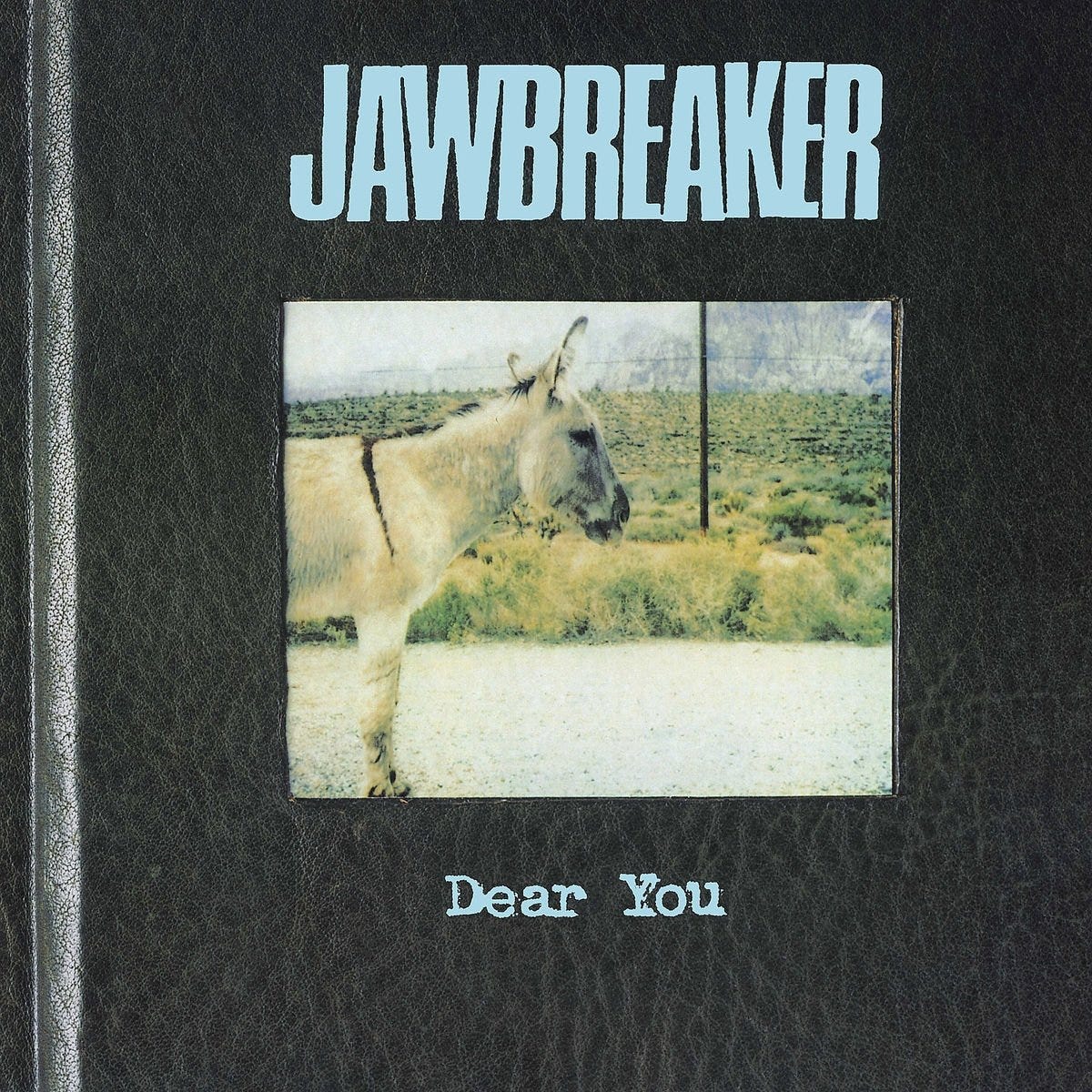
But it was also the early-mid 90s, and people were still drawing extremely Talmudic definitions of what constituted “selling out” or not. Jawbreaker happened to sign to DGC and release “Dear You” at exactly the wrong time, and the blowback was swift—and wholly unfair.
If “Sluttering” is the tale of someone being done wrong (it is), Dear You is the story of a band being turned on by its fans (also yes). For years, it was a dividing line amongst a fan base otherwise monolithic in their love for everything the band put out.
I didn’t buy this record right away. In fact, I waited some time before picking up the CD, and even then it was at a pawn shop in one of Portland’s suburbs. What a waste. The record is different from the previous three but no less excellent.
A garbage shot of the start of an amazing show. Photo by me.
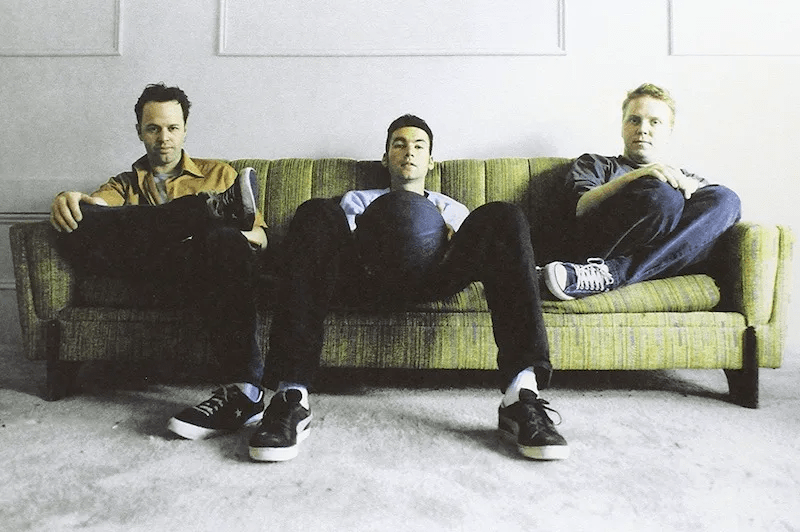
In the fallout, the band split up. They reunited for 2017’s Riot Fest, and I consider that show one of the best I’ve ever been to.
And for all the thrashing and wailing about “Dear You?” The setlist had quite a few tracks off the album, and the crowd never missed a beat.
More:
“The word ‘sluttering’ means a kind of drunk muttering,” he added. “I actually defined it once as ‘pontification under duress.’ There was an angry love triangle and then an elaborate revenge plot designed to incur maximum humiliation. It succeeded horribly and I wound up in the hospital in Concord.”







 Kevin Sent
Leave a comment