The Sugarcubes ‘Here Today…Tomorrow…Next Week!’ | What Could’ve Been, Would’ve Been…Should’ve Been!

The Best Record of 1989: Day 54: #51 The Sugarcubes, Here Today, Tomorrow, Next Week! vs. #78 3rd Bass, The Cactus Album

Good morning!

Today we’re taking a quick look at records from The Sugarcubes and 3rd Bass.


Note: As many of you know, I recently wrote about a Best Record of 1989 challenge and noted that I’d occasionally write some of these up.

I’ve started doing some quick hits of each matchup and posting them directly to the page. Some will be longer, some won’t, and some might just be a handful of sentences. There’ll probably definitely be some typos.

Check ’em out and let me know your thoughts! Chin wags & hot takes welcome! Sharing and restacks are always appreciated.

In case you missed any from earlier this week:

Camper Van Beethoven’s Key Lime Pie Record Is the Story of a Nation Crumbling Under Reagonomics

Was Blind Man’s Zoo the Last “Real” 10,000 Maniacs Record?

Is The Jesus and Mary Chain’s ‘Automatic’ a…Dance Record?

Note: Thoughts on tomorrow’s match are below.

KA—


You know those clips on YouTube where they isolate the bassline from a hit song, or Michael McDonald’s voice from “Peg?” Imagine something like that, but where you could edit out an element.

Now, picture using the audio equivalent of Control + F to find/delete everything related to Einar Örn’s vocals from The Sugarcubes’ Here Today, Tomorrow Next Week! You’d have a contender for record of the year, with fans split over whether it or Life’s Too Good is their best. I like Stick Around For Joy, but let’s be real—I might be alone on that.

Here Today, Tomorrow, Next Week! should’ve been the album where The Sugarcubes leveled up by doubling down on what made Life’s Too Good so memorable. Instead, they ran with the one element that worked because it was restrained and put it front and center. Imagine being the producer and hearing, “More Einar everywhere!” Yeesh.

On Life’s Too Good, Einar appeared in just the right doses, playing something of a foil to Björk—it worked, because it was contained. Here, the leash is off, and his constant interruptions drag down nearly every track.

I don’t mean to pile on here, but at the same time I kind of do—especially since his trumpet playing is one of the things I like most about this record. Why couldn’t he have focused on that instead? What’s with wanting to be the North Atlantic version of Fred Schneider?

Meanwhile, Björk is in fine form, throwing herself into these songs with a fury that hints at her later solo career. You hear her pushing her limits. Just when you think, Yes! Yes!—Einar bursts in with more yelped nonsense, and all bets are off.

Musically, there’s a lean, angular energy, with tight, new wave-adjacent grooves and just enough pop sparkle to keep things moving. The horn sections shine, especially on songs like “Tidal Wave.” The rhythm section is locked in, pushing things forward nicely. It makes you want to like this record more than you do. Which again begs the question—why not steer Einar toward his strengths?

Back to YouTube: imagine you’ve erased Einar’s vocals and are listening to the improved version. The sound has evolved, and the grooves have more substance. It still tries to be a party record but is less about novelty and more about what the album could have been.

That’s the rub. The record succeeds in many areas: Björk shines, and the band delivers. So what happened? Did Einar have outsized sway, or did everyone agree? It feels self-sabotaging.

The other fault is that it drags on too long. It feels longer than Life’s Too Good, despite actually being shorter. Someone should’ve made the unilateral decision to cut “Hot Meat,” which feels like a Temu version of “Cold Sweat.”

Here Today…is a record that comes so close, but with Einar’s overwhelming presence, it ultimately misses the mark. Still, if you lean in close, you can hear real gold. Here Today, Tomorrow, Next Week! is the band at a crossroads, unsure of what to keep or cut.

Sometimes it works—but more often, it’s just exhausting.


For the third Bass, I had to phone a friend. I had a feeling that we liked a couple of tracks, but otherwise, we spent most of our time pointing and laughing at MC Serch and Pete Nice. Turns out my memory failed me (quelle surprise!). My buddy texted back within minutes, saying, “The Cactus Album is a Classic.”

Okay, so that’s sorted then.

Listening to the record, I’m surprised at how well it’s held up and the creativity of the samples used. I wasn’t expecting a Blood Sweat and Tears track sample here, but it’s also possible I memory-holed it like everything else. I did remember “Gas Face,” and it’s as fun now as it was then. Does 50-year-old me find the same appeal that teenage me did? Apparently, yes. Same story with “Steppin’ to the AM” (home of the sample mentioned above). Do two tracks a record make? No, but this was a nice enough way to soundtrack part of my shift at work.

My vote: Took the easy out here, and went with The Sugarcubes. For all its faults, this is still a Sugarcubes record and Björk’s on it. That’s some gravitational pull. Also, another example of the performative voting we’ve seen previously (and will see again).

Ask yourself: Who’s cooler: Bjork or MC Serch? Exactly.

Any thoughts on either of these records? Agree/disagree with my takes? Which one of these would you vote for? Sound off in the comments!

Check out the full bracket here.

Info on the tourney, voting, and more is here.

As always, thanks for being here.

KA—

P.S. Tomorrow’s Match Up features #19 Neneh Cherry’s Raw Like Sushi taking on #110 Don Henley’s End of the Innocence.

One I’d never heard before now, and one I’m ambivalent (at best) towards. Decided to punt on this one and give myself a pass on writing it up. My bracket pick and vote will both be going to Neneh Cherry.

Camper Van Beethoven’s Key Lime Pie Record Is the Story of a Nation Crumbling Under Reagonomics

The Best Record of 1989 Day 51: #30 Camper Van Beethoven, Key Lime Pie vs. #99 Ice-T, The Iceberg/Freedom of Speech… Just Watch What You Say!

I am incredibly photogenic.

Good morning!

Today we’re taking a quick look at records from Camper Van Beethoven and Ice-T


Growing up, one of the guys on my block lived in a house with a basement. You have to understand that this was relatively unusual in Oregon. You also need to know that it had its own entry, separate from the rest of the house, which, of course, meant it was the default place for all of us to hang out.

All well and good, except that my friend also played guitar. Yeah, that guy. We all know one. Worse, he’d often play it to impress girls on the rare occasion they stopped by. This is how I first heard Camper Van Beethoven’s cover of “Pictures of Matchstick Men.” Not a strong start, but for better or worse, this was the band for me growing up.

This record was also the sound of Camper Van Beethoven growing up—not gracefully, exactly, but white-knuckling it through the end of the 80s like the rest of us. If Our Beloved Revolutionary Sweetheart was the band getting serious, Key Lime Pie is them getting mean; not in a cruel way, but with the kind of sardonic clarity that only comes after you’ve watched the Reaganomics tear apart the American Dream brick by brick.

By 1989, the band was peeling away their own layers. Jonathan Segel was gone. David Lowery had taken the wheel, and the group’s weirdness started to harden into something leaner and a bit darker. The violin remained, but now it ached. The jokes hadn’t vanished, but now, they came with shadows instead of a wink and a nudge. Irony no longer softened the blow; it was the hammer delivering it.

But that’s what makes this record the gem it is. Say what you will about this style shift, but Key Lime Pie is an honest, beautiful, and impossibly human album. The songs aren’t necessarily sad in the normal sense—they’re quietly devastating. It may take a few years and the benefit of hindsight to realize.

Listening feels like looking directly into the souls of people on edge, or even standing at the edge. It can be humbling, and it’s quite a counter to the demanding style of patriotism that was so in vogue.


Musically, Key Lime Pie is a masterclass in restraint. It’s still unmistakably them—strange little chord changes, unexpected melodic sidequests, and eerie violins—but it’s more grounded. Michael Urbano’s drumming is the most conventional thing on the whole record, giving the songs the structure they need. Pedal steel threads through tracks, especially on “Borderline” (my personal favorite) and “Sweethearts.”

And before I forget, the run from “Sweethearts” through “Borderline” is one of the strongest 4-track runs going.

The band sounds tighter, but not sanitized. They’ve ditched the genre-hopping of earlier albums and focused the chaos into something more purposeful. There’s Americana here, but it’s postmodern Americana.


Lyrically, Lowery is at his best here. There’s less snark, more ache. “Sweethearts” paints Ronald Reagan as a puppet for state-sponsored violence and capitalism, but it’s delivered with enough subtlety that you almost miss it.

“When I Win the Lottery” may be the best song ever written about bitterness as a survival strategy. It’s funny, but not ha-ha funny. It’s incredible line-level writing from the POV of someone like the guy at the end of your local bar; the one who’s seen some things.

The whole album walks the line between love and futility, beauty and decay, hope and despair—nihilism. This is a portrait of a broken America song by characters who’ve watched the American Dream collapse under its own weight.


It’s a record about America, sure. But more than that, it’s about people navigating what America does to you. People leaving, people drinking, people stuck in laundromats or backwater towns with only Swap Shop or gospel on the radio. People literally and figuratively stuck on the side of the road. Still, it’s the most empathetic album they ever made (we can use that, too). It doesn’t punch down; instead, it meets its characters where they are.

Despite my less-than-auspicious onramp to the band, this album has never really left my rotation. Very rarely do I play it and not find something new.

You can call it alt-rock, Americana (maybe), or whatever you want—it’s eclectic enough that pretty much anything will fit. But again, it’s just one of the most human records of the year. That sort of thing never goes out of style. It’s always relevant.

Gather ‘round, kids: It’s time to tell you the story of who Fin Tutuola used to be.

Shame that an entire generation only knows Ice-T from his portrayal of a cop on Law & Order. How odd it is to remember that the same guy now flashing a badge used to flout—and run afoul of—the law. This is, after all, a guy who was also almost arrested in Georgia for the high crime of swearing onstage. Such was the climate at the time. It’s all enough to catch a case of the vapors.

In 1989, Ice-T was still a rapper who put hot girls and guns on his covers. He sang songs about power, and how it started “with P like p***sy.” He swore. A lot.

Meanwhile, the Parents Music Resource Center was busy being busybodies and decided that someone should think of the children! Think Maude Flanders but with Congress’s ear. Ice-T made the perfect target. He rapped about all the things supposedly tearing this country apart, and he was popular.

Ice=T wasn’t about to give an inch, and if you were to condense a review of The Iceberg/Freedom of Speech…Just Watch What You Say down to a line or two, it’s that he made a whole-ass record doing just that. It was a baker’s dozen worth of tracks, and all of them were a raised middle finger to anyone with the audacity to decide what was best for anyone.

You can have your endless reruns of Law & Order SVU; I prefer this version of Ice-T.


My vote: Ice-T fought hard against Tipper Gore and co., but he’s no match for David Lowery. It’s Key Lime Pie all day for me.

Any thoughts on either of these records? Agree/disagree with my takes? Which one of these would you vote for? Sound off in the comments!

Check out the full bracket here.

Info on the tourney, voting, and more is here.

As always, thanks for being here.

KA—

Queen Latifah Shows She’s Here to Stay, and Violent Femmes Show They Never Left

The Best Record of 1989 Day 50: #62 Violent Femmes, 3 vs. #67 Queen Latifah, All Hail the Queen

Good morning!

Today we’re taking a quick look at records from Violent Femmes & Queen Latifah

Note: As many of you know, I recently wrote about a Best Record of 1989 challenge and noted that I’d occasionally write some of these up.

I’ve started doing some quick hits of each matchup and posting them directly to the page. Some will be longer, some won’t, and some might just be a handful of sentences. There’ll probably definitely be some typos.

Check ’em out and let me know your thoughts! Chin wags and hot takes are welcome! Sharing and restacks are always appreciated.

In case you missed any from earlier this week:

Day 46: The The’s Mind Bomb vs. the Record Matt Johnson Should’ve Made

Day 47: Grebo vs. Folk? 1989 Truly Had Something For Everyone

Day 48: Fast Jangle Pop Meets Fast…Everything

Day 49: Hey Buddy, Come Anytime

KA—


The pitch: After three years, the Femmes got back together and got back to basics. As good as Hallowed Ground and The Blind Leading the Naked may be, this is a band at its best when it’s stripped down to its core parts. Brian Ritchie’s bass, a quiet beat, and whatever of Gordon Gano’s neuroses he feels like talking about today.

3 (actually the band’s fourth record) starts strong with “Nightmares” and “Just Like My Father.” Deserved or not, Gano always seems like the type of guy we’ll hear about on the 6 o’clock news, invariably with a neighbor describing him as “…nice guy, kept mostly to himself.” Part of that is down to his habit of writing/singing songs from the perspective of some people with, well, some issues. The 1-2 punch of the first two tracks won’t do anything to disabuse people of those notions.

That theme keeps right on going on “World We’re Living In,” with Gano singing:

I can’t go out no more
I just better stay at home
I just better stay all alone
’cause what am I gonna do
if I see someone I’d like to do
something to

“Fool in the Full Moon” might just be the closest thing to a rock song the Femmes ever put to tape. But the rest of it is what most people would come to expect from the band: Gano’s nasally vocals, a mildly chaotic racket, and lyrics that’ll have you singing along until you realize what’s coming out of your mouth.

3 is a fun, enjoyable record. It isn’t quite up to the level of their band’s self-titled classic or even the maudlin atmosphere of Hallowed Ground, but it let everyone know the band was back, and that was enough.


I’ve mentioned it before, but the first time I heard Queen Latifah’s “Dance For Me,” it was thundering out of my friend Kiki’s Honda as he took the corner onto our block at an impossibly high rate of speed.

With A Tribe Called Quest and Jungle Brothers having already dropped releases, it only made sense that another member of the Native Tongues crew would come out, and it was never going to be anyone else but Queen Latifah. And that opening track put everyone on notice that she wasn’t going anywhere.

I’m sure the way I found the record has something to do with it, but to my ear, this LP had an urgency to it. DJ Mark the 45 King put his unique stamp on much of the record, diving deep into the crates, corralling some unruly sounds and reforming them as dance-floor fillers.

This was also the era when MCs became infatuated with house music—sometimes with mixed results. All Hail the Queen is no exception with “Come into My House.” A solid if unremarkable track. And it wouldn’t be a 1989 record without some friends coming along for the ride. Fellow Native Tongues De la Soul are here (“Mama Gave Birth to the Soul Children”) as is KRS-One (“Evil That Men Do”).

The former has something like 14 samples in it-everyone from Otis Redding to Billy Squier. When I said Mark the 45 King dug deep, I wasn’t kidding.

As a whole, All Hail the Queen is solid, but standouts like “Dance For Me” carry a lot of the weight, and trimming a couple of tracks would’ve elevated this from good to great.


My vote: I’m a fan of the Femmes, and the fact that they’re from Milwaukee scores some points for them. Both records are good, neither is great. I went with a nod to my old neighborhood for the tiebreaker, and threw my vote to the woman known to the New Jersey DMV as Dana Owens.

Any thoughts on either of these records? Agree/disagree with my takes? Which one of these would you vote for? Sound off in the comments!
Check out the full bracket here.

Info on the tourney, voting, and more is here.

As always, thanks for being here.

KA—

Hey Buddy, Come Anytime

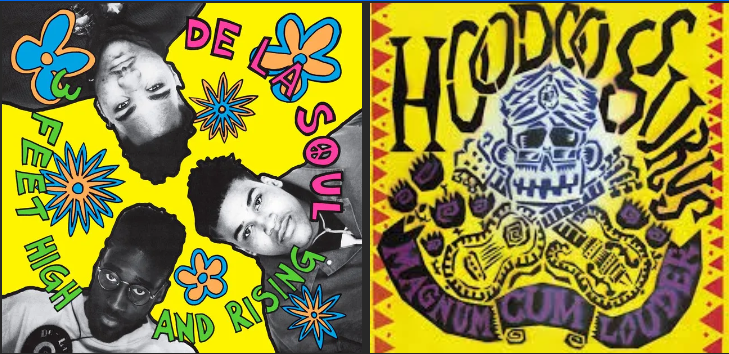
The Best Record of 1989: Day 49: #3 De La Soul, 3 Feet High and Rising vs. #126 Hoodoo Gurus, Magnum Cum Louder

Good morning!

Today we’re taking a quick look at records from De La Soul and Hoodoo Gurus


I should be mad at De La Soul—or at least annoyed. I have a particular distaste for the skits that litter so many hip-hop records, which can be traced back to the band’s 1989 record, 3 Feet High and Rising. That said, while those were often used as filler on other releases, they have a certain charm on this record. I’m still not sold on the idea, but they’re at least tolerable. If nothing else, they’re not distracting from the overall product.

Okay, so that’s the bad part out of the way. Now let’s talk about the good. We can talk about Prince Paul’s touch and how he helped sculpt this into something nothing like what we’d heard before. This and Paul’s Boutique ushered in a new era of layering samples like a collage. Now, instead of an MC and a breakbeat, we had soundscapes. Both of these records influenced countless crews that followed. Why one was a hit out of the blocks and took years to get its due is worth its own discussion.

We can talk about the stylings of Posdnous and Trugoy’s flow and the insistence on bringing concepts like peace and harmony back into the collective discussion. Maybe carve out some time to remember how fun “Me, Myself, and I” felt when it dropped. Posse cuts were de rigueur then, and “Buddy” is one of the best. All of those things are true, and each of them matters.

In our Top 100 series, Sam had this slotted in at #77.

My take then was:

Looking back through admittedly fuzzy memory, in the mid-to-late 80s, everyone I knew had three hip-hop records: Beastie Boys’ License To Ill, Run DMC’s Raising Hell, and this. Only one has a Steely Dan sample, and only one sounds as good now as it did then. “This,” of course, would be 3 Feet High and Rising. It’s the summer of love with some 808, and I’m here for it.

I still am.


I lucked my way into a group of avowed music nerds in school. Finding and sharing new (or at least new to us) music became our raison d’être. This is how Hoodoo Gurus’ Magnum Cum Louder first got onto my radar.

I don’t recall this becoming an obsession with any of us, but instead falling into the “it’s got a couple of great songs” purgatory. Those lucky few wound up circulating on mixtapes, with the rest of the tracks confined to the dustbin of history.

If you’re of a certain age, you know the deal; you bought a record on the strength of a good song over two, and hoped for the best with regard to the rest of the album. In this case, I wouldn’t have felt bad being out $8.99 or whatever the list price was, but I was also happy with just having a copy.

In Magnum Cum Louder’s case, that one good song is “Come Anytime.” About a minute in, I realized I was playing it loud and singing along at equal volume (note: If we happened to have been sharing the ordeal yesterday afternoon, I’m sorry you had to hear that).

It’s as good as ever. The hook…the sing-along chorus…all of it. It does well to set the stage for what’s to come. The next couple of tracks (“Another World,” “Axegrinder”) are also pretty good, even if they don’t quite meet that same high bar. They’re nice enough, but feel like a small step down. Get to about track six and realize it’s more of the same. It’s a nice “same,” —” Shadow Me” and “All the Way” in particular— but a same nonetheless.

Magnum Cum Louder is, of course, a play on the term Magnum cum laude, which is a fancy way of adding a “better than average” rider to a degree or diploma. It seems aspirational here, especially when stacked up against the rest of the discography.

A few tweaks here and there might’ve earned it a legit shot at that distinction.


My vote: 3 Feet High and Rising changed the game. Magnum Cum Louder barely caused a ripple in my suburban friend group. It’d be a much tougher call if we were going on the strength of “Come Anytime” alone, but we’re not.

It’s the D.A.I.S.Y. Age for the win.

Any thoughts on either of these records? Agree/disagree with my takes? Which one of these would you vote for? Sound off in the comments!

Check out the full bracket here.

Info on the tourney, voting, and more is here.

As always, thanks for being here.

KA—

Jungle Brothers’ ‘Done By the Forces of Nature’ takes on a force of nature

The Best Record of 1989: Day 44: #90 Roy Orbison, Mystery Girl vs. #39 Jungle brothers, Done By the Forces of Nature

Good morning!

Today we’re taking a look at records from Roy Orbison and Jungle Brothers


Note: As many of you know, I recently wrote about a Best Record of 1989 challenge and noted that I’d occasionally write some of these up.

I’ve started doing some quick hits of each matchup and posting them directly to the page. Some will be longer, some won’t, and some might just be a handful of sentences. There’ll probably definitely be some typos.

Check ’em out and let me know your thoughts! Chin wags & hot takes welcome! Sharing and restacks are always appreciated.

KA—


Let’s talk about Jungle Brothers’ second album. Done by the Forces of Nature isn’t just their best—it’s their crowning achievement. IMO, it’s conscious rap’s finest hour.

Hyperbole? Maybe. But I’ve listened to a ton of albums over the years, and I can’t think of one this consistent from front to back—fifteen tracks, and not a single dud in the mix. No filler. No skits. No middling nonsense. Just bangers. It never gets boring. It never stalls out. It’s sonically rich and wide-ranging. Even the cover reminds me of a happier era.

Picking a pull track here is tough. If pushed, I’d go with “Sunshine” and the infectious “What U Waitin’ For?”. If you’re old enough to remember house parties, this’ll take you right back to being squished into the front room with everyone. And of course, this being made when it was, there’s a group track, featuring Q-Tip, Monie Love, Queen Latifah, and De La Soul. It’s pretty much the full roster of the Native Tongues crew just vibing.

The production is textbook; especially with regards to sampling. Sure, you’ll recognize the samples, but they’re chopped, layered, and flipped into something new. And is that a sample of Junior’s “Mama Used to Say” on “Days 2 Come?” You better believe it. Magic. This was back when producers were alchemists, not just playlist DJs with a loop pack and a laptop. The sample of People’s Choice’s “Do It Any Way You Wanna” on “What U Waitin’ For?” is (chef’s kiss). On a sidenote, this is also fuels Public Enemy’s equally fantastic “Shake Your Booty.”

Sound-wise, you’ve got a sizeable dose of funk, jazz, and—less common at the time—Afrobeat, which fits well with the album’s Afrocentric vibe. But here’s the deal: it never gets preachy or self-righteous. None of that aggressive posturing some so-called “conscious” acts fell into that just got exhausting after a few tracks. Jungle Brothers recognize that rest is resistance. It’s okay to cut loose once in a while! It’s grounded and positive in a way often missing in modern rap.

This is the record people are thinking of when they talk about conscious, alternative hip-hop. It’s the blueprint, but somehow, still underappreciated. Maybe even forgotten in some circles? I’m sure some of that is down to its (relative) unavailability, which is a shame.

If you’ve never heard it, fix that immediately (you can find it on YouTube). If you have—listen again. It’s even better than you remember.


Until now, the only track I’d heard from Roy Orbison’s Mystery Girl was the hit “You Got It,” which seemed everywhere back in the day. With his operatic voice, Orbison has always seemed out of place in the world of rock. That’s not to say his voice is not stunning, only that he’s a square peg trying to fit in a round hole. He’s unique; I’ll give him that.

Mystery Girl was a comeback record in every sense of the word. After 10 years and a run of not-so-great releases, he put out what would be one of his best records. Unfortunately, it would also be the last one recorded while he was alive. Released posthumously, it was finished just a month or so before he passed away.

At the risk of being crass, if you’re going out on a high note, this is the way to do it. I’m not all that familiar with Orbison’s body of work, but taken in isolation, Mystery Girl works. An armada of talent put this together, including (at least) Jeff Lynne, Tom Petty, and the more famous half of U2. Bono and The Edge wrote “She’s A Mystery to Me” for Orbsion, and Bono produced the song.

With a roster like this, there’s always a risk of an album coming across as disjointed, but listening, I’m surprised at how consistent it sounds. There’s no shortage of sheen here—it’s a Jeff Lynne record, after all—but it doesn’t detract from things. The horns on songs like “The Only One” give it a nice Memphis sound.

Overall, it feels like the epitome of an Orbison record. Too bad he never got to see everyone enjoying it.


My vote: Orbison went out on a high note, but Done By The Forces of Nature is a force of nature. By bracket pick and vote are going to Jungle Brothers.

Any thoughts on either of these records? Agree/disagree with my takes? Which one of these would you vote for? Sound off in the comments!

Check out the full bracket here.

Info on the tourney, voting, and more is here.

As always, thanks for being here.

Today’s Matchup: Music With a Message Takes on A Feel Good Record

The Best Record of 1989: Day 42: #58 Boogie Down Productions, Ghetto Music: The Blueprint of Hip Hop vs #71Young MC, Stone Cold Rhymin’

Good morning!

Today we’re taking a look at records from BDP and Young MC


Note: As many of you know, I recently wrote about a Best Record of 1989 challenge and noted that I’d occasionally write some of these up.

I’ve started doing some quick hits of each matchup and posting them directly to the page. Some will be longer, some won’t, and some might just be a handful of sentences. There’ll probably definitely be some typos.

Check ’em out and let me know your thoughts! Chin wags & hot takes welcome! Sharing and restacks are always appreciated.

KA—


BDP—and, by extension, KRS-One—have always been lost on me. I have been much more interested in his role as a sort of hip-hop ambassador emeritus and the work he’s done in/for the community than I have in his work as an MC. This is not an indictment of his talent but a testament to where I was in life when he hit.

In 1989, things like “conscious rap” and a return to core principles weren’t on my radar. Sure, I’d take all the boom bap you could give me, but I was more into the beats (and bass) than anything else. Lessons and teachable moments? No thanks. And let’s be honest; as a teenager, hearing rhymes about “bitches” and light crimes was probably more thrilling than anything that would have opened my mind or raised my consciousness. I’m not saying that was cool; I’m just saying that’s how it was.

All that aside, there was a TON of hip hop to pick from in ‘89. We’ve already seen records from LL Cool J, The D.O.C., NWA, Biz Markie, Beastie Boys, with more on the way. No one was left wanting, regardless of what you were looking for in an MC or crew.

So while I was off misspending my youth, KRS-One was spreading a message to anyone ready to hear it. After the landmark Criminal Minded and By All Means Necessary, BDP came back for its third record in as many years: Ghetto Music: The Blueprint Of Hip-Hop.

The record has a dancehall/reggae flavor, reinforced through the samples used and lyrical cadence. Those easy rhythms support some harsh truths and real talk as KRS-One and co. take on all comers. No one’s safe; sucka MCs… crooked cops…you name it. The theme here is peace through strength. To achieve anything worthwhile, you must be willing to fight for it. “World Peace” throws an exclamation point on that, with wit, a deceivingly soulful beat, and a good dose of horns, oh, and a refrain of:

If we really want world peace
And we want it right now
We must make up our minds to take.. it..

That message was on time in ‘89 and is particularly relevant today. I might’ve passed on BDP back in the day, but Ghetto Music: The Blueprint Of Hip-Hop is too important to leave on the shelf.


The easy line here would be to note that Young MC had a massive hit with “Bust a Move,” and that was that. We could also talk about the chatter calling him an industry plant and grumble about his doing ads for Taco Bell and Pepsi. Doing ads might raise hackles, but they make financial sense. And who better in the game to pencil that out than someone with a (checks notes) economics degree from USC? WTF? Wasn’t everyone in ‘89 trying to talk about how street they were?

Maybe, but is it better to have one massive hit or a string of tracks the heads deem essential? One acts as a de facto annuity, and one gets you…props.

Depending on the criteria, Marvin “Young MC” Young had more than one hit to his name, helping pen some hit tracks for Tone Loc you might have heard. Even on this record, there were no less than six singles. I’ll be damed if I can remember more than two of them (“Principal’s Office” was also pretty good).

And the truth is, Stone Cold Rhymin is pretty good too. Some of the bars sound dated, as does the flow, but I’m listening to this as I type, and the overarching sentiment is one of surprise and mild delight. This isn’t half bad! Reading the liner notes, it looks like our man also had plenty of help; Mario “Mario C” Caldato Jr. is in the mix. Flea shows up. Wild. N’Dea Davenport of labelmates Brand New Heavies appears on “I Come Off.” There’s a lot more here than just the refrain of “if you want it, you got it, “ and a girl in yellow dancing on Arsenio Hall.

As much as I love that song (yes, really!), listening to it today, I’d dare say it’s not even the second or third best track on the record. The title goes to “Know How.” Young gets some help from the Dust Brothers, and using a sample from Shaft and the infamous Apache drum break, they deliver an absolute Banger.

Say what you will about Young MC, but he deserves credit for putting together a feel-good record that never tried to pretend it was anything different.


My vote: One of these records reinforced my (preconceived) notions about it, while the other demolished similar thoughts. BDP is good, carries a worthwhile message, and still just isn’t my bag. It is what it is. Young MC, meanwhile, put out a record far better than I remember/would‘ve given him credit for. I never owned either, but I am a little bummed it took me almost 40 years to dig into Stone Cold Rhymin’.

In sum, you’ve got some music with a message and a feel-good record. I have a feeling this is one match where people will vote for what they perceive as the more ‘real” record. Using that metric, BDP is the winner hands down, and my bracket reflects it.

Any thoughts on either of these records? Agree/disagree with my takes? Which one of these would you vote for? Sound off in the comments!

Check out the full bracket here.

Info on the tourney, voting, and more is here.

As always, thanks for being here.

KA—

The Best Record of 1989: Day 40

#47 Kristy MacColl, Kite vs. #82 Gang Starr, No More Mr. Nice Guy

Good morning!

Today we’re taking a look at records from Kristy MacColl and Gang Starr.


Note: As many of you know, I recently wrote about a Best Record of 1989 challenge and noted that I’d be occasionally writing some of these up.

I’ve started doing some quick hits of each matchup and posting them directly to the page. Some will be longer, some won’t, and some might just be a handful of sentences. There’ll probably definitely be some typos.

In case you missed any from earlier this week:

Day 36: #34 Bonnie Raitt, Nick of Time vs. #95 The Field Mice, Snowball

Day 37: #15 Madonna, Like a Prayer vs. #114 Peter Murphy, Deep

Day 38: #50 Lyle Lovett, Lyle Lovett and his Large Band vs. EPMD, Unfinished Business

Day 39: #18 Kate Bush, The Sensual World vs. #111 The Wonder Stuff, Hup

Check ’em out and let me know your thoughts! Chin wags & hot takes welcome! Sharing and restacks are always appreciated.

KA—


I first found Kristy MacColl, as I suspect many others have, through the “Fairytales of New York” song she did with The Pogues. Today, it seems the consensus pick for favorite Christmas song among hipsters. It’s one of those songs that’s somehow everyone’s favorite, that you’re just expected to like. I find it interminable. And for a long time, I used that as an excuse not to delve any further into her work. Silly me.

Other than that, all I really knew was that she did “They Don’t Know,” a lovely bit of sugary pop that was covered by Tracey Ullman. This is a small bit of trivia that has yet to come in handy. And did you know Tracey Ullman had her own show that featured recurring interstitial animation skits about a family named The Simpsons? I’m incredibly fun at parties and Bar Mitzvahs.

Back to Kite: MacColl was the daughter of folk singer Ewan MacColl, who, by most accounts, sounds like an asshole and may be why she steered her own career toward a poppier sound. Refusing to be pigeonhole (or molded) into whatever label execs thought a pop star should be, her career floundered a bit. She found a niche performing on other people’s records (see above) while still chugging along in her own career. Kite is her sophomore outing, released 8 years after 1981’s Desperate Characters (see above again). I should tell you now that I brought every preconceived notion I had to the party. I was expecting a record that alternated between dirges and folk songs.

And holy shit was I wrong! Sure, there are strains of folk here and there, but this record is …dare I say, jaunty? Opener “Innocence” was a delight and will be on a few playlists going forward. “Mother’s Ruin” slows the tempo, but is in no way a downer. There’s a Kinks cover (“Days”)!

Maybe more importantly, while it does concede that she’s good at singing other people’s work, often at the expense of her own, it also gives her a chance to showcase her own chops. MacColl can, in fact, write a helluva song.

There’s some overproduction here and there—then husband Steve Lillywhite was behind the boards, and I wonder if he was aiming to make this as accessible as possible (i.e., hoping to help his wife find commercial success). Not every edge has to always be sanded off, you know, but after a listen or two, I’ve decided that’s a feature, not a bug. I’m obviously late to the party, but Kite has proven to be a nice surprise.


Ask five people to name their favorite Gang Starr record, and you’ll get six opinions. Odds are also good that No More Mr. Nice Guy won’t be one of ‘em. It’s not that it’s a bad record, it’s that the others are soooo good. Dj Premier and Guru have rightfully earned a spot in any GOAT discussion, but in 1989, they still weren’t on the map. 

If nothing else, this record feels ”new,” like everyone‘s still new to the game and each other. They’re all feeling each other out and finding their levels. There’s a lot of first-day energy here, right down to the lyrics that feel kinda boilerplate.

Mark the 45 King is here, and his signature sound colors a couple of tracks. On the one hand, that‘s a good thing. On the other hand, it immediately took my mind to all the different tracks he was on at the time. Gang Starr’s unique style is what made them what they are. That’ll come in time, but it isn’t fully formed here.

I’m mindful that retroactively comparing this to their later records isn’t fair. Again, this is a solid record, especially for 1989—it’s just not on the level of what was to come.

Track picks: “Gotch U,” “2 Steps Ahead”


My vote: At the risk of undercutting literally every point I made above, my vote goes to Gang Starr. RIP Guru.

Any thoughts on either of these records? Agree/disagree with my takes? Which one of these would you vote for? Sound off in the comments!

Check out the full brackethere.

Info on the tourney, voting, and more is here.

As always, thanks for being here.

KA—

The Best Record of 1989: Day 38

#50 Lyle Lovett, Lyle Lovett and his Large Band vs. EPMD, Unfinished Business

Good morning!

Today we’re taking a look at records from EPMD and Lyle Lovett


Note: As many of you know, I recently wrote about a Best Record of 1989 challenge and noted that I’d be occasionally writing some of these up.

I’ve started doing some quick hits of each matchup and posting them directly to the page. Some will be longer, some won’t, and some might just be a handful of sentences. There’ll probably definitely be some typos.

Check ’em out and let me know your thoughts! Chin wags & hot takes welcome! Sharing and restacks are always appreciated.

KA—


If EPMD’s 1988 debut, Strictly Business, put the duo on the map, its follow-up, Unfinished Business, cemented their spot. The record is an incredible sophomore outing. Hip-hop back in the day had more weight: chunkier beats, rugged samples, and more bounce to the ounce (sorry, not sorry). The beats came out of the trunk like a left hook, except this was one you didn’t want to duck for.

That’s not to say that the duo of Erick Sermon and Parrish Smith don’t have flow- the pair has bars for days. But they lay down that flow over some industrial-grade beats. There’s fewer moving parts. Less is more. Things pop off with “So Wat Cha Sayin'” a bruising 5 minutes of funk with the infectious sampling of BT Express’ “If It Don’t Turn You On (You Oughta Leave it Alone), layered over some drums from Soul II Soul of all people. Knick Knack Paddy Whack has a sample you’ll likely recognize. Try and see. Those samples and scratches are courtesy of George “DJ Scratch” Spivey, and his work on the 1s and 2s should not be overlooked here.

That flow might be their superpower. The two play off one another like two friends on a patio or sitting at a picnic table on their work break. They’re puttin’ in work, but it never feels labored (FWIW, I think P is better technically, while E has better flow per se.).

That’s not to say Unfinished Business is a no-skip record—you can feel confident in skipping “It’s Time 2 Party” and “You Had Too Much to Drink—but the good far outweighs the bad. Sermon and Smith are all business, and on this record, business was good.


I’ve never quite been able to read Lyle Lovett. Is he country? Something else? And how exactly did he and Julia Roberts wind up together? Lucky him.

That he’s never quite ascended to A-list stardom means that most audiences (and A&R reps and programming directors) were also stumped. But for those that get it, his records are a treat.

I hadn’t heard this one before, and if I’m honest, I wasn’t ready for the bluesy/jazzy/band-y flavor here. It’s good, just not what I thought would be on order. On brand for the man, I suppose. For example, I did not have “Here I Am” with its monologue in the middle on my bingo card. Nor was there a spot for a straight-faced cover of Tammy Wynette’s ” Stand by Your Man.” Yet here we are.

This record is light years from what I was playing in ’89, but listening now, it’s pleasant (not derogatory). I can easily see myself giving this a spin over brunch or on one of those rare days when I get to lie on the couch with Gizmo and stare out the window. It feels like Lovett came to terms with not being a “star,” embraced it, and made the record he wanted to make. Lucky us.


My vote: My heart (vote) says EPMD. My head (bracket pick) has me sayin’ Lyle Lovett.

Any thoughts on either of these records? Agree/disagree with my takes? Which one of these would you vote for? Sound off in the comments!

Check out the full bracket here.

Info on the tourney, voting, and more is here.

As always, thanks for being here.

KA—

The Best Record of 1989: Day 33

2 Beastie Boys, Paul’s Boutique vs. #127 Cardiacs, On Land and in the Sea

Good morning!

Today we’re taking a look at records from Beastie Boys and Cardiacs


Note: As many of you know, I recently wrote about a Best Record of 1989 challenge and noted that I’d be occasionally writing some of these up.

I’ve started doing some quick hits of each matchup and posting them directly to the page. Some will be longer, some won’t, and some might just be a handful of sentences. There’ll probably definitely be some typos.

Check ’em out and let me know your thoughts! Chin wags & hot takes welcome! Sharing and restacks are always appreciated.

KA—


Last fall, Sam Colt and I took on the absurd fun idea of writing up our respective Top 100 lists. We started at 100, and over several weeks worked out way to the top. I’ll say only this; Paul’s Boutique made it’s appearance pretty late in the game. Felt strange trying to describe what is best described as the band’s magnum opus, but below is/was my attempt.

Around the time this came out, a guy was something of an extra in the movie of my life. He was a DJ, and I’d see him everywhere. Tower Records, house parties, on the street; you name it. I lived in a suburb, but it wasn’t that small. He would refer to himself as “{your] hip hop connection” and hand us a business card, which I guess was the late 80s way of building a brand. I dunno. But he was really good at turning people on to new records. One of them was Paul’s Boutique.

Running into him on the street, he was evangelical about the record, almost begging us to buy it and see for ourselves. I did…and was promptly disappointed. In hindsight, I should‘ve known a DJ would talk up a record built on samples- so many, in fact, that a lot of them are almost unrecognizable. But I was expecting/half hoping for a License to Ill PT II. That, of course, wasn’t going to happen. Time and the band had moved on.

What we got instead was nothing the world had ever seen. MCA hadn’t yet gone full monk, but he was already cooler than a cucumber in a bowl of hot sauce. Tracks like “Shake Your Rump” show Ad-Rock and Mike D largely dropping the frat boy bit but none of their swagger. For anyone looking for “Brass Monkey” or a similar ditty about chasing girls, “Hey Ladies” will have to do. “Sounds of Science” is still a banger. “Looking Down The Barrel of a Gun” feels like an homage to the Cookie Puss days. This is a hip-hop record, but they were a band first.

It took me a while, but I came around to his record. Several months later, I was at a party where my DJ friend was spinning wax. He played “Sounds of Science,” and the place came alive. Later that night, we were outside smoking, and I told them I loved the record. “Man, I told you!” he said, “If you ever need a DJ, let me know,” pressing yet another business card into my hand.

Thirty-something years later, my son tagged along with me to our local record store. He liked rap and was looking for what would be his first vinyl buy. I sold him on Paul’s Boutique the same way I had been all those years—and miles—ago. He walked out the door with a copy.


If listening to Paul’s Boutique made me feel 10 times cooler, playing On Land and in the Sea did the opposite. I know there’s a whole world of fans out there that dig this sort of thing, but it just felt like a bit that would show up on an episode of The Young Ones. Something Vyv would love and something Mike the Cool Person wouldn’t touch. Rick would go predictably berserk, and Neil would say something out of pocket about carrots, or whatever. Hijinks ensue! Yawn.


My vote: Is there any question? A record that upended a whole genre for the better, or one that had me looking for some Anacin? Paul’s Boutique. All day.

Any thoughts on either of these records? Agree/disagree with my takes? Which one of these would you vote for? Sound off in the comments!

Check out the full brackethere.

Info on the tourney, voting, and more is here.

As always, thanks for being here.

KA—

The Best Record of 1989: Day 31

#21 Lou Reed, New York vs. #108 Tone Lōc, Lōc-ed After Dark

Good morning!

Today we’re taking a look at records from Lou Reed and Tone Loc.


Note: As many of you know, I recently wrote about a Best Record of 1989 challenge and noted that I’d be occasionally writing some of these up.

I’ve started doing some quick hits of each matchup and posting them directly to the page. Some will be longer, some won’t, and some might just be a handful of sentences. There’ll probably definitely be some typos.

Check ’em out and let me know your thoughts! Chin wags & hot takes welcome! Sharing and restacks are always appreciated.

KA—


By the time the late 80s rolled around, Lou Reed was on something of a downswing- I say this not with the backing of any empirical information, but rather the prevailing mindset of people in my circle and what I was hearing on the radio/MTV.

The Velvet Underground still carried emeritus status -and some people were into their records because that’s just what you were supposed to have in the crate. If your parents had a copy? That telegraphed a sense of coolness you couldn’t buy. But by 89, VU was something from the past. It would eventually become my fave record of his, but New Sensations (great!) had been followed with Mistrial (not so much).

Say what you will about Reed, but he’s certainly willing to transform himself and his style. If Mistrial was an attempt at creating a synthetic version, New York was about a return to basics–and nothing says “return to basics” like a record about your hometown.

New York in the 1980s was beset by socioeconomic ills—AIDs, crack, and more. The big apple was rotting, and Reed was right under the tree. He did the only thing he could—he wrote some of the best songs of his career.

It’s worth noting the irony that the same person who sang “Sister Ray” and “I’m Waiting for the Man” is penning polemics about the scourge of drugs. But times change, and people do, too.

The songs on New York are over-indexed on pop/rock. Reed has some things on his mind, and 1989 was not the time for a field trip into Metal Machine Music territory or whatever esoteric pursuits he might’ve wanted to follow. Instead, we get one of the most straightforward records in the catalog.

“There is no Time is a ripper” (that’s a sentence I never thought I’d type about a Reed song), and plenty of tracks come as close as Reed’s gonna get to pop as well. “Dirty Blvd.” is the story of a kid growing up in a hotel and wound up hitting #1 on the Billboard Modern Rock charts…and that might not even be the 2nd or 3rd best track on the record.

I’m mindful that many people rank Reed higher than they might otherwise because of his– and VU’s–status in the rock canon. Fair enough, but fair play to Reed- when he’s on, he’s on, and this is a helluva record.

Reed might have once been down, but he was never out—and neither was the city (or people) he sang about.


Whoever nominated Tone Loc’s Loc-ed After Dark must either have A: Been waxing nostalgic, or B: just returned from a cruise.

I vote for B since artists like Tone Loc always find a second life on such excursions. Your mom, dad, (or grandparents!) relive the wild parts of their youth while also wearing wristbands, entitling them to an endless buffet and bottomless drinks. No house party here. No pre-planning on which backyard fence to jump if need be. It’s a very curated sort of hedonism.

While Reed was writing about cities falling apart, Loc was penning tracks about clothes coming off and any other sort of tawdry thing you can imagine. Pop culture was full of big hair and small bikinis. Some of the biggest stars weren’t even people—they were dogs used to sell beer…and it worked.

This being 1989, outsized guitar riffs weren’t entirely out of style- indeed, they were just what many of us were still clamoring for, and a well-placed Van Halen riff propping up verses easy to sing along to when drunk made for a winning recipe, which makes the case for option B. Time sweetens all memories, and we remember the good parts of the parties, not the mornings after or the gouges on one ‘s leg that came from picking the wrong fence. Cruise lines, too, have figured this out, and these have become a cash grab, with just about any genre you want available on the high seas.

With the benefit of hindsight, Loc-ed After Dark is derivative. He’s got a unique voice…until you realize that so did the DOC (note: I’m not calling either out for WHY their voices are the way they are- only noting the similarities).

His flow is fine…until you remember that Rakim exists.

Ditto Slick Rick when it comes to the writing itself. Even the cover art pips Donald Byrd’s New Perspective album.

And there’s a bit of trans and/or homophobia worked in on “Funky Cold Medina,” because, of course, there is. I wonder if Nana and Papa will still sing along with that line on the main deck?

So what’s good about this record? For one, the sampling. The Dust Brothers are on the boards and brought a big-ass crate into the studio. “Funky Cold Medina” alone pulls from no less than six tracks. “Cutting Rhythms,” seven. And for the latter, the roster ranges from Steely Dan to Juice to Wings (!). Anytime you’re surprised and delighted by a sample is a good thing, and it’s a notch in the win column for Loc-ed After Dark, but it’s not enough to overcome the dated way the album sounds. It’s enough to make me want to miss my Joe Camel t-shirts.


Bottom Line: Both records represent the bipolar nature of 1989 well. It was truly a “best of times, worst of times” situation, and what side you were on depended on a lot of factors you likely had no control over. One record telegraphs that you were cool in a hipster sorta way in ’89, while the other says you were a lout. And for a lot of us, given how blurred those lines got, we were both. That said, one record holds up well in 2025, while the other feels like I’m watching a beer ad while clipping Marlboro Miles.

My vote: Start spreading the news; My vote and my bracket pick are going to Lou Reed’s New York.

Any thoughts on either of these records? Agree/disagree with my takes? Which one of these would you vote for? Sound off in the comments!

Check out the full bracket here.

Info on the tourney, voting, and more is here.

As always, thanks for being here.

KA—