For The Record- 20. December. 2025

Some thoughts on Christmas, JoJos, and cinnamon bears

Note: This first ran 2 years ago and quickly became one of the year’s most popular posts. It has been lightly updated & edited. Maybe it’ll become another recurring tradition for the newsletter? Perhaps it’ll become a holiday version of trying to make ‘fetch’ work? Time’ll tell!
KA—


This is a Christmas story. It’s also a story about Portland. Portland has always been quirky—from a sign with a deer on it to a store that gave free buzz cuts in the style of its owner (“and Gloria too!”) to a parade about roses. Mention ‘Psycho Safeway’ or say ‘Rip City!’ to someone outside of The Rose City and see how it goes.

Keep Portland weird? Oregonians have been doing that since day 1, long before it became performative or a sport. 

Every city had these sorts of things, I suppose. The kind of thing that transcends most demographics but is corralled within a few zip codes. A common ground that gets the diaspora to come out of the woodwork years later. It is a language 1000s share, but few outsiders get, like how the best Jojos come from gas stations. That is an absolutely true fact, btw. It’s science. And that statement reads like gibberish if you aren’t from the 503. 

This is a Portland story and one about Christmas. And quirks and traditions. 

It is the story of the Cinnamon Bear.

I grew up in a time when department stores still had flagship outlets in the middle of the city. Beautiful buildings with stunning facades and elegant insides that, even after their heyday, still made you feel fancy just walking through the door. There used to be a few of these downtown—stately matrons who watched over Pioneer Square—and the parking garage that was there before it. The Meier & Frank building was gorgeous, taking up an entire city block. During the holidays, no expense was spared in turning the place into a winter wonderland that looked like it was straight off the set of Miracle on 34th Street.

There was even an (admittedly sketchy) monorail that took you around Santa Land. The whole experience was magical enough that seeing Santa wasn’t even the best part.

It was the stuff childhood dreams are made of.

None of that was happening at Frederick and Nelson’s. 

There were decorations, but they felt lifeless and apathetic. Spartan, even. 

But they did have something not even the vaunted Meier & Frank could touch— the Cinnamon Bear.

All of that is well and good. But what matters here is that by the mid to late 70s, like the store itself, our man had seen better days. The costumes were a little more tattered, the eyes a little more wild. The cookies were still decent, though I’m sure that as a 7-year-old, my bar was low. 

After Lipman’s was bought by department store Frederick & Nelson in 1979, they kept the character and trotted him out for another decade, to the abject terror of some Portland children.

“Oh my god, I fucking hated that bear,” recalls Nico Bella, owner of downtown’s Spellbound Flowers. “He looked like a Sleestak [from Land of the Lost] to me, and I was terrified of those. It was in a doorway and came waving and walking towards me, and I started yelling, ‘No, no, NO!’ and wailing. I ran out screaming.”

(In addition to the Sleestak resemblance, some versions of the 1980s-era Cinnamon Bear suit look rather disturbingly like a Furry in blackface.)

It’s not like he was mean like the Santa in ‘A Christmas Story’ or a degenerate like in ‘Bad Santa.’ He was just… freakin’ weird. Sometimes, he was light brown. Sometimes, his eyes were exaggerated, rendering him an ursine George Hamilton. He didn’t even talk! How could we tell him what we wanted? And why would it matter, anyway? Santa’s the guy who delivered. Toys came from the North Pole, not Maybeland. Couldn’t we just go across the street, survive a spin on the monorail, and call it good?

Apparently not. Portland parents kept bringing their kids. Maybe out of tradition, maybe to buck tradition. Maybe spite. I don’t know, and I’m not sure it matters.

What I do know is this: when the holidays roll around, there are a bunch of Gen X’ers posting things like:
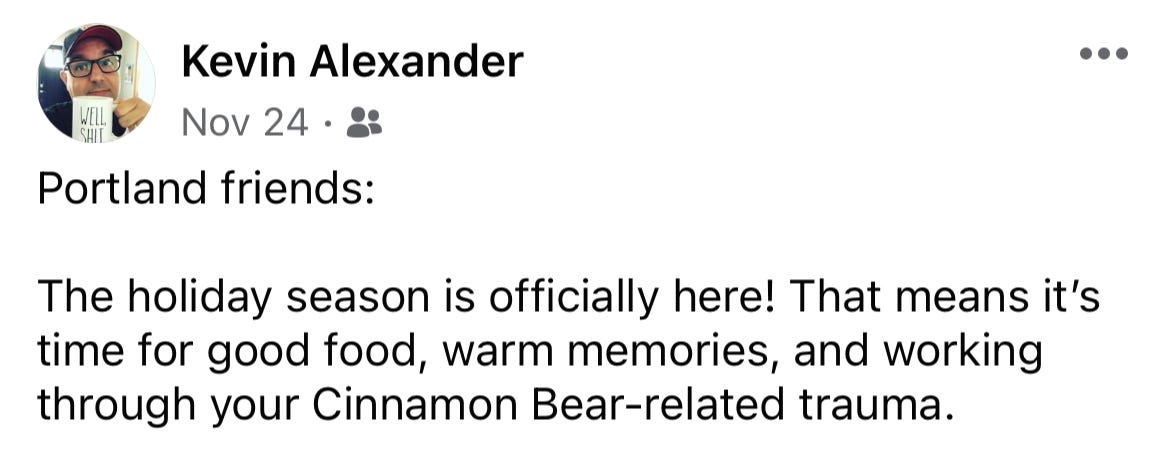
And sharing pictures that look like this:

Wherever this finds you over the next couple of weeks, and however you celebrate, I hope it’s a holiday season filled with laughter, music, and joy. 

And Jojos.

As always, thanks for being here.

KA—

Leave a comment

Not a Plane in the Sky

9/11-The day that changed everything

World Trade Center Memorial & Museum. Photo: www.donnagore.com

Good Morning!

Note: Last night I had the pleasure of seeing Garrett Graff speak. Graff is the author of several books, including The Only Plane in the Sky, a harrowing recount of 9/11 as told by those who were there. Below is mine. I originally wrote this to mark the 20th anniversary of that day. I’d like to think my writing style has changed a bit in the years since. My feelings about 9/11 have not. Thanks for letting me share this. We’ll be back to our regularly scheduled programming tomorrow.


September 11th was the day the evil came to the United States. It was the day that evil came to most people’s lives.

They didn’t think it existed. They came and it exists. And it was in our backyard.

~Mary Galligan, former head of FBI’s PENTTBOM team

It’s hard to believe that over 20 years have passed since that day. The actual events were over fairly quickly-just a few hours, really. But 9/11 was an inflection point for this country, and in a lot of ways it still hasn’t ended.

Aviation today is almost unrecognizable — if you’re old enough that 9/11 was a lived event, you’re old enough to remember not having to take off your shoes, and having friends meet you at the gate.

Another good way to “tell someone your age without telling them your age” is to have a plane fly overhead at low altitude. Anyone who was around that day will still reflexively look up.

Memories can be quirky. Quiz me about last week, and I’d be hard-pressed to answer. Ask me about 9/11, and I can tell you almost anything with amazing clarity. Not just the obvious parts, but much smaller details:

  • What the weather was like.
  • The sounds (or lack thereof).
  • How calm my commute to the airport was — I followed a white car over the Glenn Jackson bridge.
  • Snippets of conversations.
  • The tinny voice coming out of the AM dial in my work truck as I “guarded” grounded aircraft.

I’ve tried to write this story multiple times — the funny thing about 9/11 is that everyone wants to share “their” story — but I keep getting tripped up. It’s hard to do justice to something so profound, yet something we each experienced in our own unique way.

I hope that sentence reads better than I think it does.

The aviation community is extremely fraternal. Maybe second only to law enforcement. Everyone “knows a guy” at this carrier or that station. It may not have been our our paint on those 4 planes, but in an abstract way it still us, you know?

I was that kid who used to look up and stare at planes flying overhead. In a lot of ways, I still am. To realize that these machines had been turned into weapons of mass destruction was devastating. To wonder what those last minutes were like is more than I can bear.

Flights departing the East Coast were already in the air when the FAA decided to ground all air traffic. Those flights were diverted to the nearest available concrete. Flights inbound from Asia and Europe overwhelmed Canadian airports on both ends of the country.

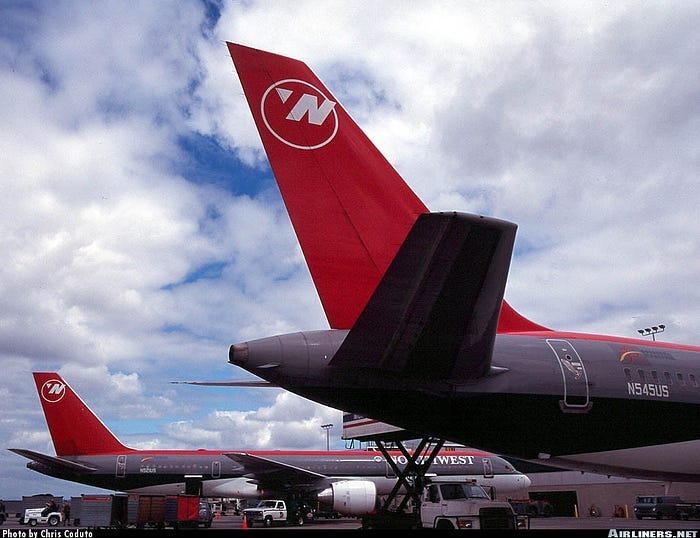
Where I spent 9/11/2001. Photo: Airliners.Net/Chris Coduto

Flights on the West Coast, where I was, had for the most part never left. Gates are usually full overnight, but rarely at midday. Yet there all the planes were, still tucked in from the night before.

The airport looked as if it had just overslept.

We had five planes on the ground. I was initially tasked with “guarding” one. Against what, I didn’t know. I also wasn’t armed or trained — before 9/11, the protocol was to accommodate a suspect’s demands as best you could — so I spent most of the day sitting on the hood of our station’s truck, smoking and listening to the radio. What else was I gonna do? I’ve since come to think this assignment was borne more out of a need to feel like we were doing something than anything else.

The people I worked with did not do helpless well.

As the afternoon moved into evening, we decided that playing sentry was pointless and regrouped to watch TV in our break room. We had a TV strapped to a cart like schools used to. Reception was dodgy, and developments came sporadically.

Meanwhile, our teletype printer never stopped. Looking back, I wish I would’ve saved some of those messages, but the paper fades after a few years, so it wouldn’t have done much good. Everything is ephemeral.

And everything with 9/11 is like a paradox. Recounting the day can be paralytic, and yet the words flow easily. I never really talk that much about 9/11, yet find myself writing too much, going off in every direction lest I dishonor the story by leaving some small part out.

The beautiful weather didn’t match the hellish events.

Airports were quiet.

Traffic calm.

Being high on adrenaline and drained all at once.

A few weeks ago, my state’s newspaper called for submissions. Readers were asked to send in their memories. Posts were to be capped at 250 words. At first, those guardrails seemed like a constraint. In the end, they were freeing.

I did what I could. I think I managed okay. The words below are my submission. This is my story.


I work for an airline. In 2001, I was a new crew chief working the night shift in Portland, Oregon. I was sleeping when our phone started ringing off the hook. Our friends back east were already seeing the horror show unfold. They woke us up just in time to watch the second plane hit, and our lives forever changed.

I was called into work early that day to “guard” our planes; an absurd request, given that none of us were armed, and our training at the time was to accommodate the demands of any threat (much like the flight crews on that day). All of that would change shortly.

In the meantime, I spent most of Tuesday, September 11th, 2001, sitting on the hood of our station’s 20-year-old truck listening to ABC News on AM radio.

People will tell you that it was beautiful that day, and it was. It was sunny in NYC and clear and a million on the West Coast. It was quiet, too; no noise on an airfield is both rare and disconcerting.

Late that night, we were still glued to our break room TV. The graveyard supervisor came in and wondered why we weren’t working. He’d left his previous shift in an ordinary world, slept all day, and returned that night to one that was now unrecognizable to any of us.

One guy wordlessly pointed at the TV. He took a seat and watched with us all.


Wherever the day finds you, I hope the weather is as beautiful as it was that Tuesday morning in 2001.

And please spare a second for the flight crews who fought so valiantly for us before we knew anything was wrong.

Thanks for being here,

Kevin—

Leave a comment

09.July.2021

Flying over Key West in early 2020. Photo by me.


“Be less curious about people and more curious about ideas.” 

— Marie Curie 

When I was a kid, my dad traveled often for business. He’d come home with the usual souvenirs he probably grabbed at the airport (my dresser was full of “Visit New Hampshire” type shirts) and would tell us about the cool places he had visited in between appointments. 

If we were lucky, there’d be a trip to the Fotomat, and in a few days, we could look at some grainy pictures of wherever he’d been. But no matter where he went, when pressed for a favorite part of the trip, he’d always give the same answer: the flight. 

It was the one place no one could reach him. It gave him time to read, think, whatever. Sometimes he’d spend the entire flight looking out the window and daydreaming, with only his thoughts and imagination keeping him company.

We like being distracted. Since the earliest days of aviation, airlines have been happy to help us with that. Food, playing cards, In-Flight Entertainment; the list goes on. 

If you’re of a certain (ahem) age, you may remember the introduction of the Airphone on airplanes. They were bulky, cost a fortune, and were mainly used to tell people… you were calling them from an airplane. Movies were played on monitors that dropped down from the ceiling.

Today there are screens at every seat and 100’s of hours of content to pass the time. The advance in technology is nothing short of amazing, really. Airphones are long gone, but who needs that when you can iMessage everyone?

Put another way, you can spend an entire trip not ever thinking about the miracle of flight, or having to notice the view unfolding 30, 000 ft. below you. You can be as busy in the air as you are on the ground. Or not.

Yesterday I took my first post-pandemic flight. I had all kinds of plans to get things done; a pile of things to read, a decent-sized to-do list, phone stuffed with podcasts, etc. 

About 15 minutes in, I decided not to do any of it.

Instead, I read a little, looked out the window, and let my mind wander. 

It’s still the best IFE there is.

02. July.2021

When I first moved to the Midwest I found an apartment that had one of those wall-mounted heater/AC units you see in hotels. I thought I was getting a steal. Growing up in Portland, a lot of people didn’t have A/C. It rarely really gotthat hot, so it never occurred to me that this was standard issue in other parts of the country. 

In her latest edition of The Profile, Polina Marinova Pompliano is writing from the road. She talks about how her grandfather marvels at things most of us never notice like the way tile is laid out in the buildings they visit. 

It’s an engrossing story, with an expected arc about how travel changes us, realigns our priorities, etc. But she really got my attention when discussing perceptions and how traveling shatters any illusion of what normal is.

Here she is talking about travel expert Rick Steves: 

“Steves once said that people who don’t travel often think their way of life is the norm (ie: Americans say the British drive on the “wrong” side of the road. No, they just drive on the other side of the road). “

This past week, Oregonians (at the west coast in general) had their illusion of “normal” shattered when temps soared over 110. Those are numbers seen in other places. In Phoenix…in Death Valley…in Riyadh.

Temps like that test the limits of human endurance anywhere. But in a place whose average temps are 40 degrees cooler? Where for many people having A/C really means an underpowered window unit and an intricate maze of box fans? 

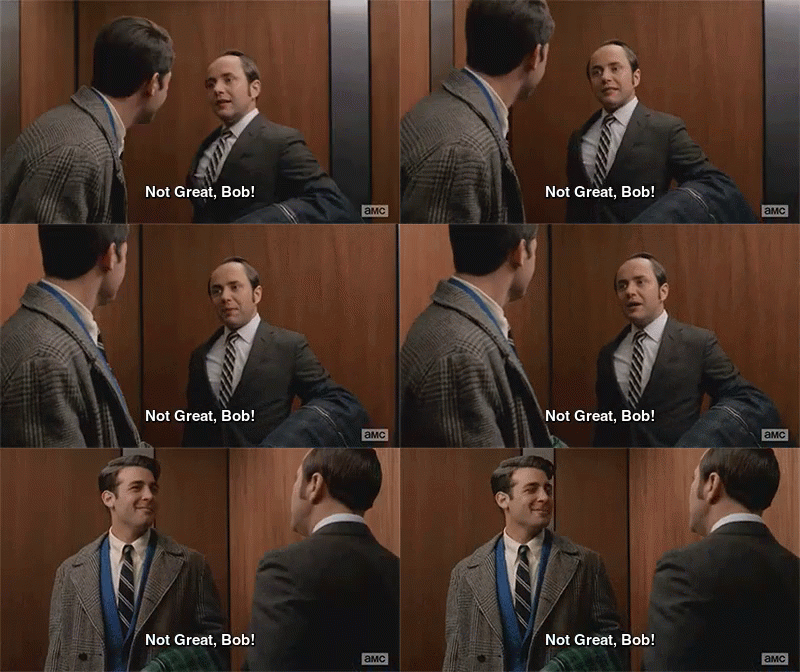
Not Great, Bob. Another all-too-honest update on… | by Matt Anderson |  Struck | Medium

Next week, I’ll return home to Oregon for the first time in over 3 years. I won’t be there long—it’s never enough, really— but it’ll be good to see my family, Mt. Hood, and smell the Pacific Northwest air. 

I’ll be staying with mom, a proud owner of one of these Rube Goldberg HVAC contraptions. So far, she says she’s managed. I hope so. 

I also hope this isn’t a new normal for them.

On to the good stuff:


  1. In the writing world, “killing your darlings” is often dished out as advice. Austin Kleon proposes relocating them instead. 
  2. A good read: Jonathan Malesic on the rise of Substack, and what it may/may not mean for journalism going forward.
  3. Jon Gruber weighs in on the plea from Apple workers to continue working remotely. Gruber’s take is hot enough to bathe in, but in a lot of ways, I think he’s on the right track here. To be clear, there is definitely merit in the idea of working remotely. I’m also mindful that living in Silicon Valley doesn’t come cheap or without a long commute. At the same time, these sorts of employee petitions reek of entitlement. As Gruber notes, Apple’s new “three days on site” policy wasn’t a request for comments — it was a decision.” I’m open to the idea that mine is a generational reaction, and one from someone whose job has to be done in person. I just think a little intellectual honesty would’ve gone a long way here. I’d love to hear where you fall on this
  4. A good tweet:Colleen @Coll3enGmy mom and I were driving and I decided to call my grandma and my grandma was like “hey sweetie I can’t talk right now, your mom’s at my door” and i was like “grandma I’m driving with my mom right now” and my grandma just said “oh darn you caught me, I just don’t want to talk”June 26th 202112,469 Retweets215,489 Likes
  5. Here’s a YouTube clip of someone literally doing nothing for 2 hours. It has over 5 million views as of this writing. I’m not sure what to do with that.
  6. Ear Candy: Paul Westerberg’s Eventually
  7. This is why we can’t have nice things: TSA resumes self-defense classes amidst a surge of in-flight incidents
  8. This week, United Airlines announced amassive order for 270 new planes. It also plans to hire 25000 people over the next few years.
  1. Another good tweet (or thread) from a first-time watcher of Ted Lasso. I don’t watch a lot of TV, but it’s an easy series to fall in love with. Season 2 kicks off on July 23rd.
  2. RIP Frank Bonner. The man who brought WKRP’s Herb Tarlek to life left us earlier this month. His nonstop schmoozing of the “big guy,” running paycheck pools, or trying to win the hearts of Bailey and Jennifer might’ve made you cringe (he’d definitely get canceled today). But underneath that veneer of sleaze was a solid teammate. Tarlek always struck me as the kinda guy that might’ve tried to get you to take the bad square in an office pool, but would also lend you a (very loud) coat without being asked. The world’s a better place with people like that in it.

Thanks for being here,

Kevin—

What caught your attention this week? Got a rant or rave? Let me know in the comments or send me an email. I read all the responses. You can also read more of my work on Medium, and connect with me on Twitter.