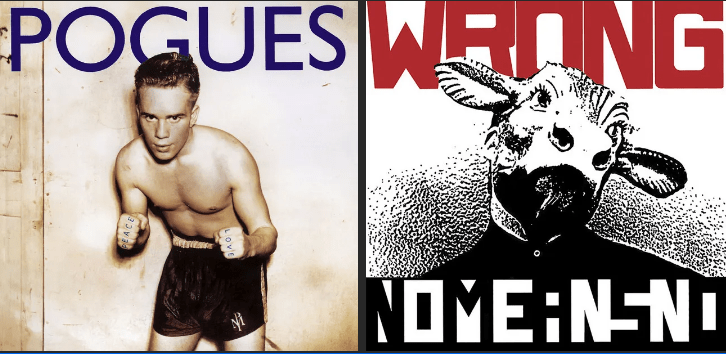
The Best Record of 1989, Day 62: #54 The Pogues, Peace and Love vs. #75 Nomeansno, Wrong

Good morning!

Today we’re taking a quick look at records from The Pogues and Nomeansno


Note: As many of you know, I recently wrote about a Best Record of 1989 challenge and noted that I’d occasionally write some of these up.

I’ve started doing some quick hits of each matchup and posting them directly to the page. Some will be longer, some won’t, and some might just be a handful of sentences. There’ll probably definitely be some typos.

Check ’em out and let me know your thoughts! Chin wags & hot takes welcome! Sharing and restacks are always appreciated.

KA—


The Pogues, Peace and Love

By the time Peace and Love dropped in the summer of 1989, the end of The Pogues was near. This was the moment the Pogues started to fall apart—and not in the sexy, myth-making way we like watching on rock docs. It was more like the ugly slow-motion collapse that happens in real life.

Everyone knew it was coming, but me. I wouldn’t find the band for a couple more years.

On a stereotypical dreary fall night in the midwestern college town where I live, a friend dragged me out for a night on the town. We’re gonna end up at a house party, he promised. The kind that you hear about from a friend of a friend whose buddy might know someone who actually lived there. This was an era of my life best described as “good music and bad decisions,” so of course I said yes. The night was as promised. To this day, I’ve never found a stronger Long Island than those served at Amy’s Cafe in Madison, WI. If you know of one, let me know. Actually, maybe you shouldn’t. Lol.

At any rate, we wind up at this house where a cover band is playing. I don’t know it yet, but they’re ripping through covers of The Pogues. I mean, tear the roof off the place, good. Of course, we’re a long way from the internet, and Shazam was still a cartoon character (or the name of an ATM if you’re from Iowa), so I finally had to ask. I was also the last person to hear about the band (The Kissers) and who they were covering. This could have gone all kinds of wrong, but the girl I asked was all too excited to tell me all about both. The next day, I went to Borders (RIP) and grabbed a copy of their Waiting For Herb record.

But before all of that, there was peace and Love. The record was their fourth, and (with hindsight) the one where the wheels start coming off. You could hear it in Shane MacGowan’s voice, which had gone from a cute, kinda feral to ghostly mumbling through a megaphone. It was the sound of a man’s liver and central nervous system teaming up to sabotage his own genius. You could hear it in the songs, too.

And yet—and yet—somehow, Peace and Love isn’t the disaster it probably should be. Even with all of that as a backdrop, it holds up better than many post-peak albums from great bands. Shane might’ve been fading, but the rest of the band came out swinging. “Young Ned of the Hill” and “Gartloney Rats,” both feel brand new and 200 years old (not derogatory). Philip Chevron gave us “Lorelei,” which aches in all the right places and blends melodrama with power pop without falling apart at the seams. If nothing else, you can say this: Peace and Love was from a band that still had something left to say—if not to prove.

Musically, they pushed the envelope just enough. A surprisingly jazzy, noirish thing is happening on “Gridlock,” there’s some rockabilly, and even (check notes) calypso? It’s messy, sure, but it’s a good messy. The messy that only happens when a band still gives a f**k—even if their lead singer’s interests are elsewhere.

Peace and Love isn’t Rum, Sodomy & the Lash or If I Should Fall from Grace with God. It’s not even Waiting for Herb (my fave). It may not be their finest hour. But it is the moment when the rest of the Pogues stood up, picked up the slack, and kept the thing going, if only for a bit longer.


NoMeansno, Wrong

We ended last week with a trip to Canada, and kicked this week off with some Fugazi. So it only seems fitting that we’d wind up here with a band that reminds one of a Canadian version of the band. Wrong is a wild ride through some unhinged riffs, drum beats that make no sense on paper, and choruses that range from “pop punk” to “screamed at you.” The ingredients make for a tasty mix, albeit one that’s an acquired taste.

My vote: I banked on a dollop of name recognition and a dash of sentimental value, and voted for The Pogues.


Any thoughts on either of these records? Agree/disagree with my takes? Which one of these would you vote for? Sound off in the comments!

Check out the full bracket here.

Info on the tourney, voting, and more is here.

As always, thanks for being here.

KA—

The Tragically Hip’s “Up to Here” | A Quick Look at the 1989 Debut Album that Launched a National Obsession

Overlooked outside of Canada, The Tragically Hip is worth a second listen

Good morning!

Today Graham Strong’s taking the wheel and is talking about The Tragically Hip’s Up to Here.


Today we’re lucky to have friend of On Repeat Records  Graham Strong sharing his thoughts on The Tragically Hip’s album, Up to Here. If you’re not already familiar with his work, Graham is the man behind To Write With Wild Abandon, where he helps writers overcome obstacles and emphasizes having fun along the way. It’s a never miss newsletter, and his work is well worth your time! When you’re done here, please check it out!

Today, Graham’s making his case for why Up to Here deserves to be in the running for Best Record of 1989. I’m happy to have him; this is a band that for whatever reason has always been a bit of a blind spot for me. One of these days, I’ll do a deep dive into their discography and see what I know I’ve been missing. In the meantime, I’m happy to have an expert fan weigh in!

And with that, I’ll get out of the way…

KA—


How would I describe The Tragically Hip?

Imagine a band that can grab you like Elvis, Bruce Springsteen’s power and patriotism, Paul Simon’s poetic lyrics, and the Rolling Stones’ straight, thumping rock songs that beg to be turned up to 11.

“Oh, that’s over-hyping them,” you might say. But I’d reply no, that’s exactly how fans might describe The Tragically Hip. Let me explain why.

Unless you grew up in Canada when The Tragically Hip first started playing, it’s hard to understand the full impact of this band. It baffles me that, except for a few pockets around the world, people outside of Canada don’t seem to get the Hip. It’s like the Beatles showed up in New York one August evening after taking over the world, and everyone in summery Central Park just stood there and stared, unable to make heads or tails…

My sense from the comment sections of On Repeat Records is that the readers here are more open to things that are different. So I’ll tell you why I think the Hip’s debut full-length album, Up to Here, released on September 5, 1989, deserves to be on the list of the best albums of that year – and why you should give them a listen.

A short bio: The Tragically Hip formed in 1984 in Kingston, Ontario, about three hours east of Toronto. The line-up from left to right on the Up to Here album cover: Gord Downie, singer, lyricist, and frontman; Gord Sinclair, bass and back-up vocals; Johnny Fay, drums; Rob Baker, lead guitar; and Paul Langlois, rhythm guitar and back-up vocals. They started as one of those hard-working bar bands who showed up no matter how far the drive through the night, playing throughout southern Ontario before touring across Canada and into the States and Europe.

After a successful EP, the band recorded Up to Here at Ardent Studios in Memphis. Until this point, the Hip hadn’t broken out, even in Canada. But four singles from the album changed that: the sometimes soft, sometimes loud “Blow at High Dough” (great album opener), the straight-out rocking “New Orleans is Sinking” (my favourite song of all time), the bluesy “Boots or Hearts”, and the Canadiana ballad, “38 Years Old.”

The Rolling Stones comparison from above is apt for this album. Many of the songs are hard-edged, bluesy rockers. You’d be forgiven if you mistook the opening to “Trickle Down” as a Stones song.

But the important thing – and what makes this album so important – is that the proto-DNA of what would become the Hip is already percolating underneath the familiar rock beats. As all good bands do, they would mature as songwriters, but this album laid a solid foundation. For example, even Stones-y “Trickle Down” features chord changes that are undeniably Hip. And that’s not all – the lyrics, the tight-but-loose playing style, the social commentary, the Canadianess… It’s all there in those first vinyl grooves.

Ah yes, and there’s their so-called Achilles’ heel – being too Canadian for international markets. That comment always bugged me. Here’s the thing: you don’t have to get the Canadian references to enjoy the songs. Many Canadians didn’t even get them until they were pointed out. They’re just… lyrics.

But, great lyrics. Wow, what a poet Gord Downie was! Like the rest of the album, his lyrics on Up to Here are proto, but the story in “38 Years Old” – imagined from a real jailbreak near Kingston – has incredible impact in just 275 words, eight of which are repeated five times. That takes talent.

Here’s another example from “Opiated”, the last track on the album:

He bought two-fifths of lead-free gasoline.
Said, “The bottle is dusty, but my engine is clean.”
He bought a nice blue suit with the money he could find.
If his bride didn’t like it, St. Peter wouldn’t mind.

Nothing earth-shattering. And at least one line pulls from another song – The Grateful Dead’s “Brown-Eyed Woman.” But for the debut album of a straight-rocking band? None too shabby, either. Makes Robert Frost’s snowy woods look like a stroll through the park.

Up to Here made the Hip instant rock stars. The album went Platinum with 100,000 units sold in the first six months (hey, we have a tenth of the US population) and Diamond within 10 years (1,000,000 records). They won a Juno, the equivalent of a Grammy in Canada, for “Most Promising Artist” in 1990.

They certainly lived up to the award. The Tragically Hip’s popularity exploded in the 1990s. The band released 12 more studio albums in their career (10 reached Platinum or higher) and they made an appearance on SNL in 1995.

But their live shows were where they really rocked. Probably the best Hip concert I saw was at Grandma’s Sports Bar in Duluth, Minnesota, with 997 raving fans from Thunder Bay, Ontario, and three or four locals wondering what the hell was going on… The Tragically Hip remained a bar band in spirit to the end.

And that’s what Up to Here is: a great bar-band album that is solid in its own right, but also a glimpse of the amazing things to come.

Gord Downie died in 2017 from a rare form of brain cancer, gutting millions of fans. Just like Elvis’ death did, just as John Lennon’s. Except for a couple of special one-offs, the band doesn’t have the heart to play with a new singer à la Queen or Journey. I don’t blame them.

Their music, of course, is still there for the listening. Spotify now has a preview button that will give you a good taste of the album, if you want to zip through tracks. But if you’re looking to sample full songs, I’d go with the singles in the order they appear on the album: “Blow at High Dough,” “New Orleans is Sinking,” “38 Years Old,” and “Boots or Hearts.” There’s not a bad song here, but those may be the most approachable for the first-time listener.

Oh, and one more thing. Crank your headphones to 11. Like I say, the songs are begging for it.

Graham Strong is a freelance writer and die-hard Hip fan. He writes about the common pitfalls and fears writers face, and how to overcome them on his Substack site, To Write with Wild Abandon.


Kevin here again:

Thanks to Graham for his time and for sharing his thoughts on The Tragically Hip, and to you for being here.

My vote: Today’s matchup sees The Hip taking on the much higher-seeded Seeds of Love by Tears for Fears. My bracket pick was a straight play for the higher seed (and the record I’d actually heard.) As for my vote today? I’m on the fence, but leaning toward underdog; Graham’s made a pretty compelling case for Up To Here. It’s great album- turns out I really have been missing out!

Any thoughts on either of these records? Agree/disagree with my takes? Which one of these would you vote for? Sound off in the comments!

Check out the full bracket here.

Info on the tourney, voting, and more is here.

As always, thanks for being here.

KA—
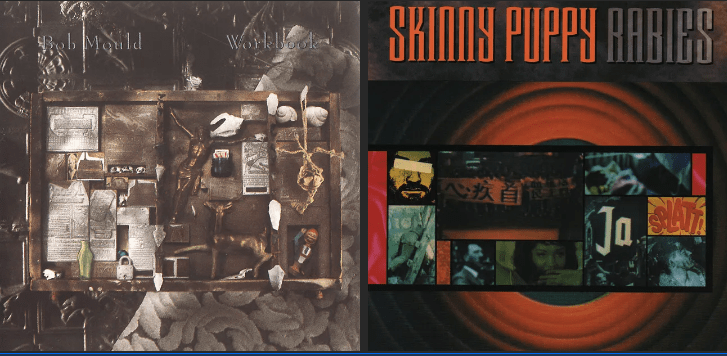
A Punk Icon and Industrial Band Walk Into a Bar…

The Best Record of 1989, Day 43: #26 Bob Mould, Workbook vs #103 Skinny Puppy, Rabies

Good morning!

Today we’re taking a look at records from Bob Mould and Skinny Puppy


Note: As many of you know, I recently wrote about a Best Record of 1989 challenge and noted that I’d occasionally write some of these up.

I’ve started doing some quick hits of each matchup and posting them directly to the page. Some will be longer, some won’t, and some might just be a handful of sentences. There’ll probably definitely be some typos.

Check ’em out and let me know your thoughts! Chin wags & hot takes welcome! Sharing and restacks are always appreciated.

KA—


The first time I heard Husker Du’s New Day Rising, it was like a kick to the head. The blast furnace riffs, the distortion, the vocals—the record was a revelation. I couldn’t get enough and went on to devour any record of theirs I could find.

The first time I heard Bob Mould’s Workbook, I was surprised. I’d been looking for more of the same and instead got… an acoustic guitar? And was that a cello? WTF was going on here? Where was the feedback? The molten lava feedback? Had Mould gone pop?

Maybe. Or maybe he was just tired of being angry. Either way, Husker Du was dead, and Mould was starting anew. In his autobiography, “See A Little Light,” he notes, “I sensed there was a part of the punk audience that would feel betrayed.” I’m sure there was plenty of that (it’s worth noting that when seeing Sugar a few years later, he emphatically stated that they would NOT be playing any Husker Du songs), but if anyone felt betrayed, that’s on them.

Artists are allowed to pivot, are they not?

I didn’t feel betrayed per se— I hadn’t been a Husker fan that long, anyway. Even if that was justified, I’m not sure I’d put in enough time for it to be justified. It was a case of not knowing what to do with what I had in my hands. I was an angry/angsty teenager, and records like New Day Rising fit right in with that. Workbook opens with a 2(ish) minute acoustic number. This record was appealing, but it was also much more (relatively) poppy. Those two things did not align for 14-15-year-old me.

Much like the Grinch, whose heart grows two times bigger, mine opened just enough to let this record in. It took a few listens and more than a few renewals from the Beaverton Library for that to happen, but I eventually came to love this record.

The aforementioned acoustic track (“Sunspots”) is fine, but things really kick off with “Wishing Well,” which to my ear initially felt like a feedback-free return to form. “See a Little Light” is, for my money, the most accessible track Mould has ever penned. I’m talking about mainstream audiences here, btw.

“Poison Years” is a preview of what was to come with Mould’s next project, Sugar, and proves early that this wouldn’t be all mandolins (or whatever) and pastoral moods. It was all right there; it just took a few listens for it to click for me. Mould is supported by Tony Fier and Tony Maimone here, and they do well to both support him as he strikes out on his own and keep him tethered (this isn’t the last time we’ll see Maimone in this challenge, btw).

And lest anyone still feel betrayed, the swirling maelstrom of the closing track, “Whatever Way The Wind Blows,” offers one last chance to see that the patented sound hadn’t died; it‘d just changed form.


My youngest son recently asked me if he could go with his friends to see Pantera play. My official on-the-record answer was that I needed more info (who, what, here, all the things we’re supposed to be asking). My unofficial answer was “hell yeah.”

My own experience with shows means I require clearing a pretty low bar to get permission. Really, it just involves listening to my prepackaged bit about safety, sticking together (he’s going with friends), and serving up my boilerplate speech about wearing earplugs. Luckily, a lifetime of him hearing me say “What?” makes this an easy sell. But really, I just want him and his brother to have the same transformative experiences I did.

In the winter of 1990, I had a chance to see Skinny Puppy perform. I’m intentionally using the word “perform” here instead of the (linguistically) easier “play.” It was as much a performance as a concert, and it completely rearranged my mind in all the best ways. The kids today would describe it as unhinged.

You could say the same thing for their records. Bites was my on-ramp to the band, and “Assimilate” is still one of my go-to records anytime I’m in the mood to hear something industrial. Many of those elements were still in place on Rabies; Nivek Ogre’s vocal stylings (half growl/half underwater), film clip dialogue spliced into tracks, and synths best described as vaguely menacing. There is an art to creating music like this, and Skinny Puppy are master craftsmen.

Opener “Rodent” starts things off on just the right note. Ditto “Hexonxonx.” You want industrial dance music? You’re gonna get industrial dance music. “Worlock” comes across as something Front 242’s evil twin made. It’s magnificent.

Ministry’s Alain Jourgensen produced and contributed here, and depending on your tastes, either enhances the order or detracts from it. This was the same era as “A Mind Is a Terrible Thing to Taste,” where our Al was shifting further away from synths and more towards blinding speed and off-the-charts BPMs. That works well in limited doses, but feels out of place in spots. And that’s the rub; as a fan of the band, this is a record I enjoyed, but don’t return to the same way I do BitesViva Sect VI, or Remission. I like my Skinny puppy synth-y, thank you.

Tracks like “Tin Omen” would be right at home on A Mind…, but on Rabies, they feel a bit like an odd man out. Still, it sounded great live; I just wish I’d worn earplugs.


My vote: To varying degrees, both of these records represent a shift in style(s). Rabies is more of a transition, while Workbook is almost a clean break. There’s really not much other common ground here.

Workbook took time to grow on me, while Rabies never truly landed the way earlier records had. I played it early and often, but it was more about skipping to tracks I liked than letting it play all the way through. Workbook was enjoyable enough to clear the hurdle of my preconceived notions, while Rabies clipped the bar. My vote will be for the former.

Any thoughts on either of these records? Agree/disagree with my takes? Which one of these would you vote for? Sound off in the comments!

Check out the full bracket here.

Info on the tourney, voting, and more is here.

As always, thanks for being here.

KA—

A Fantastic Music Project You Should Know About

The ways we discover and create music continue to evolve. Matthew Vanderkwaak’s new project is shining a light on both his own music and other emergent Canadian artists.

Photo: Samuel Landry

It’s 2025, and many of the guardrails and gatekeepers that used to decide what music we consumed are gone. We are no longer bound solely to whatever an A& R rep might decide we like. We can decide for ourselves.

That goes for artists as well. Most of us grew up with the narrative that discovery is either by sheer luck or after getting in the van and burning hard miles down the road. And even if you wanted to make a record, that might prove cost-prohibitive.

While some of that is still true, for the most part, the barriers to entry are lower than they’ve ever been. Today, it’s entirely possible to make a record using your phone and a few other software programs. You can do this without ever leaving your bedroom.

So that’s the good news; if you want to make a record, you can! The not-so-good side effect is that listeners must wade through more and more records before finding you.

Discovery might’ve changed forms, but it still matters.

Enter Matthew Joel Vanderkwaak. Matthew is from Atlantic Canada and is an artist himself. Taking a page from the likes of Fog Chaser, miter and olivia rafferty, he’s creating music in real time, using new pathways, and his readers get to hear it first.

Further, he’s committed to raising the profile of other artists and has a series where he spotlights emerging Canadian musicians, with an emphasis on Canadian folk and country music.

In 2025, algorithms and digital platforms are making a lot of noise. Artists/curators like Matthew Vanderkwaak provide a valuable signal, lighting the way for new listeners.

And with that, I’ll get out of the way and let Matthew share his work.

Enjoy!

KA—

I’m Matthew Joel, an artist from Atlantic Canada on a quest to encounter the spirit of Canadian folk and country music as it lives and breathes in our moment. I’m here today to share about my new project, The New Canadiana—a journalistic series about regular and mostly unknown Canadians who are writing, recording, and releasing music right now.

In the age of algorithmic curation and procedurally generated noise, I think folks are more hungry than ever to make meaningful connections with the human beings who make the music they love. This might be one of the major upshots of ai-generated media—it shows us how precious human-made art really is. More than ever I want to feel I know the people making the music I’m listening to, and more than ever, I’m learning that this kind of relationship requires an almost heroic act of focused attention. That attention, though, leads me into the spirit of art-making that inhabits human life and makes it special.

Last year, I finally finished grad studies and realized I wanted to start recording and releasing music again. It turned out that after 10+ years of desk work, academic writing, and listening to Carrie and Lowell on repeat, a lot had changed in the world of music marketing and promotion. Back in 2010, it was all about selling CD-Rs to my friends, posting on tumblr, and sending out mass emails hoping to strike gold in the blogosphere. I had never distributed music to streaming platforms before. If I did, would anyone hear it? How could I find a community of interested listeners?

Purveyors of music-biz best practice said that I should find out who else was making music like mine and do whatever they did. But who even were these people? Where could I find them? While asking these questions from within the horizons of social media and streaming platforms, I felt lost. The fact was that many of the people I knew making beautiful music had almost no traction on a place like Spotify. But at the same time, as I gathered more and more of this pressingly beautiful music together, I started to see common threads running through these different Canadian cities.

My conviction is that algorithms cannot be trusted to tell the stories of the human beings who make the art most precious to us. It takes human beings to make known what is truly human in our music. Of course, here at On Repeat Records, I’m preaching to the choir. This is how The New Canadiana was born—out of my attempts to practice attending in a more structured and public way to the beautiful human-made art that is all around me.

In this post, I’m distilling what I’ve learned from the year so far: three rules for attending to the music of a place. I’m especially happy to share about these principles, because what I’m seeing in these Canadian cities must be happening everywhere else too. I want to know how you are following rules like these and what you have discovered along the way.

1. Start with music made in the place where you are

In the effort to resist the algorithmic anonymization of music, I think each of us has a special vocation in the places we belong to. The first rule is to begin with the music made by people you know in places you know. Then, follow the threads. Trace the outlines of the scene that you are at the centre of by virtue of the fact that you are the one listening. You are the one who most of all can understand the meaning of the music that arises out of the situation that you also arise out of. And the rest of us need you to help us access to the art you are most equipped to hear.

The spirit of locality is very close to the spirit of music making. Human-made music belongs somewhere, and that place is not primarily an Instagram reel or Youtube video (which are only records of an event). Canada, which is ostensibly the subject of The New Canadiana, is, in truth, much too large a subject.

Instead, I have begun my quest with the actual Canadians I know whose music burns bright in my ears and heart. This first rule is about learning to trust that this feeling shows me the way forward. There’s no one else with my particular experience of this music made by these particular people. This means I have a task—something to attend to.

2. Have meaningful conversations with the music you love

The great threat to music distributed by streaming platforms is that it becomes a mere mechanism to evoke a mood or vibe without ever being allowed to become an end in itself. By contrast, I’m amazed at what I discover when I sit down with a friend and really ask them about their art. I might have assumed that the public nature of an interview would involve too much self-conscious reflexivity to invite meaningful reflection. On the contrary, I find that when I have a conversation that is on record, this imparts a focus and intensity that elevates my awareness of what we are trying to explore together.

As I prepare for interviews, I bring a structured mode of attention to the music that I rarely make time for. As I pay attention, I start to get curious: what makes this music work? What is it saying to me? How can I dialogue with its particular beauty? While conducting these interviews, I feel my conscience prick—why haven’t I asked my friends these questions before? They’ve made this beautiful art, and the meaning of its beauty is at risk of slipping by, unnoticed unless someone stops to recognize what has occurred.

3. Keep a public record of your discoveries

All it takes to dignify a work of art is attention, and the third rule is to give what you have understood in the art a public voice. Let us infiltrate online spaces designed to manipulate and monetize attention with the records of what we have discovered on the ground and in our bodies with other human beings.

Let us keep coming back to places like On Repeat Records to celebrate the beautiful music that has made itself known individually upon each of us as individuals. Keep a record of what you notice—snapshots of live music, reflections on concert experiences, evidence of physical media, listening journals, conversations shared between friends and fellow aspirants. The record of these experiences matters because only a human can access what is human in a work of art.

4. The New Canadiana

I’ve committed in 2025 to make my discoveries public in two ways:

  1. I am interviewing one Canadian songwriter a month. The interviews are an almost anthropological effort to encounter the spirit of this moment in Canadian music. If you’re to new to the series, I encourage you to start with the first one featuring Simon Bridgefoot.
  2. I maintain a playlist that situates these Canadians’ music in the larger context of folk and country music in this country. The playlist privileges songs that have come out in the past five years.
    The playlist lives here:

It all started as a chance to work out where I can locate my own music, and what I’ve discovered instead is that there is a world to which I already belong. Give the interviews a read and the playlist a listen and let me know what you see in them.

How many of you are already applying principles like these in your own practices listening to music? What have been the results?

Kevin here again: Thank you to Matthew for sharing his work, and thank you for being here. Be sure to check out his project and the other fantastic interviews he’s already done!

Leave a comment