Good morning! Need an antidote for the algorithms? Looking for a place to share the music you love with like-minded people? You’re in the right spot.
As always, thank you to those who upgraded their subscriptions this past week. Your direct support fuels this community and makes a positive impact. Shares and reposts also help! Thank you!
When you’re ready, joining them is easy. Just click here:
For those of you who are new, we kick off every week by sharing what we’ve been playing.
The playlist below is some of what I’ve had in heavy rotation. This week, we again overindex new tracks, with a couple of old faves balancing things out. We start with community fave Water From Your Eyes before kicking into high gear with a 1-2 punch of Bob Mould & Die Spitz. From there, we’ve got the latest from our friend,
The Ririverse, and we end Side 1 with the latest from a longtime DC area band.
Side two kicks off with a track from a record I once deemed the #4 record of all time, before taking a trip to Pittsburgh to hear some Gaadge. I’m not on Threads anymore, but before I left, I was lucky to meet a couple of you and find Palm Ghosts. Their latest is here. Here’s to silver linings.
I know I keep saying it, but it’s true: 2025 might be a hot mess, but not when it comes to new music.
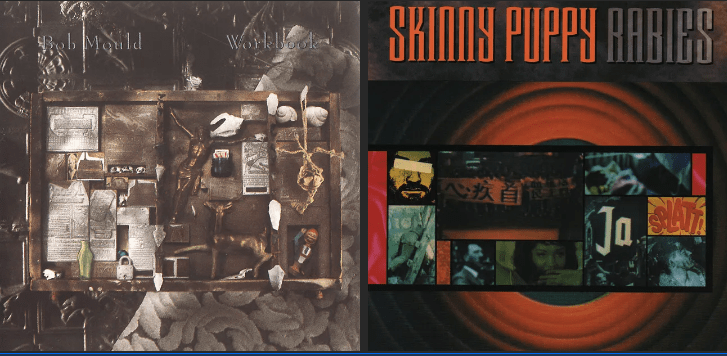
The Best Record of 1989, Day 43: #26 Bob Mould, Workbook vs #103 Skinny Puppy, Rabies
Good morning!
Today we’re taking a look at records from Bob Mould and Skinny Puppy
Note: As many of you know, I recently wrote about a Best Record of 1989 challenge and noted that I’d occasionally write some of these up.
I’ve started doing some quick hits of each matchup and posting them directly to the page. Some will be longer, some won’t, and some might just be a handful of sentences. There’ll probably definitely be some typos.
Check ’em out and let me know your thoughts! Chin wags & hot takes welcome! Sharing and restacks are always appreciated.
KA—
The first time I heard Husker Du’s New Day Rising, it was like a kick to the head. The blast furnace riffs, the distortion, the vocals—the record was a revelation. I couldn’t get enough and went on to devour any record of theirs I could find.
The first time I heard Bob Mould’s Workbook, I was surprised. I’d been looking for more of the same and instead got… an acoustic guitar? And was that a cello? WTF was going on here? Where was the feedback? The molten lava feedback? Had Mould gone pop?
Maybe. Or maybe he was just tired of being angry. Either way, Husker Du was dead, and Mould was starting anew. In his autobiography, “See A Little Light,” he notes, “I sensed there was a part of the punk audience that would feel betrayed.” I’m sure there was plenty of that (it’s worth noting that when seeing Sugar a few years later, he emphatically stated that they would NOT be playing any Husker Du songs), but if anyone felt betrayed, that’s on them.
Artists are allowed to pivot, are they not?
I didn’t feel betrayed per se— I hadn’t been a Husker fan that long, anyway. Even if that was justified, I’m not sure I’d put in enough time for it to be justified. It was a case of not knowing what to do with what I had in my hands. I was an angry/angsty teenager, and records like New Day Rising fit right in with that. Workbook opens with a 2(ish) minute acoustic number. This record was appealing, but it was also much more (relatively) poppy. Those two things did not align for 14-15-year-old me.
Much like the Grinch, whose heart grows two times bigger, mine opened just enough to let this record in. It took a few listens and more than a few renewals from the Beaverton Library for that to happen, but I eventually came to love this record.
The aforementioned acoustic track (“Sunspots”) is fine, but things really kick off with “Wishing Well,” which to my ear initially felt like a feedback-free return to form. “See a Little Light” is, for my money, the most accessible track Mould has ever penned. I’m talking about mainstream audiences here, btw.
“Poison Years” is a preview of what was to come with Mould’s next project, Sugar, and proves early that this wouldn’t be all mandolins (or whatever) and pastoral moods. It was all right there; it just took a few listens for it to click for me. Mould is supported by Tony Fier and Tony Maimone here, and they do well to both support him as he strikes out on his own and keep him tethered (this isn’t the last time we’ll see Maimone in this challenge, btw).
And lest anyone still feel betrayed, the swirling maelstrom of the closing track, “Whatever Way The Wind Blows,” offers one last chance to see that the patented sound hadn’t died; it‘d just changed form.
My youngest son recently asked me if he could go with his friends to see Pantera play. My official on-the-record answer was that I needed more info (who, what, here, all the things we’re supposed to be asking). My unofficial answer was “hell yeah.”
My own experience with shows means I require clearing a pretty low bar to get permission. Really, it just involves listening to my prepackaged bit about safety, sticking together (he’s going with friends), and serving up my boilerplate speech about wearing earplugs. Luckily, a lifetime of him hearing me say “What?” makes this an easy sell. But really, I just want him and his brother to have the same transformative experiences I did.
In the winter of 1990, I had a chance to see Skinny Puppy perform. I’m intentionally using the word “perform” here instead of the (linguistically) easier “play.” It was as much a performance as a concert, and it completely rearranged my mind in all the best ways. The kids today would describe it as unhinged.
You could say the same thing for their records. Bites was my on-ramp to the band, and “Assimilate” is still one of my go-to records anytime I’m in the mood to hear something industrial. Many of those elements were still in place on Rabies; Nivek Ogre’s vocal stylings (half growl/half underwater), film clip dialogue spliced into tracks, and synths best described as vaguely menacing. There is an art to creating music like this, and Skinny Puppy are master craftsmen.
Opener “Rodent” starts things off on just the right note. Ditto “Hexonxonx.” You want industrial dance music? You’re gonna get industrial dance music. “Worlock” comes across as something Front 242’s evil twin made. It’s magnificent.
Ministry’s Alain Jourgensen produced and contributed here, and depending on your tastes, either enhances the order or detracts from it. This was the same era as “A Mind Is a Terrible Thing to Taste,” where our Al was shifting further away from synths and more towards blinding speed and off-the-charts BPMs. That works well in limited doses, but feels out of place in spots. And that’s the rub; as a fan of the band, this is a record I enjoyed, but don’t return to the same way I do Bites, Viva Sect VI, or Remission. I like my Skinny puppy synth-y, thank you.
Tracks like “Tin Omen” would be right at home on A Mind…, but on Rabies, they feel a bit like an odd man out. Still, it sounded great live; I just wish I’d worn earplugs.
My vote: To varying degrees, both of these records represent a shift in style(s). Rabies is more of a transition, while Workbook is almost a clean break. There’s really not much other common ground here.
Workbook took time to grow on me, while Rabies never truly landed the way earlier records had. I played it early and often, but it was more about skipping to tracks I liked than letting it play all the way through. Workbook was enjoyable enough to clear the hurdle of my preconceived notions, while Rabies clipped the bar. My vote will be for the former.
Any thoughts on either of these records? Agree/disagree with my takes? Which one of these would you vote for? Sound off in the comments!

 Kevin Sent
Leave a comment