In Conversation: Gelli Haha

It’s time to take a rocket ride to the Gelliverse

Good morning!

We’re in for a treat today; Gelli Haha stops by to talk about her latest record Switcheroo, how it came to be, and what’s coming next.


There’s a particular kind of pop record that doesn’t wait to be invited in—it knocks down your door and dares you to keep up. Switcheroo, the debut LP from Gelli Haha (aka Angel Abaya), doesn’t waste time being performatively cool. It’s too busy being genius. Equal parts sugar rush, fever dream, and circus act, this kind of album turns overthinking into a punchline and escapism into high art.

Gelli Haha (pronounced “jelly”) has built a chaotic wonderland, aka the “Gelliverse,” where the synths are steady, beats alternate between hiccup-y and booming, and every note feels hand-drawn in crayon and glitter glue (and slightly outside the lines). Imagine your favorite dream pop band grabbing a copy of The B-52s’ Whammy! on the way to the launch pad, taking off, and crash-landing in an electroclash warehouse party in the coolest part of the galaxy.

That said, Switcheroo isn’t just wacky for wackiness’ sake. There’s a wry intelligence to it all, a real structure hiding beneath the glitz. Tracks like “Tiramisu” make you laugh…and then realize you’ve been singing along. “Spit” will remind you of all those hot, sweaty nights at the club back in the day. “Bounce House” is purpose-built for the pop charts. Seriously, why is this not climbing the Hot 100 already?! Even the deliberately juvenile “Piss Artist” glows with confidence and (per Bandcamprevels in tequila-fueled storytelling about an infamous party moment (involving a jar — don’t ask, just dance). Fair enough! Another artist might’ve buried it as a skit. Gelli Haha put it right in the middle of the album. Meanwhile, tracks like “Dynamite” chug along at just the right pace/BPM.

The record saves the best for last. “Pluto is not a planet; it’s a restaurant” (this writer’s favorite track on the record) takes all of the above and puts it in a blender, pouring out grandiose synths, pulsing beats, and a cathedral sound that will make you feel like you’re floating untethered in space.

Maybe it’s just me, but here’s something liberating about how this album refuses to care what you think. It’s not just theatrical—it’s maximalist identity performance with zero fucks given apologies. Gelli Haha isn’t aiming for relatability; she’s too busy being a pop gremlin, and tbh, that rules. The whole project feels like a rejection of our (collective) obsession with being “real,” that’s often ripping through the usual music discourse channels. Instead, she turns her persona into a playground—and lets you run wild with it.

Switcheroo is weird, hilarious, and absolutely unhinged—and it might be the most fun I’ve had with a record all year. Listening makes joy feel like a radical act- a rare treat in the current era. Once you’re in the Gelliverse, you may never want to leave. I certainly don’t.

I recently had a chance to chat with her via email. In our wide-ranging discussion, we talked about how the concept for Switcheroo came to pass, what she hopes listeners will take away from it, and what’s coming next. Our chat has only been lightly edited for grammar and flow.

KA—


For those that might not know, can you walk us through the backstory of how this project came together?

Gelli Haha is a project born out of curiosity. I wanted to create something that was fun and moved people physically and emotionally—fun music to dance to, something mystical and enchanting, and silly. A couple of years ago, I started working with Sean Guerin of De Lux, wrote dozens of demos, and then created a live performance art world to accompany the project.


On Bandcamp, a supporter described the records as “…like Kate Bush meets Suburban Lawns, and it is pretty good!” Is that an accurate take?

It’s subjective, but I like those artists. Kate Bush was a top influence for the project. I’ve not listened to Suburban Lawns much, though. There’s more of an experimental, electronic flavor to the record as well that goes beyond these artists.


Switcheroo has been described as an “exercise in letting go, an inside joke turned theatrical spectacle.” Say more please.

In order to make the record, I had to let go of some old tendencies of mine. I can be a bit of a perfectionist and want people to take me seriously. This record sounds very free because I had to become very free to make it. We wanted the project to feel like something everyone is in on, like the audience is involved somehow. And it’s all just really goofy. When we perform, we have mini trampolines and dolphin balloons and boxing matches and snakes in a can.


Listening to the record, I can hear everything from Italodisco to the B-52s and back again. Are there any artists who had a particular influence on the sound here?

I’m a big fan of Björk, Animal Collective, of Montreal…and lots of obscure late 70s/early 80s records that Sean showed me. But I also grew up listening to pop radio and MTV, going to musicals, and being in a choir and orchestra, so there’s a lot of influence coming from everywhere.


What’s the songwriting process look like? What generally comes first, the music/beats or the lyrics?

I made about 45 demos, each a minute or so long. Sean and I picked which ones we liked the most and expanded upon them together. Vocals and lyrics followed suit. Sometimes, they came quickly, and other times, we had to search a little bit.


If you had to narrow it down, what’s one thing you hope someone will get out of listening to Switcheroo?

A laugh.


What’s next? Any shows? Touring? What’s the back half of 2025 look like?

We have some fun things in the works for later this year to be announced!


Last one, just for fun; I bump into you as you’re walking out of the record store. What records are you carrying?

Tom Tom Club by Tom Tom Club, Philharmony by Haruomi Hosono, and Oops!…I Did It Again by Britney Spears.


Listen:

Gelli Haha | Switcheroo (2025)

Click the record to listen on the platform of your choice.
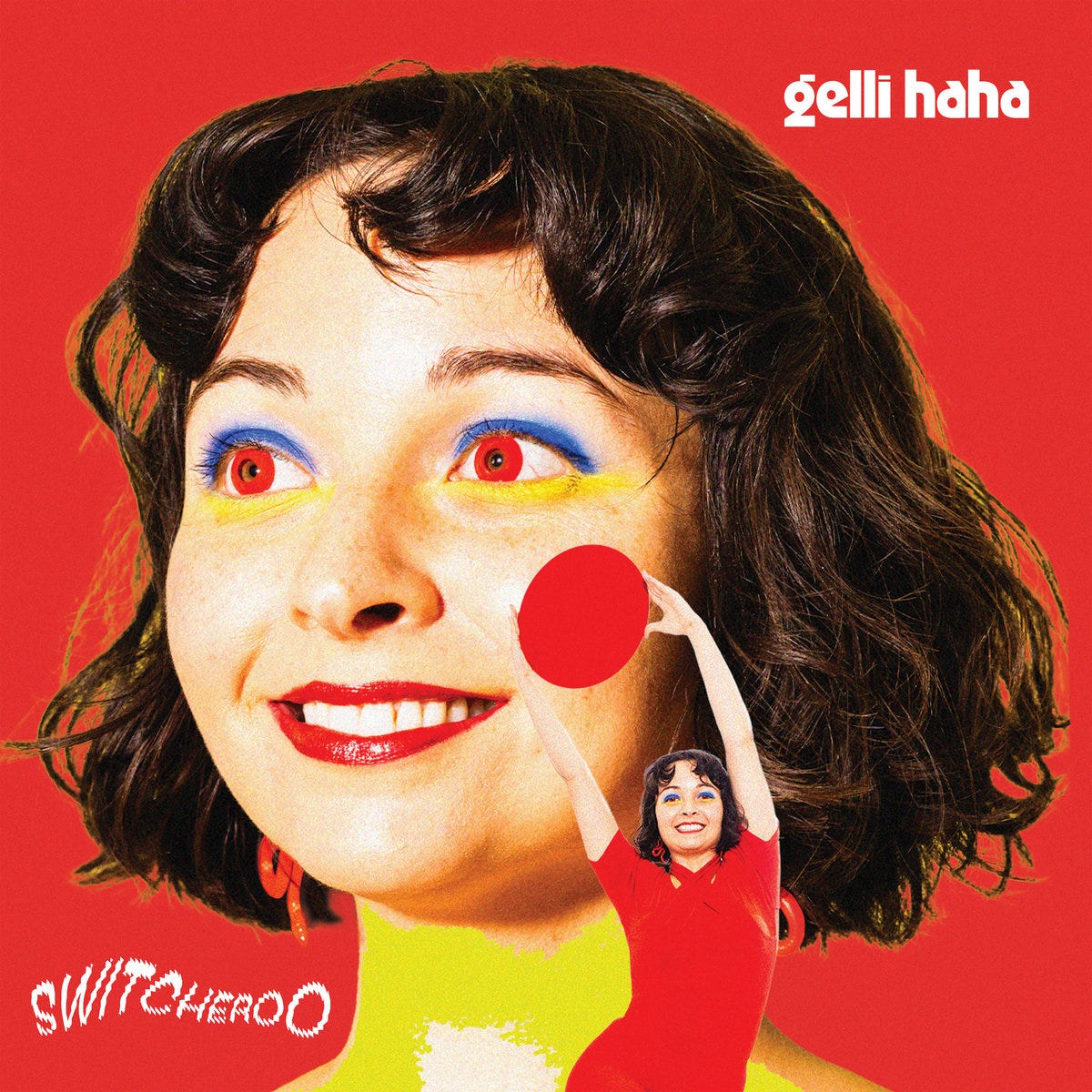
Switcheroo out now. You can grab your copy here.

You can also connect with her via her Website or on Instagram.

Thank you to Gelli Haha for her time, and thank you for being here.

Kevin—

Are The Stone Roses the Most Overrated Band in This Tournament?

The Best record of 1989 Day 41: #7 The Stone Roses, The Stone Roses vs. #122 Lounge Lizards, Voice of Chunk

Good morning!

Today we’re taking a look at records from The Stone Roses and Lounge Lizards


Note: As many of you know, I recently wrote about a Best Record of 1989 challenge and noted that I’d be occasionally writing some of these up.

I’ve started doing some quick hits of each matchup and posting them directly to the page. Some will be longer, some won’t, and some might just be a handful of sentences. There’ll probably definitely be some typos.

Check ’em out and let me know your thoughts! Chin wags & hot takes welcome! Sharing and restacks are always appreciated.

KA—


If this were a tweet, I’d sum up this record thusly: Incredible first three tracks. Pretty weak run in the middle, before pulling out the flat spin and redeeming itself. Things are capped off with one of the filthiest grooves of the era. Particularly good if you happen to be off your face while listening.

Well, Twitter (still not callin’ it X) is an absolute dumpster fire. You’ll have to bear with me as I work my way through the reocrd.

The Stone Roses (the band) and The Stone Roses (the record) were both served up to us fully formed as things we were somehow required to like. I’m not sure who the invisible tastemakers were who deemed it so, but here we are. And there we went—to Tower Records to each get a tape or CD of our own. Copies just wouldn’t do, you see.

So! You have a record with absurdly high expectations, PR buzz ripping through my part of the world, and cassette in hand. Now what?

Well, you should know that (depending on mood) your Fast Forward and Reverse buttons are going to get a workout. The opening track, “I Want to Be Adored,” is a slow burn, building up slowly until bursting open with some of the best sounds on the record. It’s short on lyrics and long on mood, and it’s awesome—though I’m not sure I would’ve slotted it in at A1.

“She Bangs The Drums” is a lovely bit of pop that sounds like the band either rooted through their parents’ record collection or fell into a time machine set to 1967. It’s bright and “up,” a strong contrast to the moodiness on the rest of the record. It’s a goofy love song about a guy in love with a girl drummer, but hey, who wouldn’t want that? “Waterfall” is…okay… It rounds out a solid opening trio. And here’s where things take a turn…

“Don’t Stop” is frankly awful, with “Bye Bye Bad Man” only slightly better. At 53 seconds, “Elizabeth My Dear” is about 52 seconds too long.

The opening riff of “(Song For My) Sugar Spun Sister” sounds like another song, and trying to figure out what it is has been driving me bonkers. If you have any ideas, please comment!

At any rate, the song isn’t terrible. And it’s not awesome, either. Better than the three that precede it, but that‘s a bar low enough to be a tripping hazard.

Right about the time your fast-forward button will be begging for mercy, comes ”Made of Stone,” and not a moment too soon! It’s strangely uplifting and a nice break from what we’ve just been through. While looking at the lyrics, I learned this track is supposedly about the car crash that took artist Jackson Pollack’s life. Go figure.

We’re right back at it (hitting buttons, that is) for “Shoot You Down.” This strikes me as one of those songs someone brought to the studio and either made a compelling case for or lost a bet. Dealer’s choice.

I vaguely recall a bit of indignation at “I Am the Resurrection.” 1989 America was a particularly pious one, and thinking about it now, I wonder if that became part of the record’s appeal for us? Nothing ships units like a bit of rebellion. At any rate, opinion on the track itself was split in my circle, with people either really digging it or barely being able to stand it. I was firmly in the former camp, and still am. It’s not the best song on the record, but no matter, it still works. At 8+ minutes, it’s entirely too long and does devolve into a weird jam band type thing, but in 1989, this was about as close as I was gonna get to digging anything of the sort, my love for the Grateful Dead still being several years off.

The original release didn’t include “Fool’s Gold,” but I’m gonna call an audible and pretend it did. Why? ‘Cause it’s incredible, that‘s why. I know it‘s not for every taste, but it was right up my alley. Mani’s Bass? On point. Reni’s drumming? Off the charts. John Squire’s guitar work is good too, but it’s the rhythm section that carries it.

That this record is seeded at #7 for this tournament tells me two things: nostalgia has a long shelf life, and that maybe there was something to that PR campaign I mentioned up top. If nothing else, it’s got a long tail. This is a solid record, but is it #7 seed good? I’m not seein’ it.


When I think of jazz, I usually think of either Thelonious Monk or the poppier side (e.g., George Benson). The sort of “this is a work in progress, and we’re not really sure where it‘s going, but we’ll have fun along the way” stuff is kind of a blind spot for me. Doubly so anything made after the Eisenhower administration. It always feels like a squonk too many, or just dissonant enough to turn me off. The idea that you‘re supposed to see the notes between the notes (or whatever) always felt like a papering over for what was most likely a jam session by the local chapter of psychonauts.

There’s a third lane as well; the one that evokes images of places like New York at dawn, the sort of grainy image with the early light of, say, 6 AM, a taxi (obvs), and steam coming up through the vents. It’s this sort of noir imagery that I couldn’t shake the entire time I listened to this. It’s the sort of record that could only be made in NYC (note: I haven’t looked to see if it was or not).

Sure, there are plenty of squonks and odd notes, and a few tracks suffer from a touch too much sax (‘Sharks”), but there are some fun things like elements of blues here. “Tarantella” is what you’ll hear as you’re walking into the best funhouse you’ve ever been to. “A Paper Bag and the Sun” is almost too esoteric for its own good (notes between the notes and all that), but somehow managed ot become my favorite track on the record.

In the end, that smiling sneakiness is what made this such an enjoyable listen. Will I come back to it? It beats me, but I wouldn’t be surprised to find myself using it to soundtrack a Saturday morning breakfast. I would probably fast-forward through “Sharks,” though.


My vote: A lounge Lizards win would be a hell of an upset—and stranger things have happened— but in this case, I think name recognition will carry The Stone Roses far further than the record alone. And I need every win I can get, cheap or not. My bracket pick and vote will be for them.

Any thoughts on either of these records? Agree/disagree with my takes? Which one of these would you vote for? Sound off in the comments!

Check out the full bracket here.

Info on the tourney, voting, and more is here.

As always, thanks for being here.

KA—

The Best Record of 1989: Day 31

#21 Lou Reed, New York vs. #108 Tone Lōc, Lōc-ed After Dark

Good morning!

Today we’re taking a look at records from Lou Reed and Tone Loc.


Note: As many of you know, I recently wrote about a Best Record of 1989 challenge and noted that I’d be occasionally writing some of these up.

I’ve started doing some quick hits of each matchup and posting them directly to the page. Some will be longer, some won’t, and some might just be a handful of sentences. There’ll probably definitely be some typos.

Check ’em out and let me know your thoughts! Chin wags & hot takes welcome! Sharing and restacks are always appreciated.

KA—


By the time the late 80s rolled around, Lou Reed was on something of a downswing- I say this not with the backing of any empirical information, but rather the prevailing mindset of people in my circle and what I was hearing on the radio/MTV.

The Velvet Underground still carried emeritus status -and some people were into their records because that’s just what you were supposed to have in the crate. If your parents had a copy? That telegraphed a sense of coolness you couldn’t buy. But by 89, VU was something from the past. It would eventually become my fave record of his, but New Sensations (great!) had been followed with Mistrial (not so much).

Say what you will about Reed, but he’s certainly willing to transform himself and his style. If Mistrial was an attempt at creating a synthetic version, New York was about a return to basics–and nothing says “return to basics” like a record about your hometown.

New York in the 1980s was beset by socioeconomic ills—AIDs, crack, and more. The big apple was rotting, and Reed was right under the tree. He did the only thing he could—he wrote some of the best songs of his career.

It’s worth noting the irony that the same person who sang “Sister Ray” and “I’m Waiting for the Man” is penning polemics about the scourge of drugs. But times change, and people do, too.

The songs on New York are over-indexed on pop/rock. Reed has some things on his mind, and 1989 was not the time for a field trip into Metal Machine Music territory or whatever esoteric pursuits he might’ve wanted to follow. Instead, we get one of the most straightforward records in the catalog.

“There is no Time is a ripper” (that’s a sentence I never thought I’d type about a Reed song), and plenty of tracks come as close as Reed’s gonna get to pop as well. “Dirty Blvd.” is the story of a kid growing up in a hotel and wound up hitting #1 on the Billboard Modern Rock charts…and that might not even be the 2nd or 3rd best track on the record.

I’m mindful that many people rank Reed higher than they might otherwise because of his– and VU’s–status in the rock canon. Fair enough, but fair play to Reed- when he’s on, he’s on, and this is a helluva record.

Reed might have once been down, but he was never out—and neither was the city (or people) he sang about.


Whoever nominated Tone Loc’s Loc-ed After Dark must either have A: Been waxing nostalgic, or B: just returned from a cruise.

I vote for B since artists like Tone Loc always find a second life on such excursions. Your mom, dad, (or grandparents!) relive the wild parts of their youth while also wearing wristbands, entitling them to an endless buffet and bottomless drinks. No house party here. No pre-planning on which backyard fence to jump if need be. It’s a very curated sort of hedonism.

While Reed was writing about cities falling apart, Loc was penning tracks about clothes coming off and any other sort of tawdry thing you can imagine. Pop culture was full of big hair and small bikinis. Some of the biggest stars weren’t even people—they were dogs used to sell beer…and it worked.

This being 1989, outsized guitar riffs weren’t entirely out of style- indeed, they were just what many of us were still clamoring for, and a well-placed Van Halen riff propping up verses easy to sing along to when drunk made for a winning recipe, which makes the case for option B. Time sweetens all memories, and we remember the good parts of the parties, not the mornings after or the gouges on one ‘s leg that came from picking the wrong fence. Cruise lines, too, have figured this out, and these have become a cash grab, with just about any genre you want available on the high seas.

With the benefit of hindsight, Loc-ed After Dark is derivative. He’s got a unique voice…until you realize that so did the DOC (note: I’m not calling either out for WHY their voices are the way they are- only noting the similarities).

His flow is fine…until you remember that Rakim exists.

Ditto Slick Rick when it comes to the writing itself. Even the cover art pips Donald Byrd’s New Perspective album.

And there’s a bit of trans and/or homophobia worked in on “Funky Cold Medina,” because, of course, there is. I wonder if Nana and Papa will still sing along with that line on the main deck?

So what’s good about this record? For one, the sampling. The Dust Brothers are on the boards and brought a big-ass crate into the studio. “Funky Cold Medina” alone pulls from no less than six tracks. “Cutting Rhythms,” seven. And for the latter, the roster ranges from Steely Dan to Juice to Wings (!). Anytime you’re surprised and delighted by a sample is a good thing, and it’s a notch in the win column for Loc-ed After Dark, but it’s not enough to overcome the dated way the album sounds. It’s enough to make me want to miss my Joe Camel t-shirts.


Bottom Line: Both records represent the bipolar nature of 1989 well. It was truly a “best of times, worst of times” situation, and what side you were on depended on a lot of factors you likely had no control over. One record telegraphs that you were cool in a hipster sorta way in ’89, while the other says you were a lout. And for a lot of us, given how blurred those lines got, we were both. That said, one record holds up well in 2025, while the other feels like I’m watching a beer ad while clipping Marlboro Miles.

My vote: Start spreading the news; My vote and my bracket pick are going to Lou Reed’s New York.

Any thoughts on either of these records? Agree/disagree with my takes? Which one of these would you vote for? Sound off in the comments!

Check out the full bracket here.

Info on the tourney, voting, and more is here.

As always, thanks for being here.

KA—

In Conversation: Tricia Halloran

The music supervisor stops by to talk about what a normal day looks like, delivering the right song for the right scene, and drivetime radio

Good morning!

We’re in for a treat today; Brave New World’s Tricia Halloran stops by to talk about being a music supervisor for film/TV, drivetime radio, and more!


We all have a favorite.

That one song from that one movie. A track that defined a scene or even the film. One that resonates so much that years later, it still transports you to another world. There are, of course, big examples. Play a few notes on Simple Minds’ “Don’t You Forget About Me,” and ask the closest Gen Xer what it reminds them of. Odds are good that they’ll tell you Breakfast Club before you’ve finished the sentence—same story with Singles, Reservoir Dogs, and more. Same story with your favorite TV shows and those commercials that are playing one of your favorite songs.

How we consume media may have changed, but how music can define what we’re watching has not.

So how does all that happen, anyway? Between the director’s vision and what we take away from it are a long line of choices, logical hurdles, and legal issues. Hitting all the marks takes someone with not only an encyclopedic music knowledge—music might be subjective, but what music to place where is a skill—but also broad knowledge of licensing and copyright laws, what channels to navigate, and more. It’s part science, part magic. It takes a music supervisor. It takes people like Tricia Halloran.

With a background in computer science, Halloran started in the corporate world and quickly burned out. She then pivoted to the world of radio, eventually leveraging her experience in both worlds into a career as a music supervisor. Her days are still spent in a universe of sound and the less-exciting-but-no-less-important legal world. Sometimes, this can be as simple as securing licensing rights. Sometimes, it can mean getting several people with very different interests all on the same page- a critical skill in its own right. Often, it means a mix of both.

Closer to home, Halloran has a talent for sourcing new music and shares it here with her Brave New World newsletter (her radio show’s namesake). She describes herself as a musical sherpa—more on that below—and she does a fantastic job of sifting through countless releases to bring only the best to her readers.

In a wide-ranging chat, Halloran shares how she got where she is, what a “normal” day looks like for her (spoiler: there’s no such thing), and some of her favorite tracks.

Make sure to give Brand New World a read!

Our conversation has been lightly edited for clarity and flow.


KA: I’m curious about your backstory. What got you to this point in your career? What spark kicked everything into motion? Later on, what made you make the jump from KCRW to being a Music Supervisor for TV/Film?

TH: This is kind of a long but worthy story. I was a computer science major in college. Very set on having a career at a big company and a secure future with a steady good income. (ha!) I worked at Xerox right after college, as part of a sales team programming their huge laser printers and training customers. It was great fun, but after several years, I looked around at the managers above me and thought, “I don’t want to be that.” Then, somewhat simultaneously, I had a really bad breakup. And I would sit in my office morosely and play Sinead O’Connor’s “Nothing Compares 2 U” on repeat. After a few days of this my friend came in and said “I can’t take it anymore, you need to do something new, why don’t you go down to that radio station you love so much and volunteer there?” So I did. I lucked into a great evening shift volunteering for Deirdre O’Donoghue, who became my mentor, and gradually, I was able to work on-air and then get better and better shifts. Through KCRW, I met somebody who worked at Capitol Records, and I was able to get a full-time job there that used my computer background. Eventually, I was hired full-time at KCRW by Chris Douridas to help run the music department and manage the physical music library.

Also through KCRW I met an indie filmmaker and he asked me to work on his film, it was my first project and I had no idea what I was doing but luckily one of my best friends (that I also met via KCRW) was a music supervisor, so she showed me the ropes. I left my full-time job at KCRW (but kept my evening on-air shift) soon after Chris left … mainly because they chose someone else to replace him, so I thought it best to look for other opportunities. I worked at a music website startup, and then I got a full-time job music supervising commercials, so I got some great experience there.

Again, through KCRW a TV project came my way, Men In Trees on ABC starring Anne Heche. After that, more TV projects were offered to me via word of mouth. My employer wanted to focus on commercials and not TV, so I went independent, and that’s where I am today! After several years, I got an agent, and she helped me get some film work and widened out my contacts in the TV and Film worlds. (She was just thanked by name at the Oscars, by the way, her composers Clement Ducol and Camille won Best Song for Emilia Perez!)


KA: What’s a normal day look like for you?

TH: No such thing as normal, literally! That is one of my favorite aspects of this job. Assuming for a moment I am mid-project on a TV show. There are generally three 2-person editing teams working on three episodes. They are filming an episode and writing episodes simultaneously. So the Executive Producers, the director, the writers, or any of the six editors might need songs for what they are working on. Once they ask, they generally need things immediately. So it’s a lot of responding to their needs. Somewhere in there, I also need to research song ownership, clear songs, keep a budget updated to let the Post Producer know our costs, and eventually create cue sheets.


KA: The Telecommunications Act of 1996 forever altered the radio landscape. Apologies if I have my timelines off, but In what ways did it affect you personally? How did you navigate those changes?

TH: That is a really interesting and deep question! By 1996, I was deep into my tenure at KCRW, which, being a public-owned radio station, wasn’t affected negatively by the consolidations. However, thinking about it, I’d say there was probably a positive effect for KCRW since they became the only independent choice left, right? Used to be there was a decent commercial alternative rock station in Los Angeles, and a really good “Adult Alternative” (AAA) station that would play Roxy Music and the BoDeans. But KROQ became much more commercial after that, and the AAA station was purchased by one of the conglomerates. So I’m speculating that, if anything, it drove curious listeners to camp out at KCRW. The mid to late 90s were really great times for KCRW, membership would increase year over year, and amazing artists would come by the station – perhaps this was assisted by the fact that they became the only indie radio left in town?


KA: Jumping back to the present: when you’re working on a TV/film project, what’s the process you use to find songs that fit? Do you come in later and maybe watch a rough cut of the film, or does it start at the beginning?

TH: It’s never too early to start! For example, let’s say there’s a Karaoke scene scripted. Once they film the scene with the actors singing a song, it’s married to the visual, and you have no choice about the song and no bargaining power over the fee. So it’s better if I can work with the writers when they are imagining the scene and suggest songs that I know will be both clearable and affordable.

Once the editors are working on a cut, I find it best to try to get them choices so they don’t go hunting around on their own, which is sure to turn up obscure things that are maybe difficult/impossible to clear or incredibly popular songs that are very expensive. Editors love to go on YouTube to find music, which contains a surprising amount of unreleased/unclearable music!

When an editor finishes their cut and turns it over to the Executive Producers, ideally, all the music in that cut is clearable and affordable. But the EPs may have their own ideas about the music, so sometimes I get requests to change music.

For example:

EP: “Tricia we need something different here.”
Me: “Different how?”
Them: “Just different, y’know.” !!!

As far as process, I wish it was more definable, believe me! Every placement is an equation with different aspects. If it’s a background in a bar, I’m looking more at libraries of pre-cleared music or indie artists that won’t cost a fortune. If it’s an ending song to accompany a montage, I’m looking up the food chain a little for something that might resonate with viewers, then the lyrics are really important. If it’s Karaoke, I’m looking for something vintage that is recognizable but won’t cost a fortune. Experience is the best teacher here!


KA: How much of your time is spent on the logistics side of things? I’m talking about securing licensing rights, etc.? What’s involved? Roughly speaking, how long does it take to “get” a song to use on any given project? What about costs? Is it a flat rate, or is every track/label different?

TH: Most people are surprised that I spend about 50% of my work hours securing clearances. It can be a pretty complex task, depending on the song. But I like research and right-brain stuff just as much as creative, so I don’t mind.

You first have to research who the rightsholders are. Who wrote the song? Do they have publishers that control their copyrights? Who owns the actual recording of the song – usually a record label and not the publisher, so that’s already at least two rightsholders. If there are multiple writers, there could be several different publishers and a record label. They all need to agree on the set of rights (which vary widely depending on the project) and the fee. So, it’s a combination of research, communicating, and negotiating.

I have a million crazy stories about clearances, but we don’t have the space! Costs also vary widely depending on the project and the rights. From a low of $1000 for a song to $150K, I’ve done every deal you can imagine in Film and TV. For commercials, the fees are higher, and a recognizable song can easily command $500K.


KA: You describe yourself as a “Musical Sherpa,” and if I’m honest, I wish I’d come up with a cool descriptor like that! To double-click on that for a second, when you say that, what do you intend for it to mean?

TH: I love being people’s guide to music. Most people who love music, especially indie music, are always looking for more new music to love. It’s hard to find these days (due to the radio consolidation you mentioned), and also streaming music platforms and DIY recording and distribution have provided so many more choices that it’s like we’re thirsty but drowning. Music fans can be overwhelmed! That’s why your newsletter and all the conversations you have in your chat about music are so critical for music lovers and what I’m trying to help with via my newsletter.

Maybe Substack is the new radio? My show on KCRW was always about guiding people to incredible music they might not know otherwise. So I’d play a little REM and then some Olivia Tremor Control. You like this? Then maybe you will like this. You like The Replacements? Let’s follow that up with some Buffalo Tom. So that’s where the Sherpa comes in, like a musical guide—to music fans, to filmmakers, to friends. It suits everything I do!


KA: Last one, just for fun: You’ve got an entire drivetime slot to play whatever you want. What’s coming through my speakers?

TH: Ooh best question ever! I do miss being a DJ. If you gave me one hour on the air this week, here are the 20 songs I would play.

I would begin with Hana Vu because I am obsessed with her! She’s an incredible visual and musical artist. My other current obsession is the Luke Sital-Singh song “Saint & Thief,” which is so well-written that I played it 10 times in a row the first time I heard it. He’s a genius.


Have you ever thought about the music behind your favorite movies or shows? Maybe thought about what the job entails? drop any questions, thoughts, or hot takes in the comments!

Thank you to Tricia Halloran for her time, and thank you for being here.

Kevin—