Best Record of 2001: Day 57
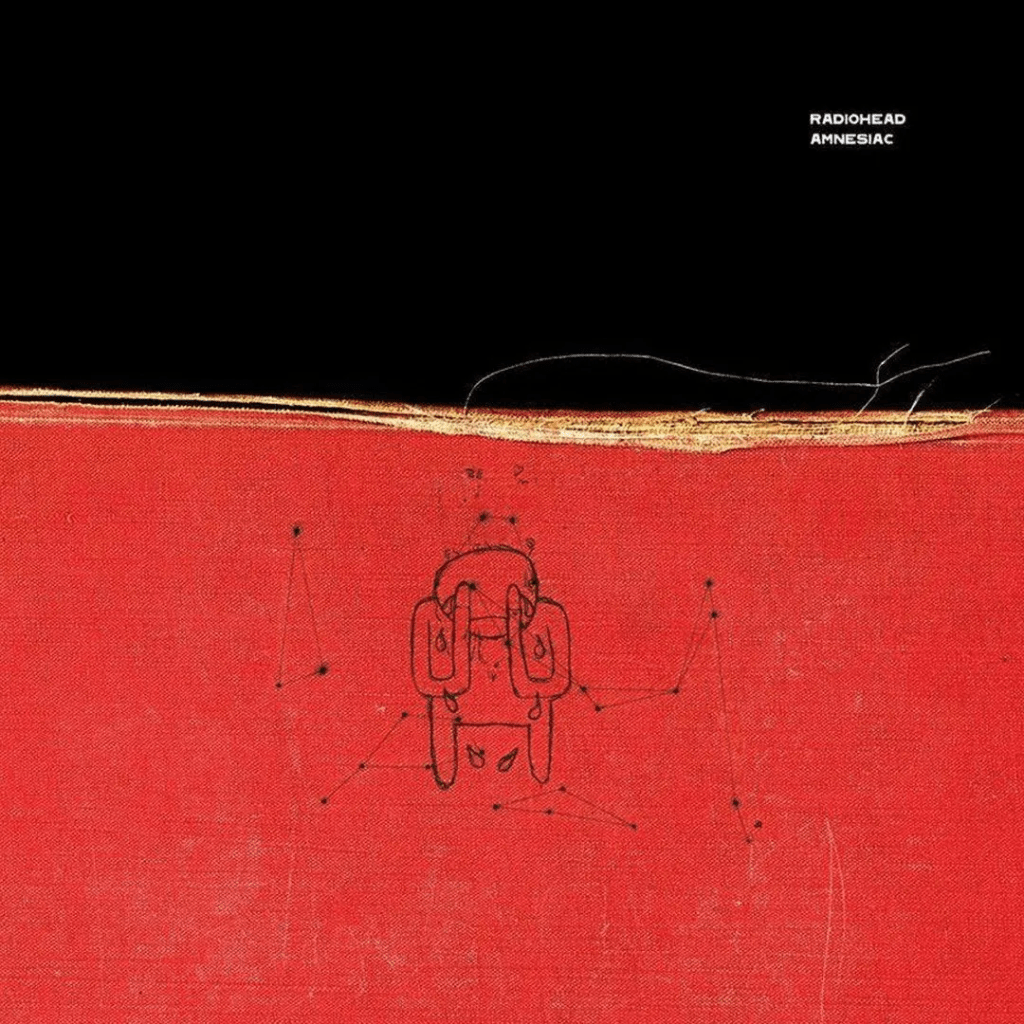
Cover art courtesy of EMI Records.
Good morning!
We’re in for a treat today, as Sam Colt takes the wheel and shares his take on Radiohead’s Amnesiac LP.
If you’ve been here for a minute, you’ve seen Sam’s work before. He and I did a Top 100 Series, are part of a group that shares our year-end lists, and, of course, have a monthly series on, well, whatever we find interesting.
You likely also know my feelings on Radiohead, and Sam’s quest to get me to come around on them. The TL;DR for new folks: he loves ‘em, and I don’t. But he’s also a helluva writer I’m lucky to get to “collab” with every month, and for as much as I give the band shi*t, I can’t think of anyone who’ll give the record its due more than him.
The words—and work— below the jump are all his, and I’m beyond grateful he let me share this with everyone! I think you’ll dig it, too. When you’re done here, please be sure to check out more of his work at This Is a Newsletter!
KA—
Supposedly made up of tracks that were recorded during the Kid A sessions, Amnesiac has been derisively called “Kid B,” and while there’s some truth to that statement, it’s also underselling the album a bit. In the aftermath of releasing a decade-defining alt-rock masterpiece, Radiohead spent years tearing apart their sound, reconstructing it, then found themselves with a deluge of material once the pieces started to fall into place. Kid A was the spearhead of their reinvention, carefully assembled as a statement of intent—one of alienation, disillusionment, and paranoia in an increasingly digitized and atomized world.
As a companion album, Amnesiac is the schizophrenic inverse: While it’s not Frankenstein-ed out of discards, it does serve as a catch-all repository for everything that didn’t suit the more controlled tracklist of its predecessor. The band once described Kid A as the equivalent of starting a forest fire from a great distance, while Amnesiac is standing at the center of the blaze. This is certainly not an immediately appealing album like The Bends or In Rainbows, but it pushes Kid A’s electronic experimentation to more anxious lengths. Amnesiac fills the vacant, desolate void within Kid A with a harrowing and offbeat freneticism. It’s more of a dark nebula than a shining star, reminiscent of Joy Division’s Closer, David Bowie’s Low, or other atmospheres of gloom.
For a band with an impeccable record of providing quality album openers, “Packt Like Sardines in a Crushd Tin Box” is particularly noteworthy, kicking off with these clanging hollow percussions and cold, desperate synths before Thom Yorke’s droning voice repeats “I’m a reasonable man, get off my case.” The transition to “Pyramid Song” is a bit jarring, but it’s an all-time Radiohead track; disquietly haunting and depressingly beautiful, and the way it descends with ghostly falsettos and ethereal strings is spine-tingling. With its razor-sharp groove, “I Might Be Wrong” is Radiohead’s interpretation of dance music, a nerve-wracking, anxiety-inducing bassline complemented by a jerky, jangling guitar riff. “Knives Out” is somewhat of an olive branch to everyone who thought the band had abandoned guitars completely, but because of its relative normality, it sounds the most alien of any track on Amnesiac, despite it being an odd endless rush forward without a chorus and seemingly beginning mid-riff.
Some of this is Radiohead at their least compromising. The backing track for “Like Spinning Plates” is a backmasked version of another song that hasn’t been released yet, and Yorke’s rising vocals syncopate with the abstract soundscape, making it feel apocalyptic and strikingly moving. “Pulk/Pull Revolving Doors” is the skeletal backing track as an attempt to record the already-fabled “True Love Waits,” but with all its melody stripped out so it sounds like a robot repeatedly banging its head against a wall. The jazz-tinged “You and Whose Army?” and “Dollars and Cents” have crescendos that carry the same gloomy power as OK Computer but reshaped into something more of a free-form jam sesh.
Amnesiac isn’t necessarily a challenging album as much as it’s disorganized and dense, flipping itself around and over its head with every subsequent song, taking you through the gamut of Radiohead’s different sounds. There’s no convenient cohesive harmony, just a collection of screams colliding into one another and forging a new context through the cacophony. It pulls the listener from one extreme to the other without pause, except for the interlude “Hunting Bears,” which offers a moment of quiet amid the maelstrom.
This album certainly deserves at least some of the criticisms directed towards it. It’s an unhinged mess that swings wildly in quality, endlessly compared against its big brother and losing in obvious ways. But even a lesser Radiohead project—it ranks sixth in my personal rankings—is still a very good album. Even at its most alienating, meandering, or downright messy, much of it is perversely interesting and positively bewildering, making for an enjoyable and revelatory listen.
Amnesiac isn’t really a grower as much as it’s a grab bag of fragmented ideas that offers something different each time you put your hand in it. It’s the release that most explicitly states that Radiohead was done with being a straightforward rock band, or anything other than some guys trying to make the most interesting soundtrack that reflects the tenor of its time.
Bottom Line: Amnesiac is the #6 seed in this tourney, and is up against Whiskeytown’s Pneumonia, which sits at #123. I might not like Radiohead, but I am a fan of a sure thing. Thom Yorke & co it is.

Thank you again to Sam for today’s post! Please be sure to check out more of his work over at This Is a Newsletter!
Any thoughts on this record? Agree/disagree with Sam’s take? Sound off in the comments!
Check out the full bracket here.
Info on the tourney, voting, and more is here.
As always, thanks for being here.
KA—

